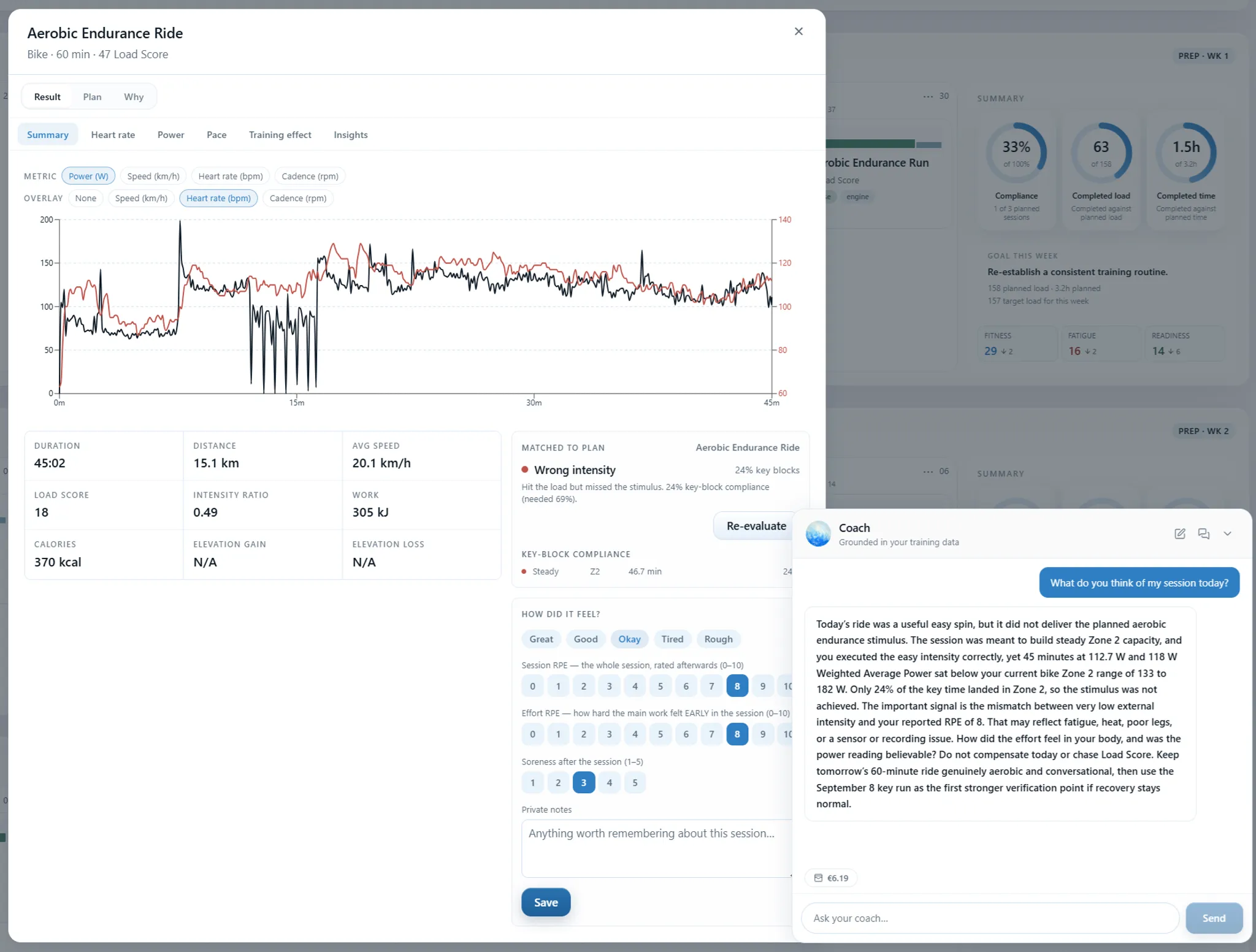

Connect Strava and let Nymiva read your training
Your history comes across on its own. Every ride, run and swim you have already done is analysed, so your plan starts from what you can actually do today rather than from a questionnaire.
Each synced activity is parsed to per-second streams and reduced to mean-maximal power and pace curves, efficiency, decoupling and durability. Thresholds are estimated from real efforts, recency weighted and evidence backed, and a new value is proposed for you to accept rather than applied behind your back.
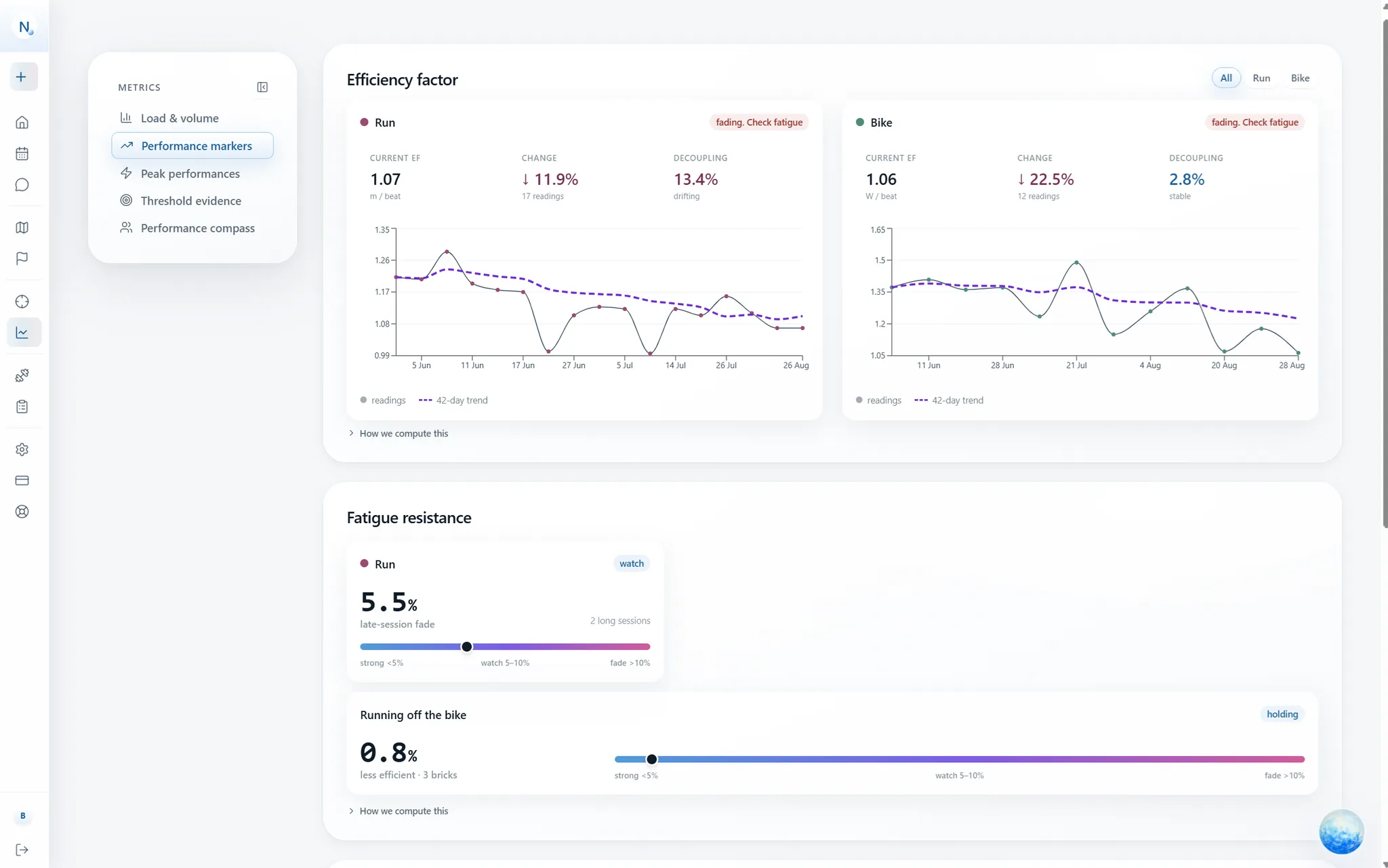
Add your race, and read what the day will ask of you
Upload the course file and Nymiva reads the climbs, the surface and the race-day weather, so the plan trains the event you actually entered rather than its distance.
Course geometry is cut into ordered climbs and descents carrying length, gradient and vertical per unit of distance, then scored across twelve demand dimensions. The forecast is shown beside the same date in previous years, and the confidence in every reading is stated rather than assumed.
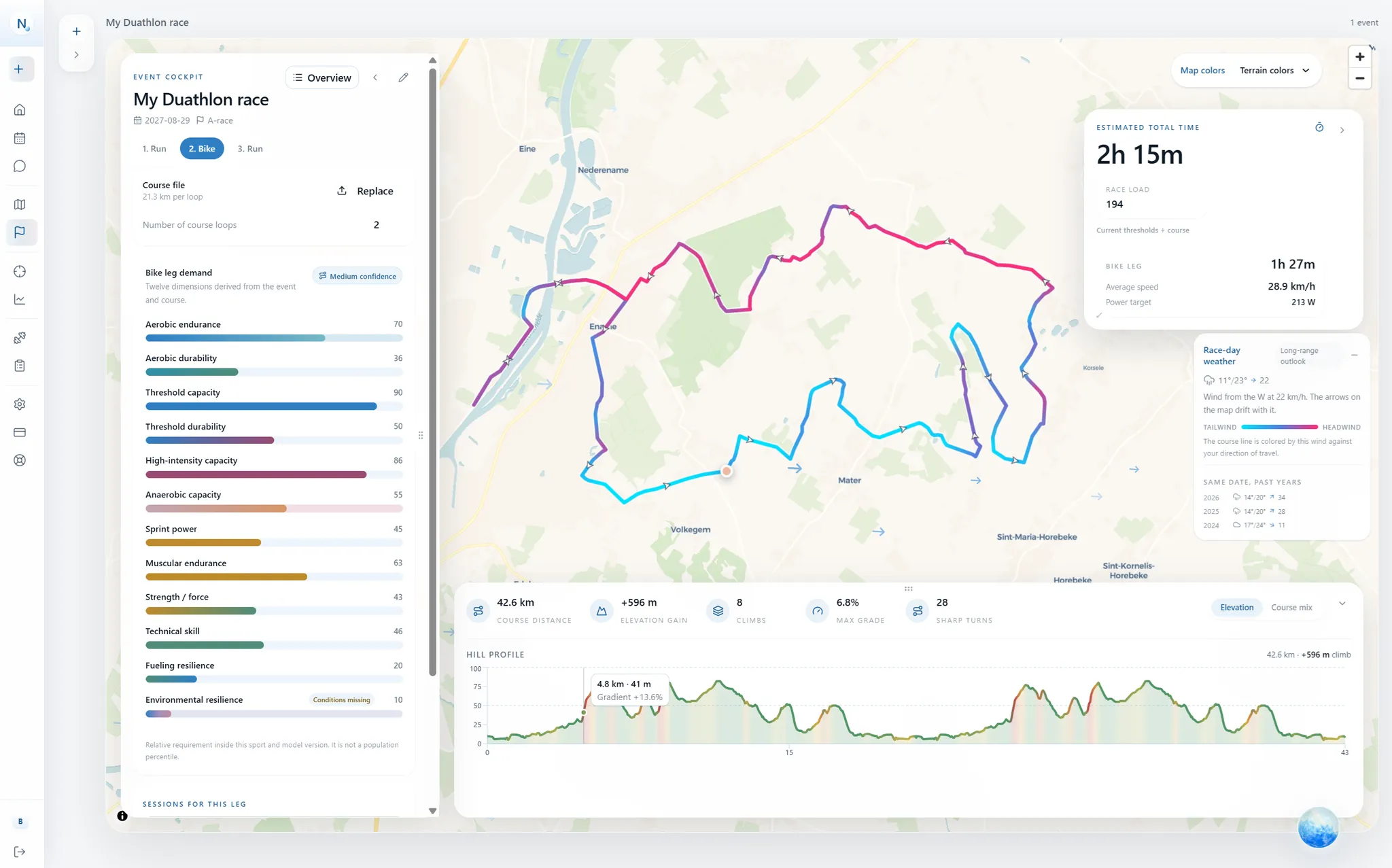
Find the ability that limits your race
The Focus Lab looks at your actual training and tells you, in one line, what is holding you back and what to do about it.
Abilities are scored on Nymiva’s governed ladders: sex-specific cycling benchmarks, age-graded run pace and championship swim base times. They are then weighted by your race’s demands, so a sprint-distance athlete and an Ironman athlete get a different focus from the same fitness.
A season plan that aims at something
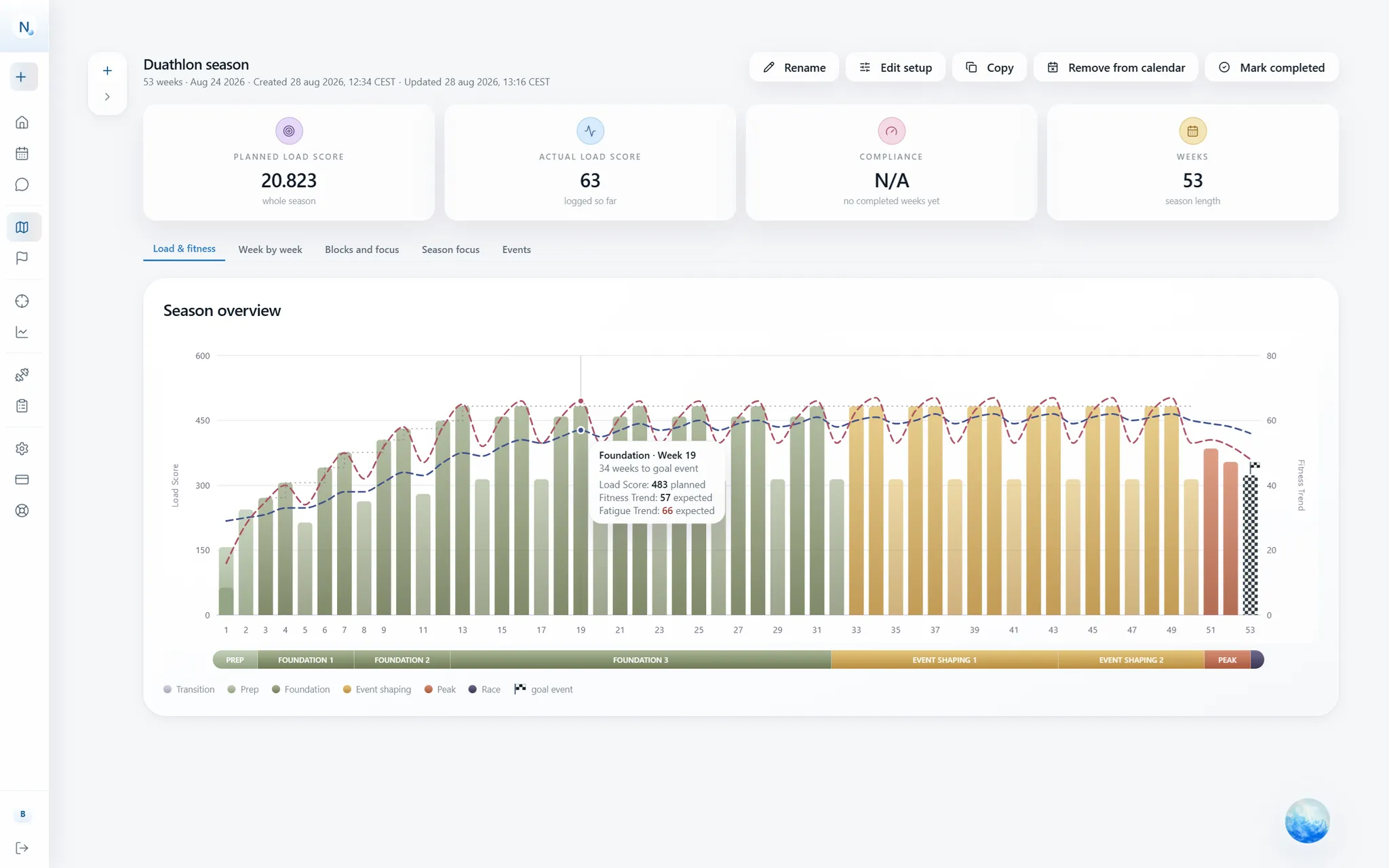
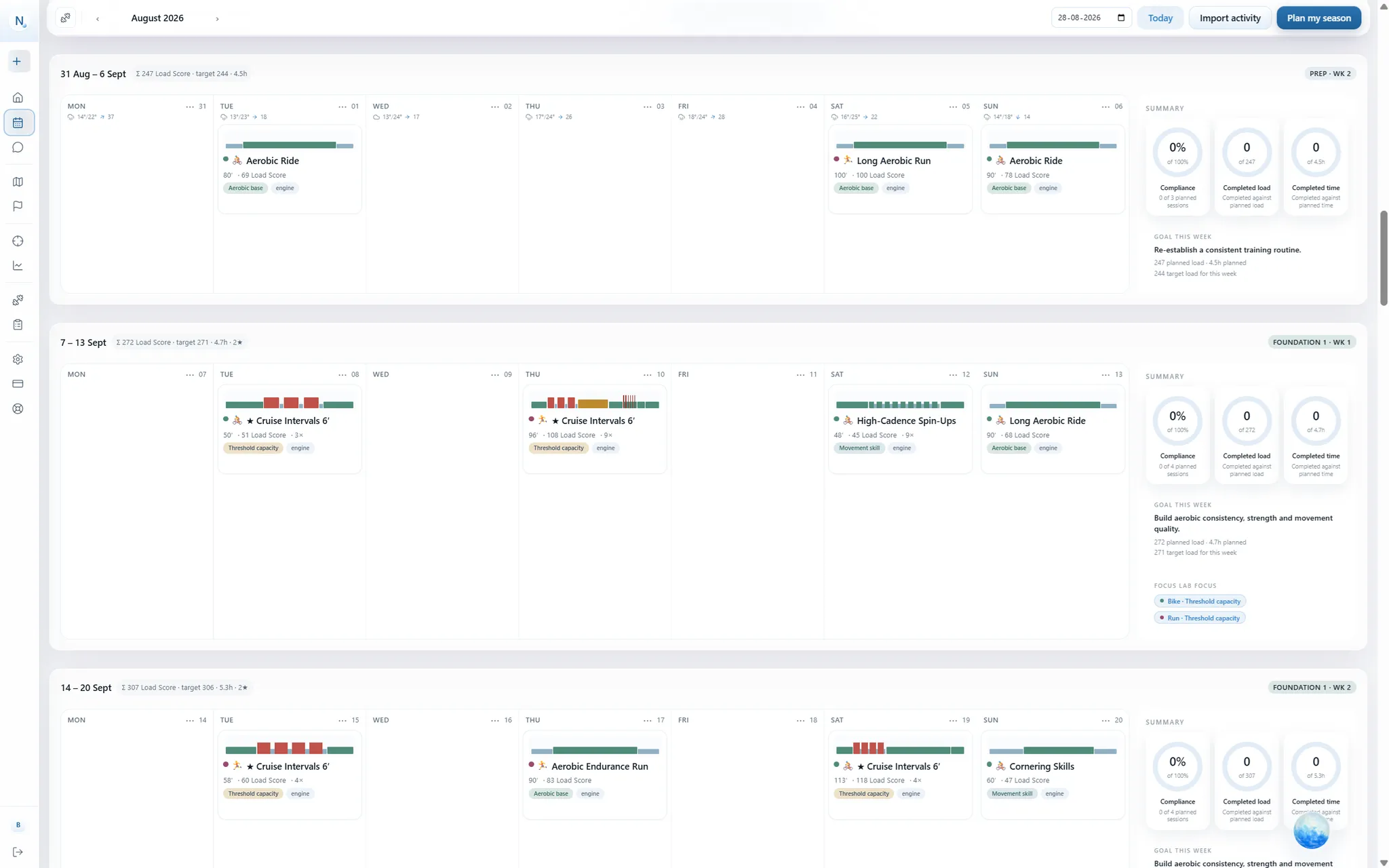
Tell it your race and it lays out the whole season backwards from race day, then fills each week with sessions chosen for your focus.
Periodization follows the Nymiva season-planning method: phase-appropriate workout progressions from a vetted library, capacity-bounded weekly load, hard/easy alternation, and field-test weeks with real protocols.
Life happens. The plan keeps up. With your approval
Miss a day or wake up wrecked and the coach proposes a fixed week. You approve or dismiss. Nothing changes behind your back.
A divergence hook compares synced actuals against the plan after every import. Deterministic readiness guardrails veto hard sessions on bad days, and every applied change is audit-logged with its reasoning.
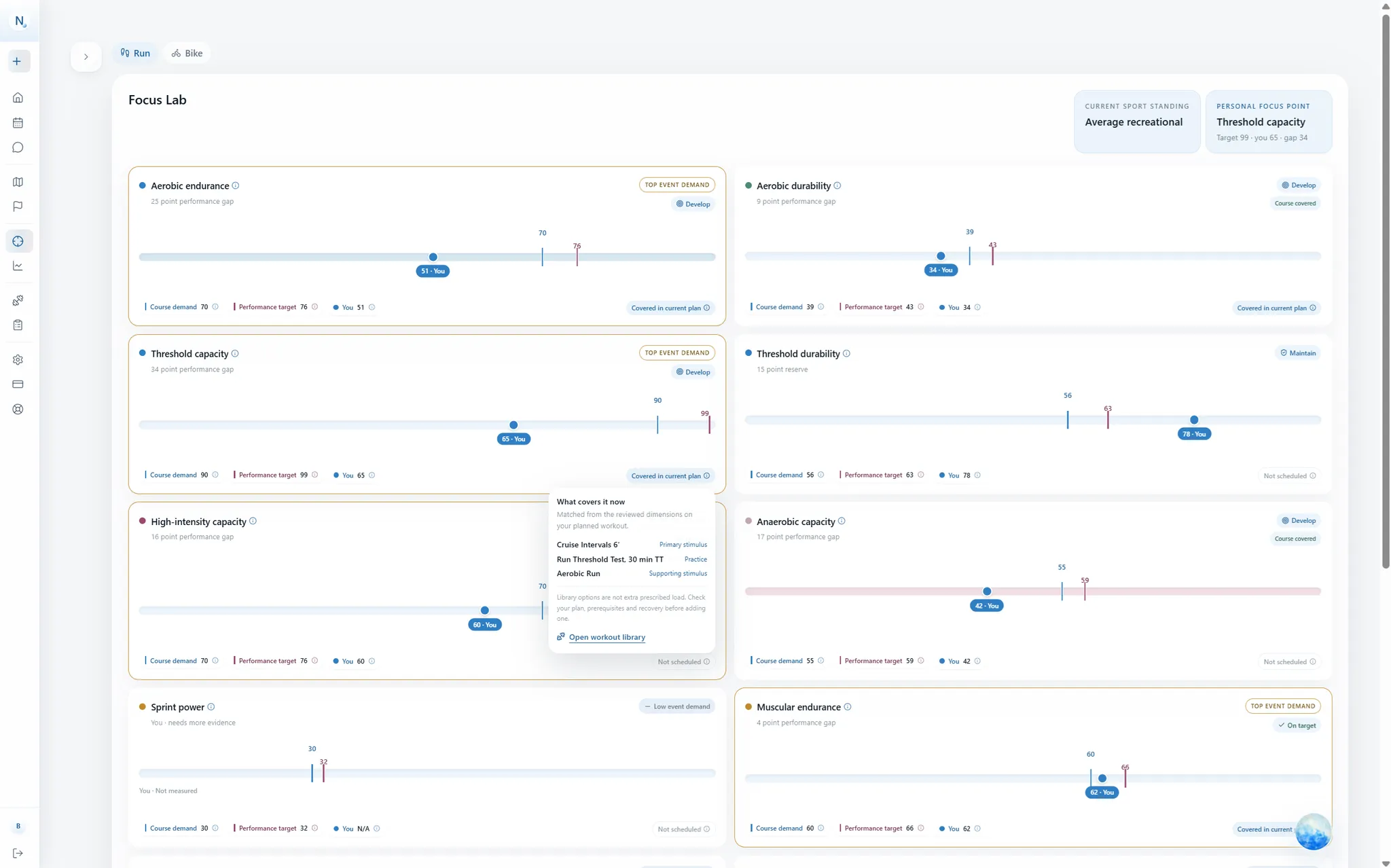
A coach that already knows your numbers
Ask why tomorrow’s session is there, whether to race this weekend, or what your last block actually changed. It answers from your own training and tells you which of it it used.
The coach holds your thresholds and their age, your zones, your curves, the focus gaps, the season and your recent compliance before you type a word. It can query your own metrics and read a single session second by second. Plan changes arrive as proposals you approve, and it escalates anything medical rather than answering it.