Find the ability that is limiting your race
Your training history is the supply, your event is the demand. The Focus Lab scores one against the other and names the gap worth closing first.
Your weakest number is not automatically your limiter
A limiter is an ability that materially constrains your performance in the event you actually entered. It is not simply your lowest score. Someone with a modest sprint is not limited by their sprint in a six hour gravel race, because that race almost never asks for a sprint, and the handful of seconds it might cost is worth nothing against the time lost fading in the final third.
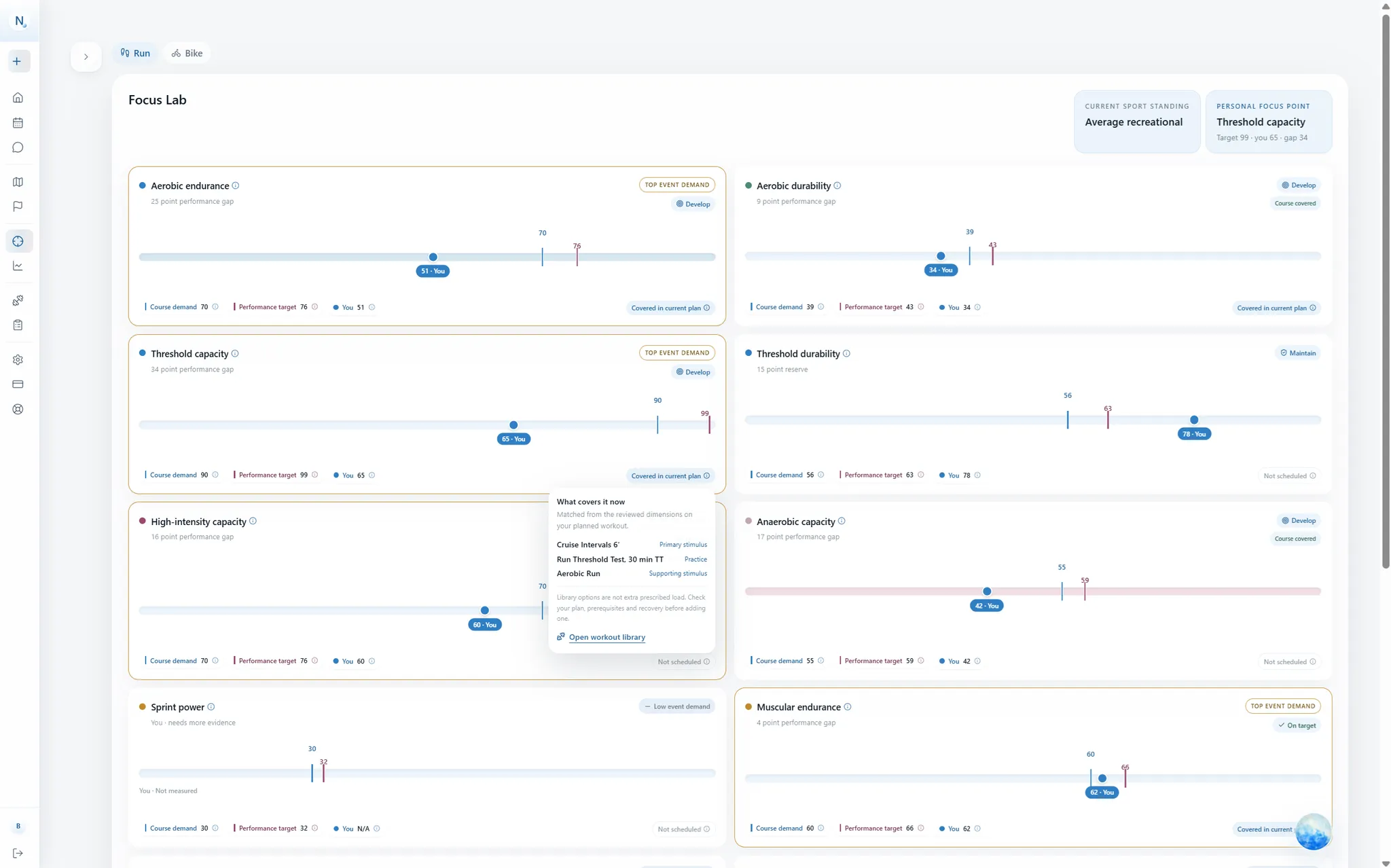
The Focus Lab is built on that distinction. It scores what your event demands, scores what your training history can evidence about you, subtracts one from the other, and names the gap worth attacking first.
In brief
- Supply is what your own history evidences. Demand is what your event asks. The gap between them, on a dimension your race actually cares about, is the focus.
- Both sides are scored on the same twelve training dimensions, so the comparison is like for like.
- The biggest raw gap does not automatically win. It is weighted by how much of the race that discipline really is, and discounted by how well the evidence supports it.
- Every finding carries a confidence: confirmed, probable, possible, unmeasured or contradicted. Unmeasured is shown as unmeasured, not rounded to zero.
- Limiter-first is never limiter-only. The focus sets a block's emphasis. It does not become the content of every session.
Supply is what your own training can evidence
Supply is your side of the comparison, built from the training you have already done rather than from what you tell the app about yourself. Efforts you sync become mean-max curves, threshold evidence, efficiency, decoupling and durability, and those measurements are scored on governed ladders: sex-specific cycling benchmarks, age-graded run pace, championship swim base times. Every ability ends up on the same twelve dimensions.
Those dimensions are aerobic endurance, aerobic durability, threshold capacity, threshold durability, high-intensity capacity, anaerobic capacity, sprint power, muscular endurance, strength and force, technical skill, fueling resilience, and environmental resilience. Some are intensity bands. Some are not. Durability describes what you can still hold once you are tired, and skill, fueling and environment describe how and where the work is done.
Each supply score also carries how it was measured: directly, estimated, from a proxy, or not at all. A threshold read from a genuine sustained effort and a threshold inferred from a proxy are not the same claim, and the product does not let them look the same. None of this needs a power meter. Without one the diagnosis degrades and says so. The planning does not.
Demand is what the day will ask of you
Demand comes from the event, not from a distance category. The event analyzer reads the course you uploaded and scores each leg across the same twelve dimensions, using the things that actually change the work: duration, elevation and how it is distributed, gradient, surface, expected wind and heat, and the fueling opportunities the day gives you.
Because the scales match, demand and supply can be subtracted. This is also why triathlon and duathlon are modelled leg by leg rather than as a single sport. The run off the bike asks something different from a standalone run, so it gets its own demand rather than borrowing one.
The consequence is the whole point of the surface. Two athletes with identical fitness, entered in different races, get different focuses. The same athlete entered in a different race gets a different focus without changing a single training file.
The gap, and which gap goes first
For every dimension, demand minus supply is the gap, and the result is classified. develop means the event asks more than you can currently evidence. maintain means you are comfortably above what the day needs and the job is to keep it. covered means it is where it should be. There is a fourth answer that matters as much as the other three. A dimension the event clearly requires and your history cannot speak to at all is flagged as required and unmeasured, which is an instruction to go and measure it rather than a score.
Ranking is where the event-specific idea bites. Three things order the list:
- The size of the gap. Bigger deficits rank higher, all else equal.
- How much of the race that discipline is. A gap is scaled by the leg's share of the event, so a triathlete's bike is not outranked by a slightly larger swim deficit that governs a much smaller part of the day. The scaling has a floor, so a genuinely large deficit in a minor leg still competes rather than disappearing.
- How reliable the evidence is. The planning priority is the gap multiplied by a confidence factor drawn from the demand confidence, the supply confidence and the measurement quality. A large gap resting on a proxy can therefore rank below a smaller one that is directly measured. That is deliberate. Spending a whole block on a deficit that might be a measurement artefact is expensive.
Confidence is shown, not smoothed away
Findings are labelled confirmed, probable, possible, unmeasured or contradicted, and the label travels with the number wherever it is displayed. Contradicted is a real state and a useful one, because it means two signals disagree and the honest response is to look rather than to plan.
Some dimensions cannot honestly carry a prediction at all. Technical skill has no established adaptation model of the kind that threshold work does, so a block aimed at it is run as deliberate practice and predicts no supply gain. It reports what happened instead of forecasting what should have.
No single number is allowed to act as a stoplight. Verdicts are a synthesis of several signals including your own subjective feedback, and performance is the primary one. Contextual limiters such as sleep, work stress and schedule instability are inputs to the picture too. Pain, illness and other medical concerns are escalated to you, never diagnosed or treated.
Limiter-first is not limiter-only
This is the most misread idea in the product, so plainly: the focus sets a block's emphasis, not the content of every session. A block that trained nothing but your weakness would make you worse.
What is protected regardless of what the focus says:
- Predominantly low-intensity aerobic development, which underwrites everything else.
- Recovery, including a recovery week in the rhythm rather than whenever you happen to break.
- Sport-specific technique.
- Maintenance of the abilities you already own, at the smallest dose that holds them. An ability you are strong in is not abandoned because it is not the focus, and a discipline that is not your focus still gets its work.
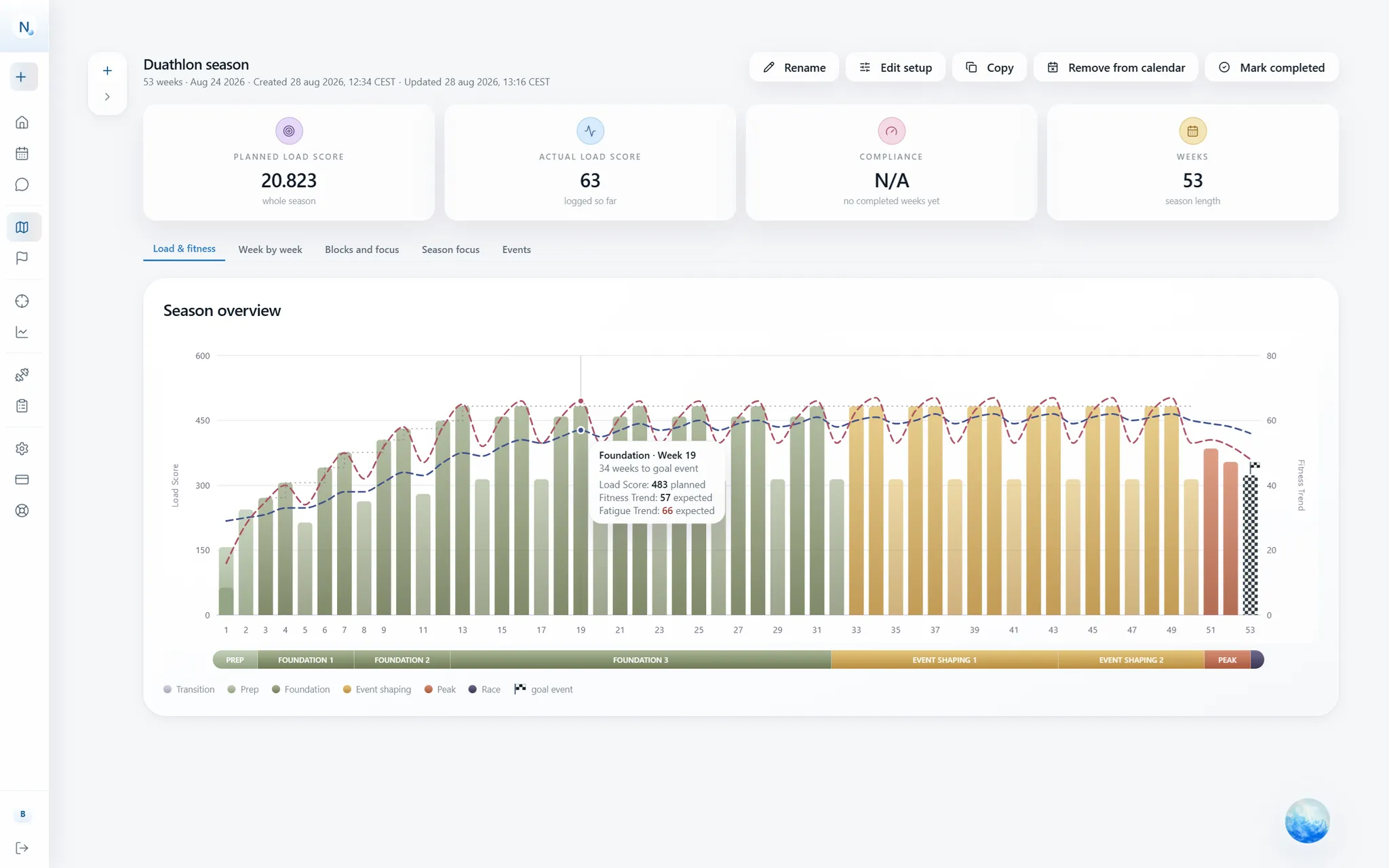
Season phase names carry the same warning. Prep, Foundation, Event shaping and Peak are budgets, not zone caps. They guide how much load a week needs and which dimensions it tackles, and early phases take the least event-critical gaps while late Event shaping takes the most event-specific ones, including course-shaped work and race-pace structures. A phase never means "only easy work". Where you cannot yet execute a dimension's real work, the answer is the smallest real dose of the real thing, climbed as fast as the guardrails allow, never months of a lower zone credited as the thing it is standing in for. The season planner is where those gaps become blocks laid out backwards from race day.
A threshold number alone can mis-rank the real problem
Technical limiters can gate physiological ones, and swimming is the clearest case. If your catch is losing water, your threshold number is a symptom of the technique rather than an independent ability. Ranking on that number alone prescribes more threshold work performed with the same stroke, which buys progressively less. The technical finding has to be able to outrank the physiological one, which is why technical skill sits on the dimension list as a first-class limiter rather than as a footnote.
The same logic covers fueling. An athlete who reliably comes apart late in a long day may not have an aerobic ceiling problem at all. Gut tolerance and a fueling plan are trainable, and they are scored as their own dimension so the diagnosis can land there.
Focus findings are re-derived as new evidence arrives, and you can watch the underlying measurements move on the performance surface. Changing the primary focus is a high-impact change, so it is proposed with its reasoning and waits for you to approve it. Nothing rewrites the season behind your back.