What your race will actually demand of you
Upload a course file and read the day before you train for it. Gradient, wind, heat, climb lengths and fueling windows, scored as demands you can train against.
A race entry is a name, not a specification
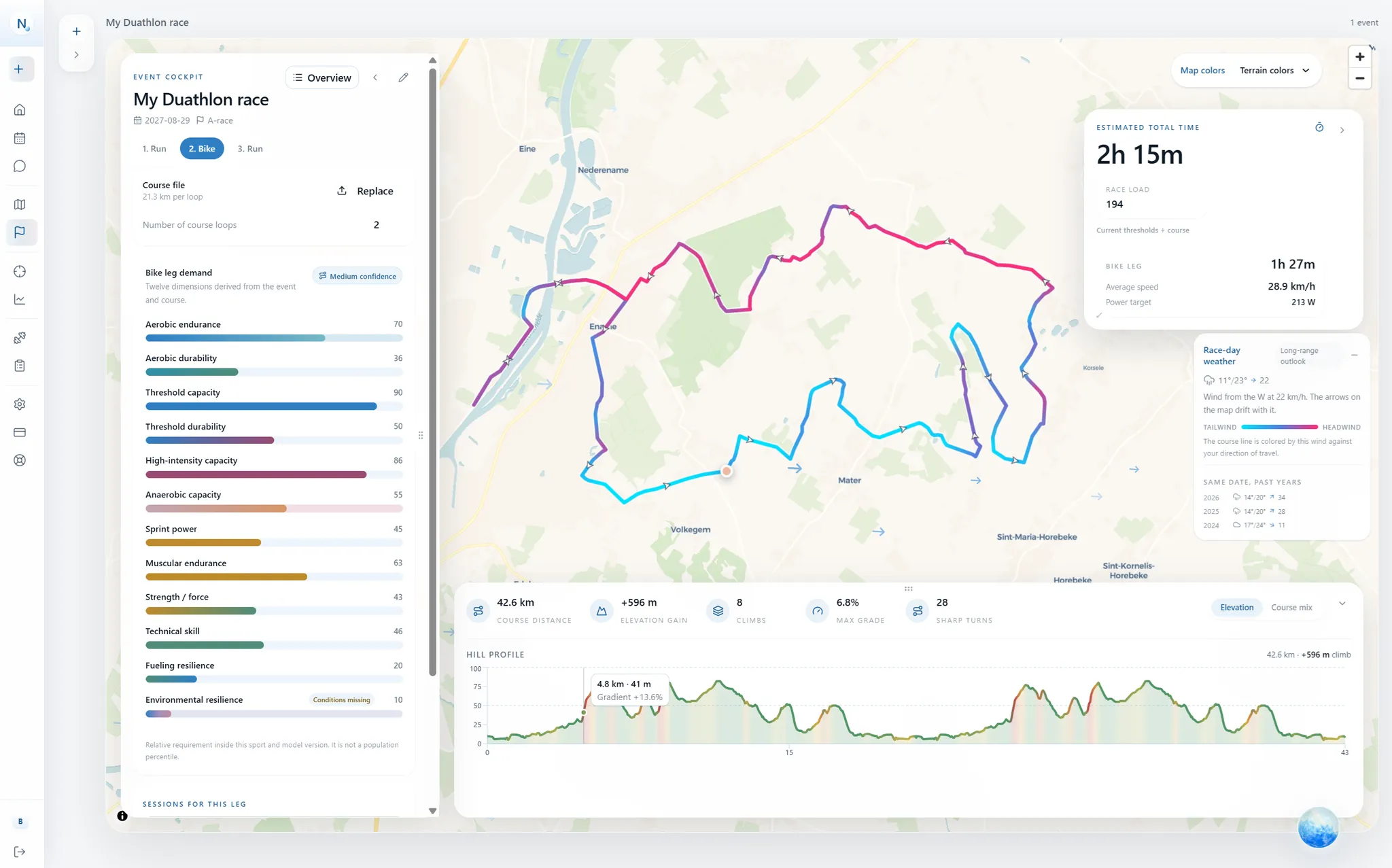
Entering a race tells you a date and a distance. It does not tell you what the day will ask of your legs. Upload the course file and Nymiva turns that route into a set of demands you can train against: how the gradient is distributed, how long the climbs are, what surface you will be on, how much elevation you cover per unit of distance, and what the weather has done on that calendar date before. The output is one leg scored across twelve demand dimensions, and that score is what the rest of the product plans against.
In brief
- A distance label is not a demand. Two 100 km courses can require almost opposite abilities.
- The analyzer segments your route into climbs, descents and flats, then measures climb length, gradient, elevation per distance and course technicality.
- It adds what the file cannot know: the race-day forecast, the same calendar date in past years, and wind drawn onto the course line by your direction of travel.
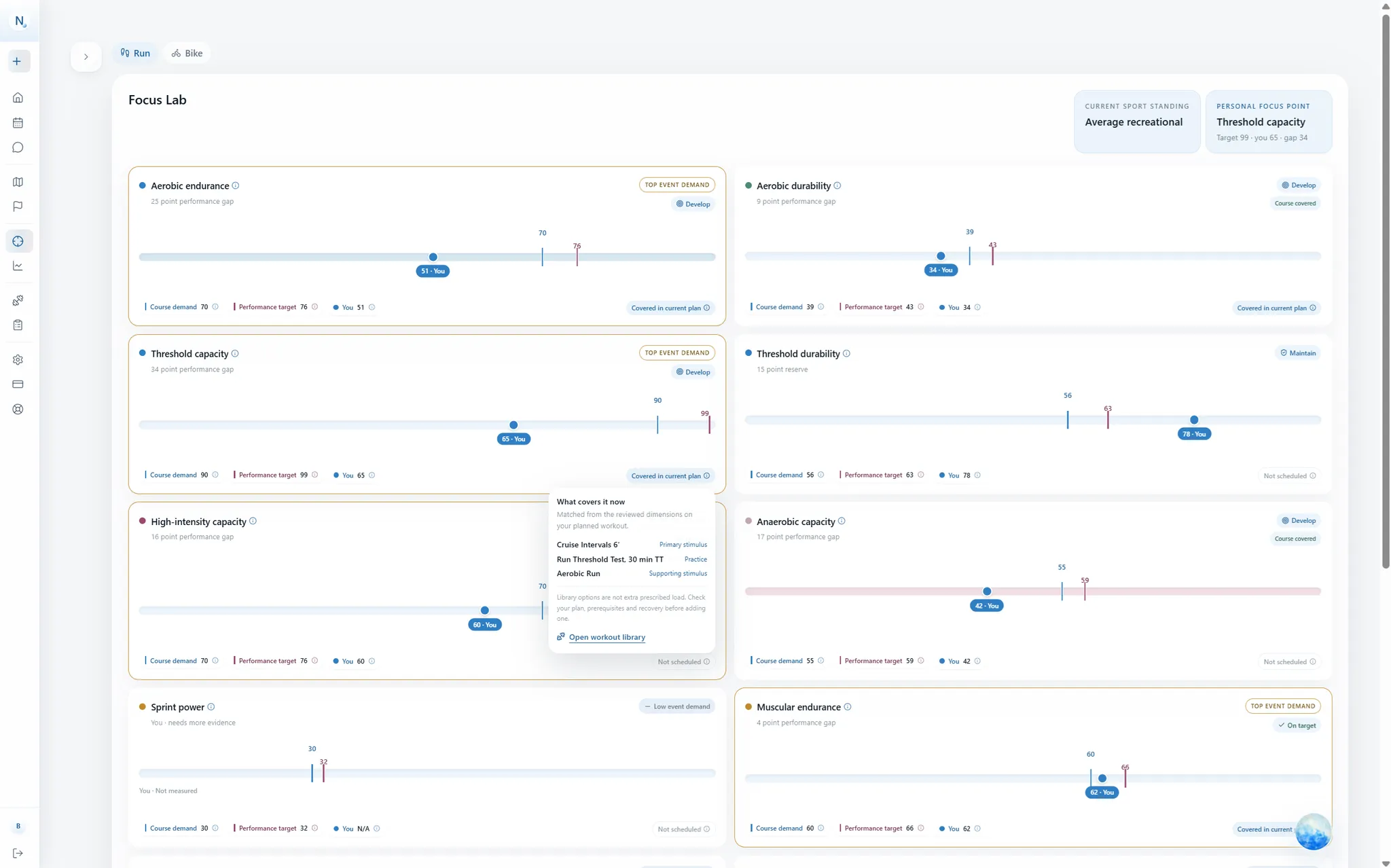
- The result is a demand fingerprint scored across twelve dimensions, which the Focus Lab weighs against your training history.
- Course confidence is stated, not hidden. No route means a distance-only estimate, and the screen says so.
What the analyzer reads from the course file
The route is treated as geometry first, not as a picture. Nymiva walks the distance and altitude series and cuts it into ordered segments, each one categorised as a climb, a descent or a flat, each one carrying its own length, elevation change and average gradient.
From those segments it derives the things that actually change how a race is ridden or run:
- Total elevation gain and loss, kept separate, because descending has its own cost.
- Climb count and longest climb, which decide whether you need repeatable efforts or one very long one.
- Average elevation change per mile, the density figure that separates a rolling course from a mountain one at the same total gain.
- Course technicality, estimated from how variable the gradient is and how many sharp turns appear per 10 km.
- Surface, one of road, trail, track, mixed, open water, or explicitly unknown.
Surface is not guessed from the elevation shape. A jagged profile is course shape, and calling it gravel because it looks rough would be inventing evidence. Surface stays unknown until real map-matched data says otherwise, and unknown is a value the model carries forward rather than quietly filling in.
Climb lengths survive as durations, not just as distances. A climb that takes roughly four minutes and a climb that takes roughly twenty minutes sit in different physiological territory, and the analyzer keeps that number because later, when the season reaches its most specific work, sessions can be shaped around the climbs the course actually contains.
What the analyzer adds from outside the file
A GPX file knows nothing about the day. Two more sources sit alongside it.
Weather against the date. Inside the forecast horizon you get a real forecast. Beyond it you get a long-range outlook, labelled as an outlook rather than dressed up as a forecast. Next to either one, the panel shows the same calendar date in previous years. That is the honest way to answer "how hot is this race normally", because one year is an anecdote and a run of years is a pattern.
Wind on the course line. Wind speed and direction alone are hard to act on. What matters is wind against your direction of travel, which changes at every turn of the route. The course map is coloured along its length from tailwind to headwind, so a loop that looks symmetrical on paper can reveal thirty exposed kilometres pointed straight into it.
Environmental factors stay descriptive. Heat, altitude and wind are recorded as present, significant or absent, and they raise environmental resilience as a demand. They do not become a numeric performance multiplier, because the evidence does not support one yet. Saying "this course is windy and exposed, prepare for it" is defensible. Attaching a precise percentage penalty to it is not.
Twelve dimensions, one fingerprint
Everything above resolves into one shared vocabulary. The leg is scored across twelve demand dimensions: aerobic endurance, aerobic durability, threshold capacity, threshold durability, high-intensity capacity, anaerobic capacity, sprint power, muscular endurance, strength and force, technical skill, fueling resilience, and environmental resilience.
The mapping is deterministic and traceable. Vertical metres per kilometre push muscular endurance up. Steep gradients and a high share of climbing push strength and force up. Repeated short climbs raise high-intensity capacity, and climbs that fall in the last stretch of the course weigh differently from the ones you meet fresh. A trail surface raises technical skill. Long gaps between aid stations, measured in distance and in time, raise fueling resilience. For events long enough to cross a night, a sleep strategy becomes part of the demand rather than an afterthought.
Multi-leg events are scored leg by leg. Triathlon and duathlon are not sports in the model, they are ordered legs, which is why the run off the bike is treated as its own demand and not as "a run". Sequencing itself adds demand, so threshold durability and fueling resilience rise for a race that stacks disciplines.
The same 100 km, two different events
Consider two hundred-kilometre bike courses on the same date. One is flat and exposed. One has four climbs of roughly twenty minutes with a long descent after each.
The flat course asks you to hold one position and one steady output for hours while your ability to sustain it decays. That is threshold durability and aerobic durability, plus whatever the wind demands. The mountain course asks for four repeatable hard efforts of twenty minutes each, separated by descents you have to handle, with the last one arriving on tired legs. That is threshold capacity, strength and force, technical skill and fatigue resistance in the final quarter.
Train for the wrong one and you will arrive fit, prepared, and prepared for a different day. This is the difference between a season spent and a season spent well, and it is invisible if the only thing your plan knows about the race is "100 km".
From demand to focus to season
The fingerprint is not a report you read once. It is the input to the next surface. The Focus Lab treats your training history as supply and the fingerprint as demand, scores one against the other, and names the gap that matters most for this event, with its measured size. Abilities already on target are shown as on target with reserve, because knowing what you do not need to train is as useful as knowing what you do.
Those gaps then become the shape of the season. The season planner lays the work out backwards from race day, and the phase names decide two things only: how much load each week needs, and which dimensions that week tackles. Early phases take on the least event-critical dimensions. Late Event shaping takes on the most event-specific ones, including course-shaped work built from the climb lengths the analyzer found. If you want the mechanics of how a week's focus is chosen, reading a season block covers it, and the product tour shows the chain end to end.
What it will not pretend to know
Course data quality varies, and the model grades its own confidence rather than presenting every course as equally well understood. There are four levels, each with a stated reason. No route at all gives a distance-only demand estimate. A route with no elevation series is low confidence. Elevation present with unknown surface is medium. Elevation and surface together is high. Where a stored course conflicts with the event's declared distance, the conflict is reported instead of averaged away.
Forecasts are forecasts. A long-range outlook is labelled as an outlook, and past years on the same date describe a climate pattern rather than predict your morning. What the analyzer offers is not certainty about race day. It is a specification of what the day is likely to demand, precise where the evidence is good, explicit where it is thin, and detailed enough that the training which follows aims at the right thing.