How to read your season blocks
What Prep, Foundation, Event shaping and Peak each mean on your own season graph, why the bars rise and fall, and what a recovery week is protecting.
Your season graph is one picture with four things in it. The bars are how much load each week is asking for, the two lines drawn over them are the fitness and fatigue that load is expected to produce, the coloured ribbon underneath names the phase each stretch of weeks belongs to, and the whole arrangement runs backwards from race day. Read it in that order and the shape starts explaining itself.
The bars are the week's budget
Each bar is one week, and its height is the planned Load Score for that week. Where you logged training, a second bar shows what you actually did. The difference between planned and actual is the first thing worth looking at, because a season missed by a third every week is not the season you are training.
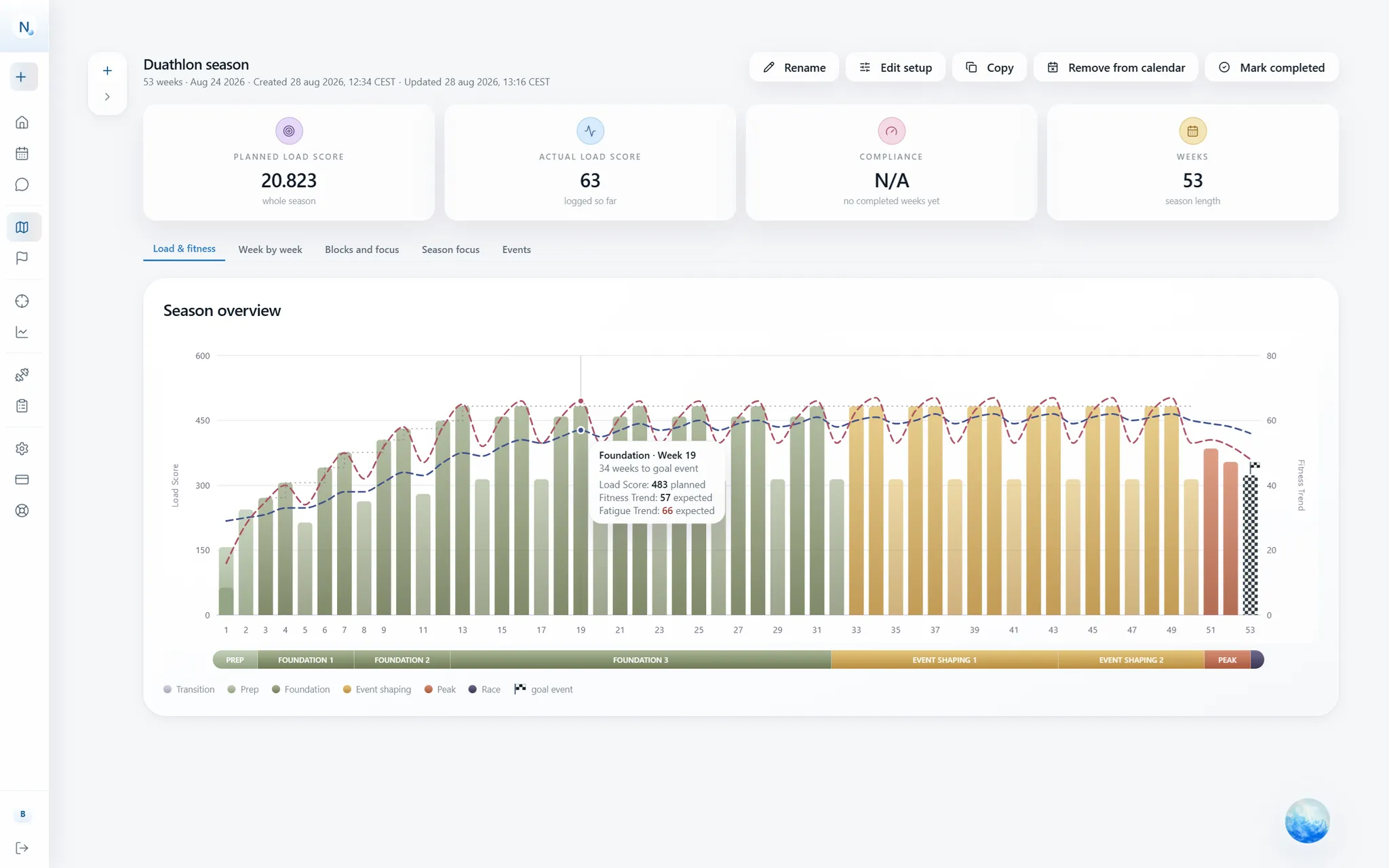
The bars rise inside a block for a simple reason. Progression is bought one step at a time, and the size of the step is capped by what your training history says you can absorb. So the line of bars is a staircase rather than a ramp, and after each drop it restarts from a higher floor than the one before. The height is an output rather than something you type, and it is a guardrail rather than a goal. A week can hit its number exactly and still fail the thing it was prescribed for.
The two lines drawn over them
Fitness Trend is a slow average of your recent load, and Fatigue Trend is a fast one. That is the whole mechanic. Load goes up, fatigue reacts within days, fitness follows over weeks, and the gap between the two is your form.
The lines are drawn in two states and labelled as such. Up to today they are measured from what you logged. Beyond today they are projected from what the plan intends, on the assumption that you stay healthy and do the work. Treating that projected half as a fact about your future is the most common misreading of the screen.
Where those curves mislead is covered in reading your performance charts. The short version here is that no single line grades you.
Every fourth bar is shorter on purpose
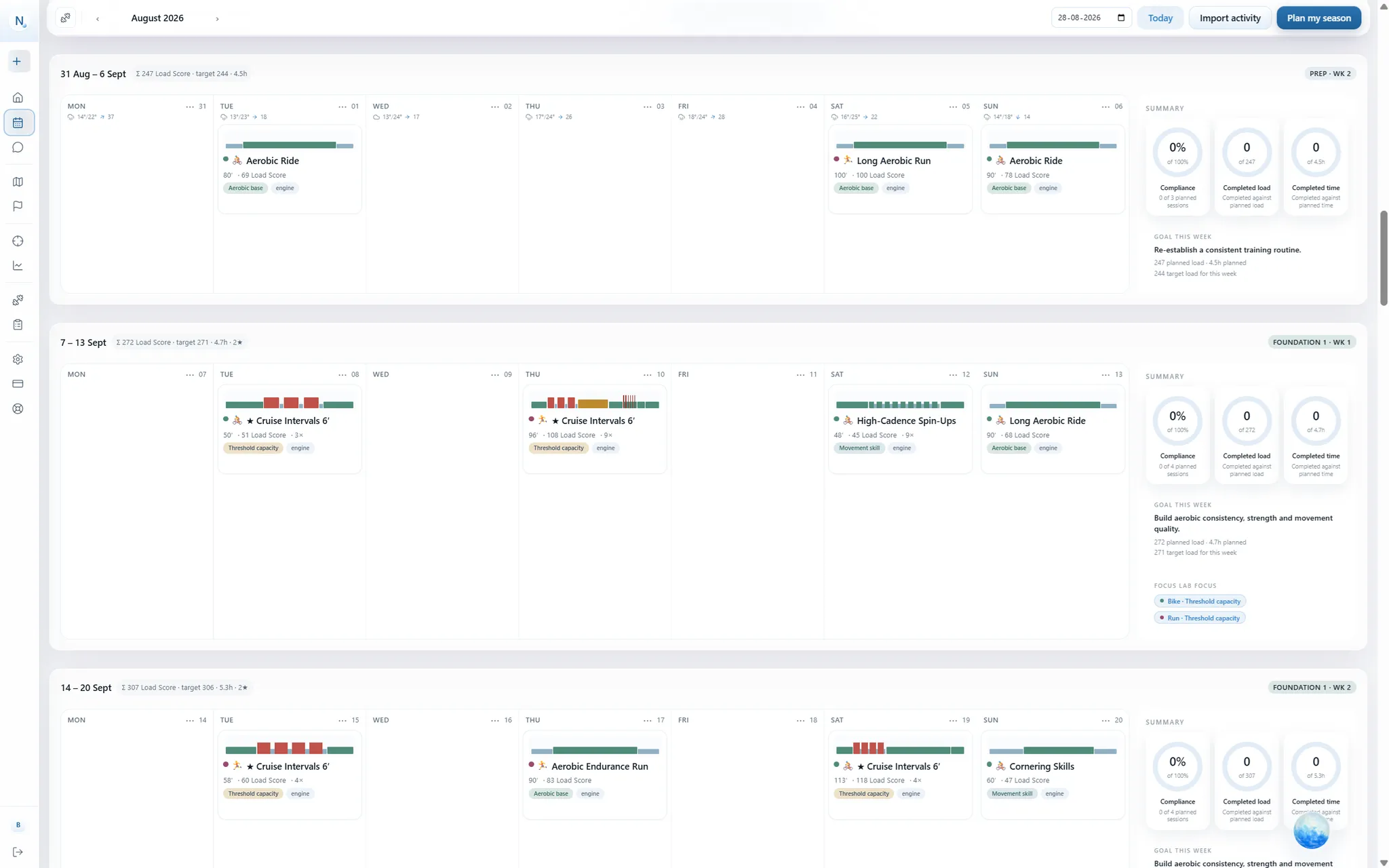
The recovery week is the last week of a Foundation or Event shaping subperiod, drawn fainter and marked as recovery when you hover it. Three loading weeks plus one recovery is the common shape. Athletes who recover more slowly get two plus one, because the cadence follows your recovery rate rather than tradition.
The step down is real. In a triathlon season a Foundation or Event shaping recovery week takes roughly a third off the load of the week it closes, and the reduction goes deeper once you reach peak. When you hover that bar the tooltip names the training peak you are stepping down from, because the dip is the plan working rather than ground lost.
What the recovery week protects is the adaptation. The hard weeks are the stimulus. The adaptation is collected during the easier week that follows, and a plan that never stops asking never gets to collect. It also protects the next block, because sessions attempted from a buried state produce the load without the stimulus.
The taper falls into the event
The last stretch of bars descends into the event week. That descent is not a fixed countdown of easy days. It is solved toward the race-day form band that suits your event's duration, using your own fatigue time constant where your data supports fitting one.
Watch the two lines through that section. Fatigue falls faster than fitness, and the widening gap between them is the entire point of the taper. If the band cannot be reached inside the taper's own bounds, the plan carries the closest achievable point and says so.
What the phase names actually mean
Two of these are named differently here than in most training literature. Your season ribbon says Foundation and Event shaping, because those describe what the block is for. If you have trained off a plan before, Foundation is what that plan called base, and Event shaping is what it called build. The subperiods number them, so a season runs Foundation 1 to 3 and then Event shaping 1 to 2, each one more race-like than the last.
| Phase | What it is for | What a week feels like |
|---|---|---|
| Prep | Consistency and tissue tolerance | Low, flat, unremarkable, and costly to skip |
| Foundation | Building the foundation dimensions | Rising week on week, with real intensity where a gap calls for it |
| Event shaping | Making you specific to the event | Volume traded for intensity, load roughly flat, sessions that look like the race |
| Peak | Arriving sharp and unburied | Descending load, familiar structures, shorter work |
| Race | Executing the day | Almost nothing, on purpose |
| Transition | Coming down | Unstructured, nothing prescribed |
Here is the correction that matters most. Phase names are budgets, not zone caps. A phase guides two things only. How much load the week needs, and which focus dimensions that week takes on. It never means "only easy work".
So Foundation does not mean three months of conversational riding. If threshold capacity is one of your named gaps, a Foundation week carrying that dimension trains it at its own intensity. A Zone 3 ride is not credited as threshold work because it was more comfortable to schedule. Where you genuinely cannot yet execute a dimension's real work, the answer is the smallest real dose of the real thing, climbed as fast as the guardrails allow.
What changes across the season is which gaps get attention. Early phases take the least event-critical ones. Late Event shaping takes the ones closest to the event's own demand, including course-shaped work and race-pace structures. That ordering is why phases are sequenced rather than shuffled, and the season planner covers why it is all drawn backwards from the last block.
Four questions to ask your own graph
Is this block's ramp steeper than the last one, and did the last one go well? Compare the rise across the bars in this block against the rise in the previous one. If that previous block ended with a run of missed or downgraded sessions, a steeper ramp is not ambition. It is a forecast already contradicted once.
Is the recovery week actually lighter? Look at the actual bar, not the planned one. Recovery weeks are where a club ride, a local race and a rescheduled long session quietly accumulate. A recovery week that matches its loading week is not a recovery week, and every block after it inherits the debt.
Does the last block before the event resemble the event? Open the sessions in the final Event shaping subperiod and check them against your race. Duration, gradients, surface, expected conditions, and for a multi-leg event the run off the bike as its own demand. A block that would suit any race is preparing you for none of them. Editing it is covered in building your own season.
Is the taper aimed at arriving fresh or at reassurance? A taper exists to let fatigue drain while fitness holds. If the final weeks are among the biggest of the season, they are not preparation. They are a last attempt to buy fitness that the calendar has already stopped selling.