Build the season yourself, guardrails included
Guided plans are a starting point, not a cage. Move blocks, change the focus, edit a week or write a session, and keep the checks that stop a plan hurting you.
The plan Nymiva builds for you is a proposal, not a verdict. Every part of it comes apart in your hands: the events and their priorities, which gaps get tackled and in what order, where blocks begin and end, what sits in a given week, and the structure of a single session. What does not come apart is the validation, which keeps running on the plan after you have edited it and tells you when your change broke something.
So the honest answer to "I already know what I am doing and I do not want a robot telling me otherwise" is this. You can overrule every decision in here. You will just be told what the decision cost, before you find out the slow way.
Your first plan is a draft, not a contract
The choice usually on offer is a bad one. Either you accept the plan you are handed and follow it, or you get a blank calendar and full authority over a grid of empty squares.
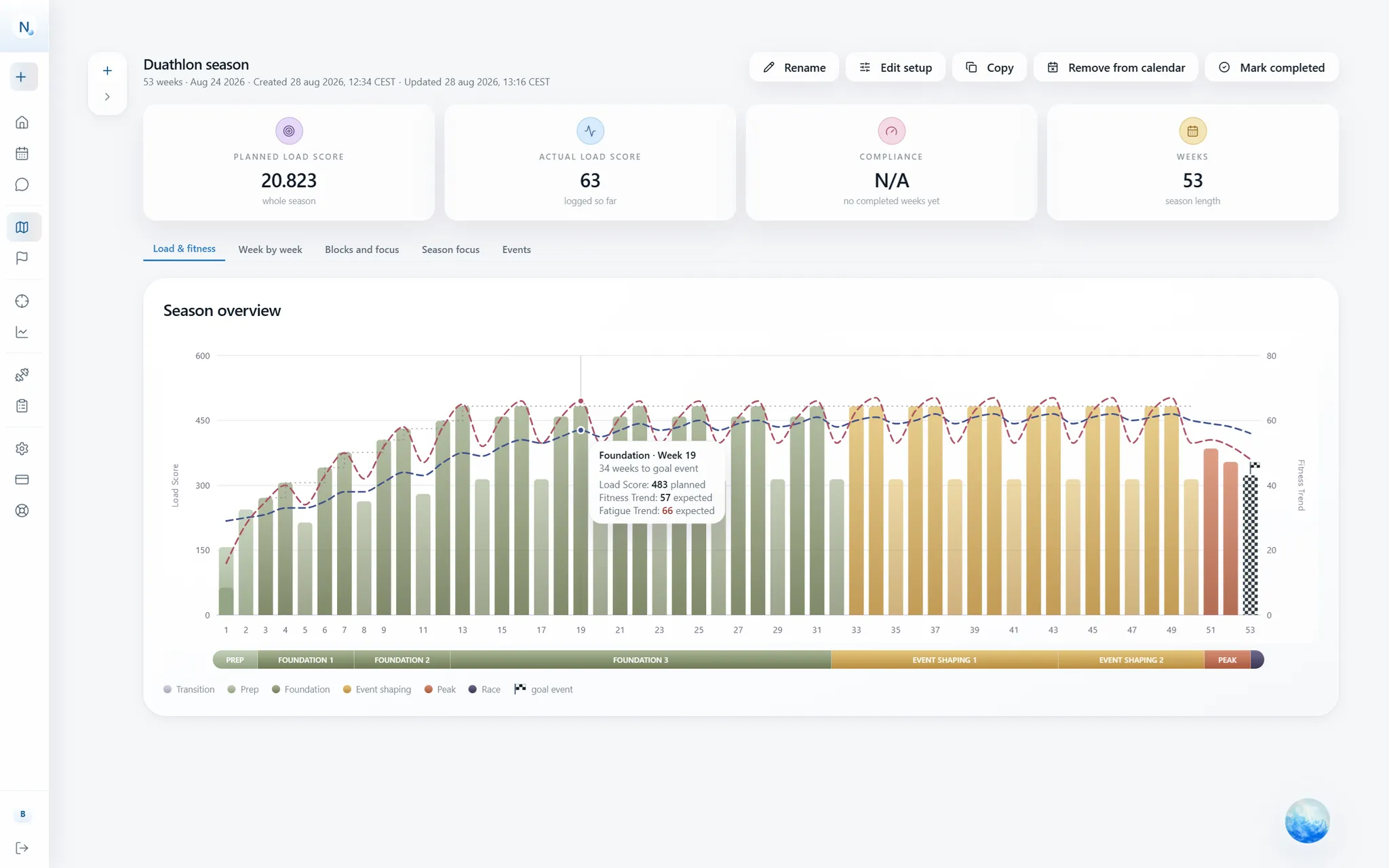
Both are worse than the middle. A season built for you is cheap to produce and cheap to disagree with, which makes it a useful thing to start from even when you intend to rewrite half of it. It has already read the event's demands, compared them against your training history, laid the blocks out backwards from race day and solved a load trajectory that arrives at the right place. Disagreeing with a specific decision in that draft is a smaller job than making every decision yourself, and it is a better one, because you are arguing with something rather than filling in a void. More on how that draft gets built in the season planner.
What you can actually change
The events and their priorities. Add, edit, remove and re-date any event. Set its priority as A+, A, B or C, and its relationship to the others, so a mid-season race can be declared a tune-up or a training race rather than pretending to be a goal. Attach a course file and the demand reading updates with it. Priority is not decoration. It is the input that decides which event wins when two of them want the same weeks.
The focus dimensions and their order. The Focus Lab names the gaps and ranks them by how much they cost you at your event. The season then sequences them, least event-critical first, most event-specific last. If you disagree with that ordering, set the dimension yourself. Each week carries a focus per sport, and each one can be pinned to a dimension you choose instead of the engine's pick. The engine's choice stays visible as the "Auto" option so you can see what you are overriding.
Block boundaries and emphasis. Subperiod length is yours to set, which moves where blocks start and end. Per week you can change the phase, change the subphase, mark or unmark a recovery week, and set the planned load score directly.
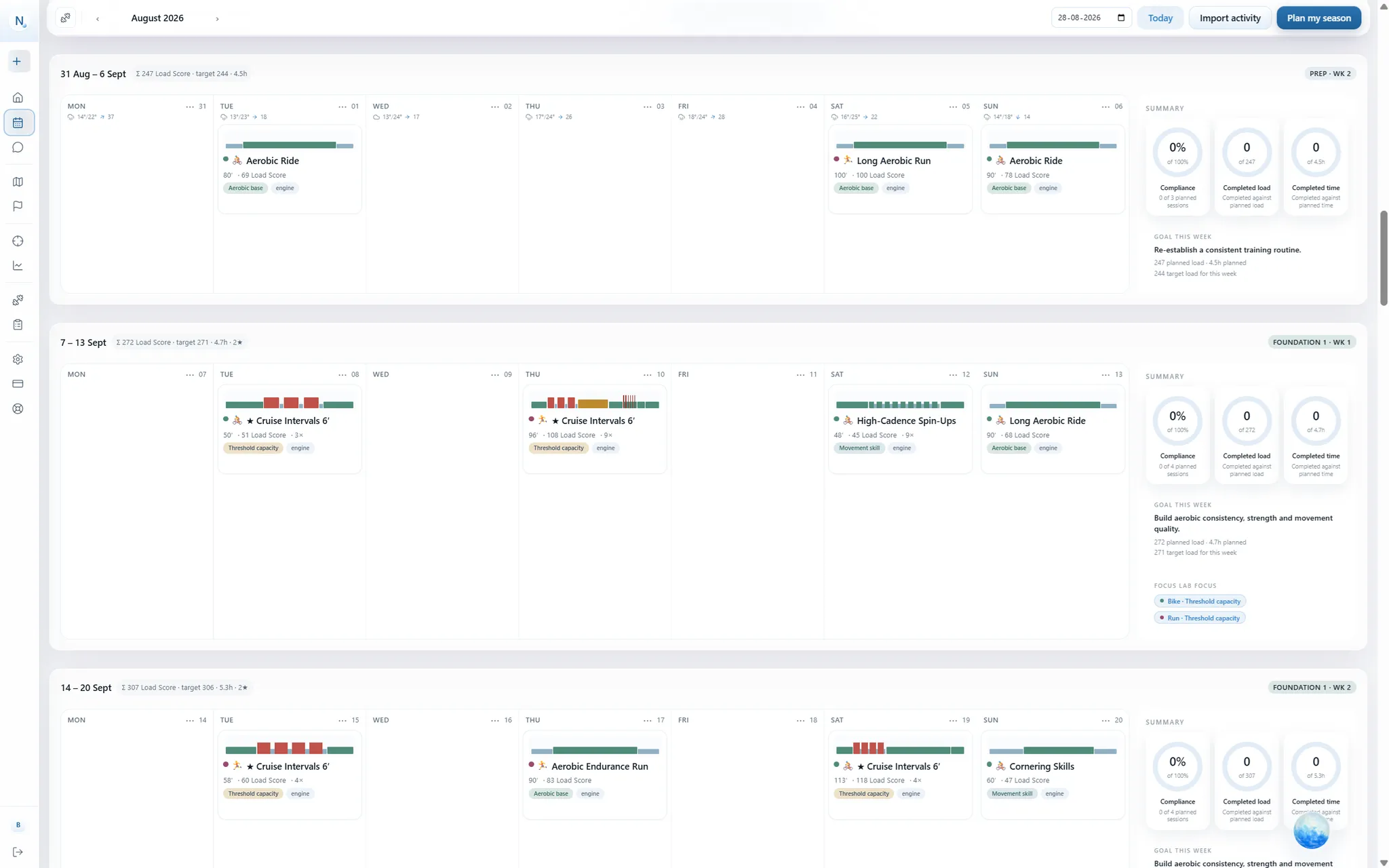
The sessions in a week. Drag a workout out of the library onto a day. The week's edit is authoritative rather than advisory, so the planner builds around the load, phase and focus you set and workouts follow on the next planning run. This is not a scratchpad layer sitting on top of a plan that quietly ignores it.
Individual workouts. Write the session yourself in the builder. Warm-up, work, recovery, steady and cool-down steps, zone or target per step, repeats, durations. The load, intensity factor and zone distribution derive live as you type, so you can see what you just built before you schedule it. What the workout library gives you vetted, the builder lets you author.
The guardrails do not switch off when you take the wheel
This is the part that makes editing worth doing here rather than in a spreadsheet. The validators run on your plan, not only on the one Nymiva proposed.
They are named, individually rule-backed checks, and they cover hard-session spacing, progression rate, recovery provision, intensity distribution, capability maintenance, cross-sport stress, event specificity, portfolio coherence, event priority protection, preparation window conflicts, taper adequacy and data confidence. In practice, four kinds of message are the ones you will actually meet.
- You broke hard-day spacing. Two demanding sessions now sit closer together than the recovery between them supports, or a key session landed the day after a race.
- Progression is climbing faster than is safe. The ramp you just asked for exceeds what your training age and current fitness band tolerate, and the cap governs the load you complete, not only the load you planned.
- A capability you still need has been left to decay. You emphasised one dimension so hard that something being held at a maintenance dose for a later event stopped being maintained.
- A smaller event has quietly compromised a bigger one. Preparation for the
Brace is now eating the weeks theA+race needed, which is exactly the failure that stacking two separately sensible plans produces.
Very little of this is a refusal. A structural error in a workout will block the save, because an interval shape that contradicts itself is not a matter of opinion. Almost everything at season level is a disagreement rather than a veto, and it arrives with a specific suggested fix, in the shape of "move the race later, or set an earlier start date, for more build time" or "add a B-priority tune-up race mid-season on the events step". You can take the suggestion. You can also read it, decide you have a reason it does not know about, and proceed.
The job the system is doing has changed. It stopped deciding and started disagreeing out loud.
An empty calendar never argues with you
That is the whole case, and it is worth stating plainly. A blank grid gives you total control and zero feedback. It agrees with everything you do, including the things that will cost you in six weeks. Its silence reads as permission.
The useful property of being argued with is not that the other party is always right. It is that the other party can see the whole season at once. When you edit week nine you are looking at week nine. The consequence of that edit is usually paid in week fifteen, or in the taper, or in the event you had planned for four months later and stopped thinking about. Holding all of that in view while making a local change is precisely the thing humans are worst at and a validator is good at.
You keep the authority. You lose the ability to break something without hearing about it.
Every change is a version, and versions come back
Nothing you do is a one-way door. A version is captured whenever the plan changes, and the history lists each one with its number, the reason it happened, an impact badge of low, medium or high, and the time it was saved. Every version carries its provenance, so an automatic change states what triggered it and which converging signals produced the verdict, rather than appearing as an unexplained diff.
Select two versions and you get the diff between them: sessions added, sessions removed, sessions changed and which fields changed on each. Restore any version and the restore is non-destructive, because the current plan is saved as a new version first. Restoring is itself reversible, and restoring something whose original change was high impact asks you to confirm harder.
The automation stays bounded throughout. Low-impact changes can apply on their own if you have allowed that. Medium-impact changes need you to have opted into that class. High-impact changes, such as changing the primary focus, rebuilding a block, changing an event's priority or returning from illness, always wait for explicit approval. The coach proposes and never silently applies, which is also why the planning engine can be trusted with the routine work without being handed the season.
One limit is worth naming rather than leaving implied. None of this is medical guidance. Pain, illness and injury concerns are escalated to you and to a professional, never diagnosed and never trained through by a rule.