From a season plan to this week to today
How a block objective becomes a week, a week becomes a session, and a missed session becomes a plan that adapts without quietly stacking the work you skipped.
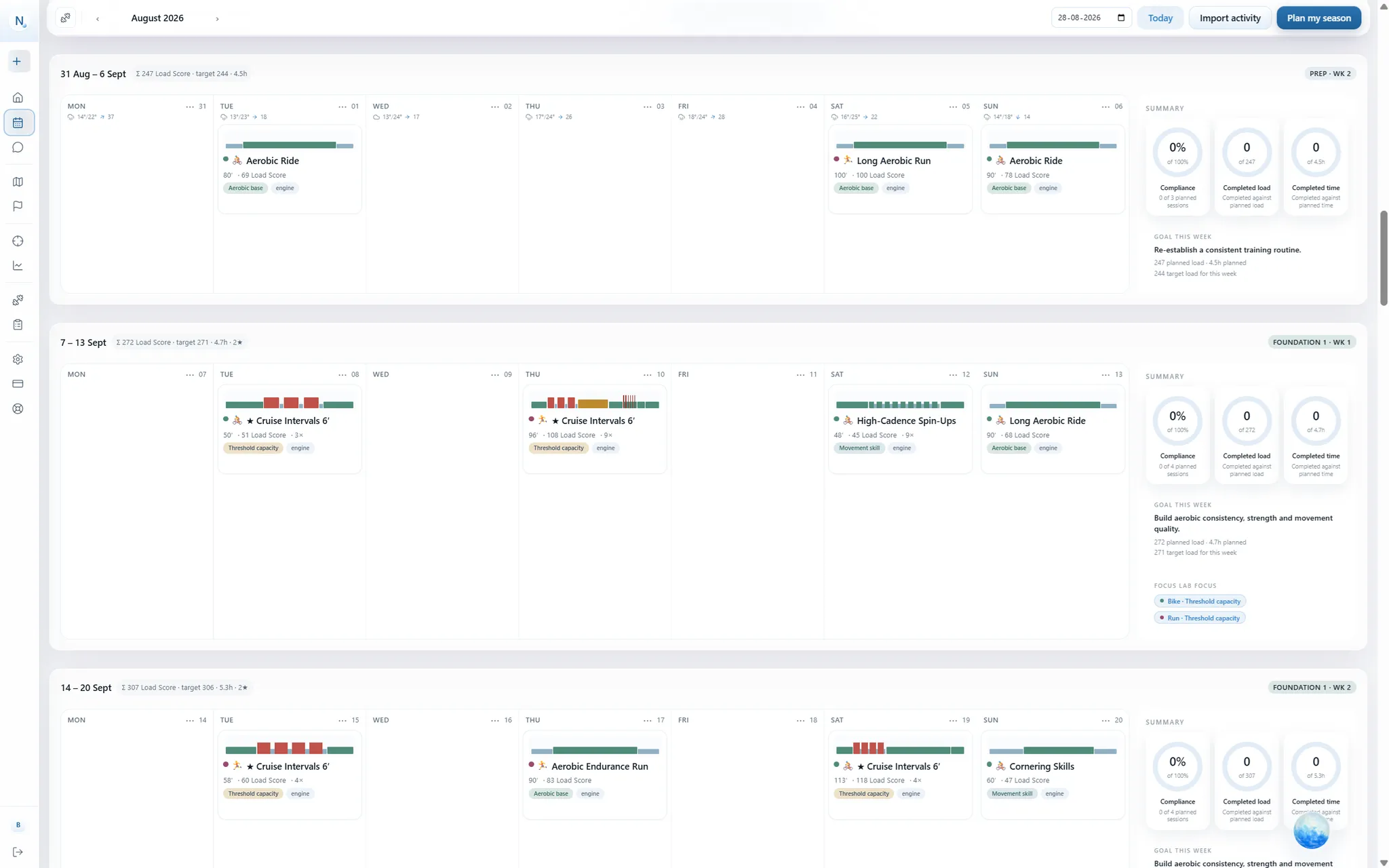
A season plan is not a stack of workouts. It is a chain of five decisions, each one narrower than the last: the season chooses the phases and the order your focus dimensions get tackled in, the block chooses its emphasis, the week chooses the sequence, the day checks whether that plan still suits the athlete who actually woke up, and the session chooses the structure, dose and targets. Today's session is the last link in that chain, which is why it can explain itself all the way back to your race.
Key takeaways
- Five levels, five different questions. Each one refuses to answer the others.
- Phase names are load budgets and focus order, not zone caps. Base does not mean easy only.
- Low impact changes apply on their own, medium impact ones need your opt-in and can be undone, high impact ones always wait for you.
- Missed load is forgiven, never redistributed. Nothing you skipped is stacked onto next week.
- When time is short the session is compressed in a fixed order, and the prescribed intensities never move.
The five levels, and what each one decides
Every level answers one question and hands the rest down. That division is what lets the plan change at one level without unpicking the others.
| Level | Decides | Deliberately does not decide |
|---|---|---|
| Season | Phases, the order focus dimensions are tackled in, taper and recovery windows | What any single session looks like |
| Block | Which dimension is emphasised, which are supported, which are held at maintenance, which are allowed to decay | The daily dose |
| Week | Session sequence, hard day spacing, where the long session sits, where recovery sits | Whether today is a good day |
| Day | Whether the planned session is still appropriate, whether targets move, whether it becomes recovery | The structure of the session |
| Session | Template, dose, targets, and the rule that decides whether the stimulus landed | What the block was for |
The season works backwards from race day. Early phases tackle the focus points that matter least for your event, and late Event shaping tackles the most event-specific ones, including course-shaped work and race-pace structures. That ordering is the point of planning a season rather than a month, and it is covered in a season planned backwards from race day.
The block then names one emphasis. This is limiter-first, never limiter-only. If fatigue resistance is the gap that matters most, the block leans on it, but aerobic development, technique and the abilities you already have are held at a maintenance dose rather than dropped. A block that maximises everything at once develops nothing in particular.
The week is where the constraints bite. Hard days need spacing, the long session needs a day that can hold it, recovery needs somewhere real to sit, and all of it has to fit the days you said you were available. You never type in a load figure or an hours budget. Your per-day availability is the binding input.
The day is the only level that knows how you are. A planned hard session can be moved, softened or turned into recovery because readiness says so. No single number makes that call. Readiness is a synthesis of several signals including how you say you feel, because a lone metric will read illness as good form and send you into intervals.
The session is the last decision. It comes from a vetted structure with a stated purpose, an approved dose range and a stop rule, never from a shape invented on the spot. Every part of that contract is described in workouts with a purpose, a dose and a stop rule.
What happens when life interferes
Plans meet travel, night shifts, sick children and bad weeks. The honest question is not whether a plan adapts, it is who gets to decide. Every change is sorted into three impact levels and treated differently.
Low impact changes can apply automatically. Moving an easy session inside a safe window, trimming duration within approved bounds, swapping an easy session for recovery, adjusting targets for heat or terrain. These do not alter what the block is building, so if you have adaptive planning switched on, they simply happen and are recorded.
Medium impact changes apply only if you opted into them. Rescheduling a key session because readiness vetoed today, reducing a key session dose inside the template's approved range, repeating a week after partial compliance. Each one is deterministic, each one is logged with the reason and the data that triggered it, and each one can be undone. If you did not opt in, it arrives as a proposal instead.
High impact changes always wait for you. Changing your primary focus, rebuilding a block, removing a key progression, changing an event priority, returning from injury or illness, or overriding a safety guardrail. The engine can prepare the change and show its reasoning. It cannot apply it. You approve or you decline.
Whichever level a change falls into, you can open it and see what moved, why, which data triggered it, which rule was applied, and whether it was automatic or approved by you. The coach can talk you through any of it, and it proposes rather than acts, which is the same boundary described in an AI coach that has to show its working.
Missed load is forgiven, never redistributed
This is the rule that separates an adaptive plan from a guilt ledger. A session you did not do is gone. It is not added to next week, it is not spread across the following three days, and it does not reappear as a longer Saturday.

The reasoning is physiological rather than moral. Next week's load was calculated for the athlete the plan expected, and adding last week's missed work on top of it raises the ramp exactly when you have less capacity, not more. Piling on skipped sessions is how a bad week becomes an injured month.
Illness gets its own path. The plan suspends rather than prescribing into a body that cannot absorb it. When you come back it rebuilds toward the level you had actually reached, not the level the old plan assumed you would have by now, then re-forecasts the goal honestly. That re-forecast is a high impact change, so it waits for your approval.
Nymiva does not diagnose illness or injury and does not offer treatment. It escalates what it sees and protects the plan while you deal with it.
When you have less time than the session asks for
Some days you have forty minutes and the plan wants seventy. Compression follows a fixed order, and it stops as soon as the session fits.
- Trim the warm-up and cooldown, down to the minimum the structure allows.
- Compress rest between efforts, but only within the work-to-rest band the template is approved for.
- Spend flexible time if you marked any as available on that day.
- Substitute or step back to a smaller rung on the progression.
The prescribed intensities are the invariant. Compression takes time out of a session, never watts or pace out of the target, because a threshold session run at tempo is no longer that session and crediting it as one corrupts the progression it belongs to.
Compression is not free. Shortening rest raises the density of the work, which spends progression headroom you would otherwise have used to make next week harder. So it is bounded. You will not get two compressed hard days back to back, and runs are not compressed for athletes with a low training age or an active injury flag.
That is the mechanism. The season sets the direction, the block sets the emphasis, the week sets the shape, the day checks reality, the session states its purpose, and when things go wrong the plan bends at a level that matches what is at stake.