Workouts with a purpose, a dose and a stop rule
Every structure states the adaptation it targets, the dose range it is approved for and how you will know it worked. No interval invented on the spot.
A workout is usually handed to you as a shape and a duration. Six by five minutes, ninety minutes total, go. That is enough to fill a calendar and not enough to know afterwards whether the session was worth doing. A Nymiva template carries the shape plus everything the shape leaves out: the adaptation it targets, the purpose of doing it now, the dose range it is approved for, how far that dose may grow, what must be banked before you attempt it, what would make it a bad idea, how much recovery it costs, which season phases it fits, and the rule that decides afterwards whether the stimulus actually landed.
What a template actually carries
Every prescribed session in Nymiva points at a vetted structure, and every vetted structure carries the same fields.

| Field | What it is |
|---|---|
| Sport and energy system | Run, bike or swim, and the system the session is built to stress |
| Intent and target | Why this session exists, and what success looks like |
| Structure | The steps, with zones, repeats, rest and cadence where they matter |
| Baseline duration and load | What the session costs at its baseline scale |
| Scaling rule | Whether it grows by repeats or by duration, and the floor and ceiling of each |
| Phase fit | The season subperiods the session belongs in |
| Prerequisites | Sessions that should be banked before this one is attempted |
| Contraindication | The cited safety note that has to be surfaced, not buried |
| Frequency and spacing | At most this many per week, at least this many days apart |
| Dimensions developed | The event-demand abilities this session trains |
| Verification rule | The zone, the zone model, and the share of moving time that has to land there |
| Source | The book, protocol or canon the structure and its doses come from |
Some templates carry more. A hill session is tagged with the terrain it prepares, so the engine only draws it when your goal course actually has that terrain. A race-rehearsal brick carries a different dose for each race distance. A structure meant only for short-course preparation is tagged so it can never be selected during long-course prep.
A stated purpose lets you judge the session, not just finish it
The purpose is the part that makes a session reviewable. Once a structure says out loud what adaptation it is chasing, "did I complete it" and "was it worth doing" become two separate questions, and the second one is the useful one.
This is why load is treated as a guardrail rather than a goal. You can hit the intended load score of a threshold session by riding an hour of tempo and still have trained nothing the session was prescribed for. The load arrived. The stimulus did not. A plan that only counts load cannot tell those apart, and it will keep giving you the same session for weeks on the strength of numbers that look fine.
An approved dose range with a ceiling
Each template declares how it scales. Some grow by adding repeats, some by adding minutes, and each declares a minimum and a maximum. That band is what lets the same session follow you through a block. Two intervals at the real intensity is a legitimate opening rung, not a watered-down version of the work, and it climbs from there as you earn it.
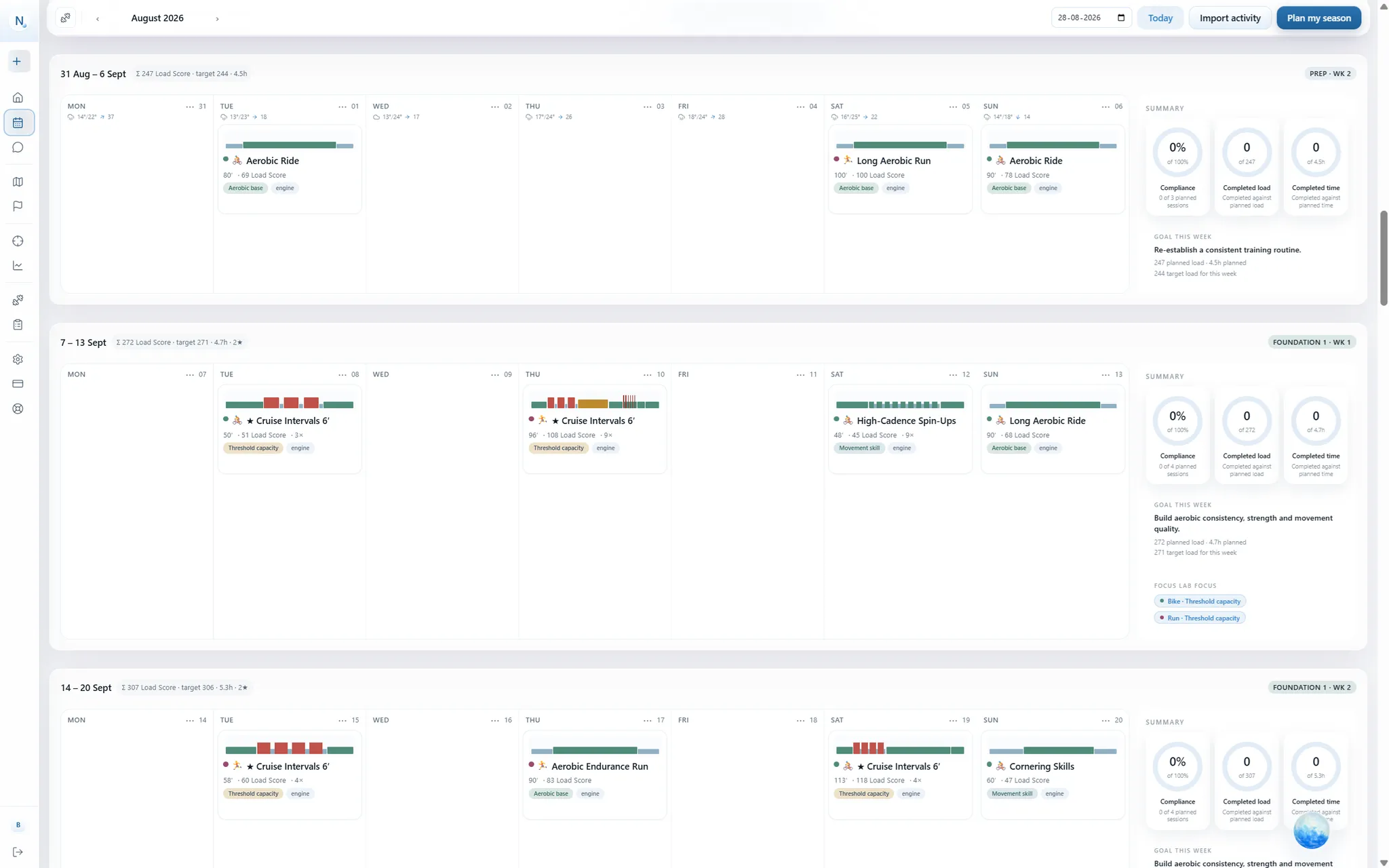
The ceiling matters as much as the floor. Without one, a session that is going well is the easiest thing in the world to keep enlarging until it stops being the session it was. Frequency and spacing guardrails do the same job on the calendar: a template that says at most twice a week with three days between instances cannot be stacked into a block that quietly becomes something else. The planning engine can only progress a session inside the band the template already approved.
Prerequisites and contraindications keep the impressive session off your calendar
A structure you are not ready for should not appear just because it sounds like real training. Prerequisites name the sessions that should be banked first, which is a plain statement that some work is built on other work. Contraindications name the conditions under which a session is a bad idea, and they are written to be surfaced to you rather than silently applied.
Neither is a medical judgment. Nymiva gives training guidance, and where a symptom belongs with a clinician it escalates rather than diagnoses.
The stop rule is the part most plans lack
Most sessions tell you when to start each interval. Far fewer tell you when to stop the session.
That gap is where good training turns into junk. If a set is prescribed above a given intensity and your third repeat lands well below it, continuing does not bank the adaptation you came for. It banks fatigue and a completed tick. A stop rule says in advance where the line is, which turns an early finish into information instead of a failure. Some protocols go further and tell you not to start: if the opening repeat cannot reach its intensity, the honest session is an easy half hour, not a mangled version of the one on the calendar.
Two ways to pass, and finishing is neither
Not every session means the same thing by "done", so Nymiva keeps two completion philosophies apart.
- Quality sessions exist to hold a specific intensity. They stop when the quality collapses, and stopping there is a pass. The prescription was the wattage or the pace, and the session delivered it for as long as it was real.
- Accumulation sessions exist to bank the work. Backing off the target intensity is allowed as long as the work gets in, because the point of the week was cumulative stress rather than perfectly executed intervals. Finishing under target is a pass.
Both of these are passes. A dragged-out quality session and an abandoned accumulation session are not, even if one of them looks better in a completion percentage. Only verified stimulus banks progression, which means the session that failed honestly today is what stops the plan from escalating you into a hole tomorrow.
The verification rule is written before you start
Every template states in advance how the session will be checked: a zone, the model that zone is measured in, and the minimum share of your moving time that has to land inside it. After the file comes in, the session is scored against the rule it was prescribed with, not against a rule invented to fit the result.
One constraint on that rule is worth naming, because getting it wrong is quietly cruel. A verification bar must never demand more time in the target zone than the prescription itself can produce. If it does, you can execute a session perfectly and still be scored a failure. There is one deliberate exception. A group ride cannot be prescribed as intervals, because the surges happen when the group makes them happen, so its rule describes the ride rather than the prescription. Encoding invented intervals to make the arithmetic work would be inventing a prescription, which is the thing this whole system exists to prevent. Once sessions are scored this way, the performance charts are reading verified work rather than attendance.
Where structures are allowed to come from
There are exactly three sanctioned authors of a workout structure.
The vetted library. Reviewed structures with cited provenance, versioned, each one carrying the full contract above.
A deterministic course compiler. Sometimes your actual course contains a pattern no library template describes, such as a climb that hands you straight into a long false flat. The compiler reads that geometry and builds the structure from it. Course truth decides the shape. Your history, your phase and the week's hard-session budget decide the dose. The result is versioned, reproducible from its provenance, and no language model is anywhere in that path.
An agent, through a validation gate. An agent may compose a structure from governed primitives, using the same step kinds, zone vocabulary and dimension vocabulary the library already uses. What it composes is untrusted until it passes the gate. The gate recomputes duration and load itself and rejects any draft that arrives carrying those numbers. It checks the structural rules, the dose envelope distilled from the vetted library, spacing and recovery cost, contraindications, and the presence of a real session rationale rather than a sentence of filler. What survives is stored as a versioned private template with full provenance.
Free-form intervals invented on the spot by a language model are not on that list. That is deliberate, and it is the same boundary the AI coach works inside. A fluent model will happily produce a session that reads like coaching and carries no dose bounds, no prerequisites, no contraindications and no way to be checked. A structure is never accepted because something claimed it was valid.