A season planned backwards from race day
Foundation and Event shaping are budgets, not zone caps. See how a whole season is laid out backwards from the event, and what each block is actually for.
A season is laid out from the event backwards. The block that sits closest to race day should be the one that most resembles race day, so that block gets designed first, and every block before it exists to make it survivable. Only once the run-in is fixed does the plan work back through Event shaping, Foundation and Prep until it reaches the week you are actually standing in.
Planning forwards does something different. It starts with what you can manage this week, adds a bit, adds a bit more, and arrives wherever that lands. More often than not it produces a fit athlete who is fit for the wrong thing, because nothing in the sequence was ever answerable to one specific day.
The last block is the one you design first
The event states its demands before the plan states anything. Duration, elevation, gradient distribution, surface, altitude, heat, wind, fuelling opportunities, and for a multi-leg event the ordering of the legs. Each leg is scored across twelve demand dimensions and compared against your own training history, which is how the gaps get named rather than guessed. That comparison is what the Focus Lab does.
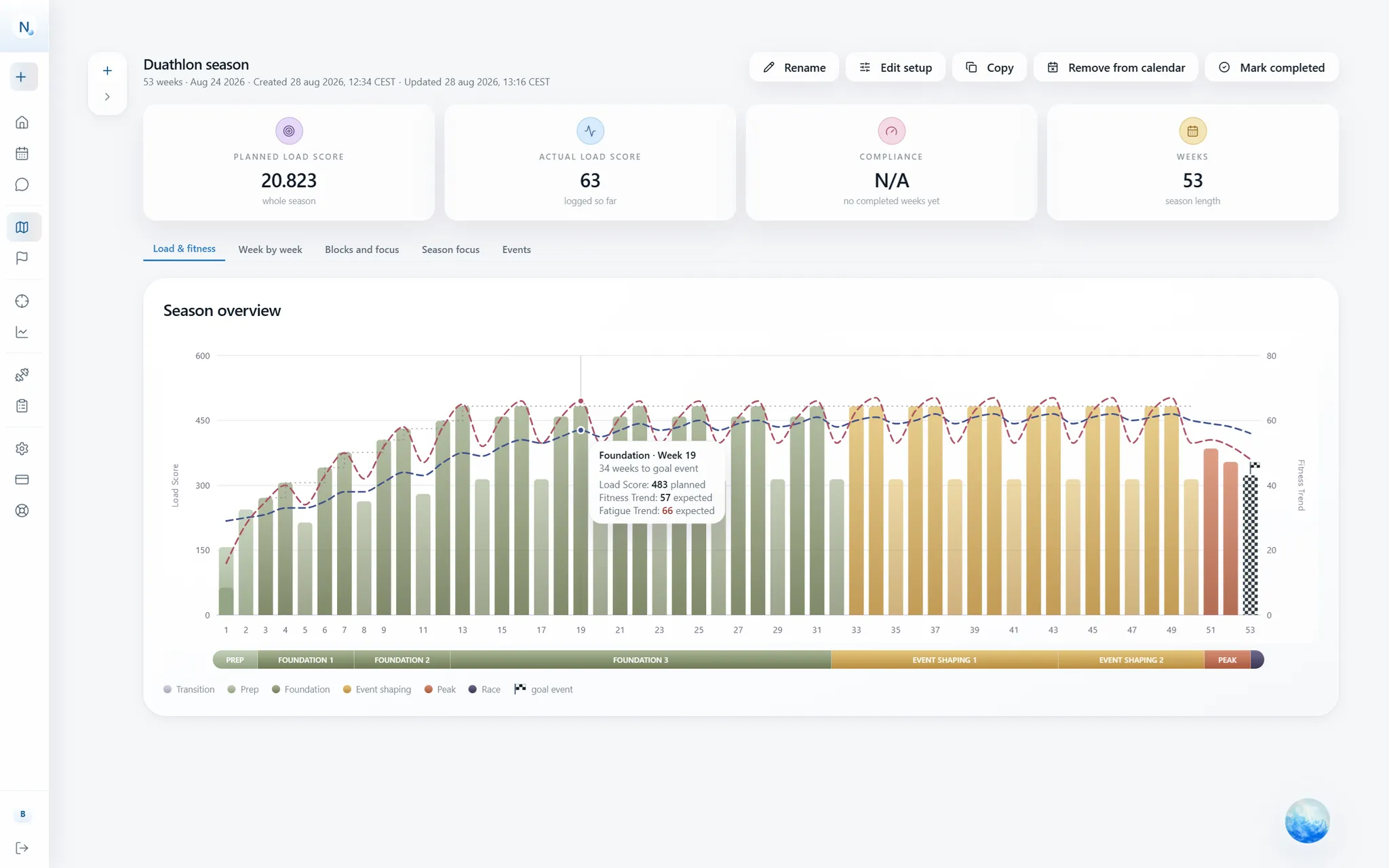
The final block before the event is then the least abstract part of the whole season. It contains course-shaped sessions, race-pace structures, and, if the event has one, the run off the bike treated as its own demand rather than as a run that happens to come after a ride. Write that block down and you have written down a requirement: this is what has to be true of the athlete on the day this block starts.
That requirement is the purpose of the block before it, and that block's entry requirement is the purpose of the one before that. Work backwards far enough and you either reach today with room to spare, or you run out of calendar, which is useful information rather than a failure. A twelve week run-in and a fifty-four week run-in are different plans, not the same plan at different speeds.
Prep, Foundation, Event shaping, Peak, Race, Transition
There are six, and two of them are named on your screen differently from how most training literature names them. Nymiva calls them Foundation and Event shaping, because those say what the block is for. If you have read about periodisation elsewhere, Foundation is what that literature calls base, and Event shaping is what it calls build. Both are split into finer subperiods that grow steadily more race-like, labelled Foundation 1 to 3 and Event shaping 1 to 2.
| Phase | What the load budget does | What the weeks tackle |
|---|---|---|
| Prep | Low and flat | Consistency and tissue tolerance, the least event-critical gaps |
| Foundation | Rises inside each subperiod | Foundation dimensions, gaps furthest from the event's specific demand |
| Event shaping | Holds roughly flat, volume traded for intensity | The most event-specific dimensions, course-shaped and race-pace work |
| Peak | Descends on a solved trajectory | Sharpening while fatigue drains away |
| Race | Easy | Executing the day |
| Transition | Unstructured | Nothing prescribed |
Here is the correction that matters most. Phase names are budgets, not zone caps. A phase guides two things and only two things: how much load the week needs, and which focus dimensions that week takes on. It never means "only easy work".
So Foundation does not mean three months of steady riding at conversational pace. If threshold capacity is one of your gaps, Foundation weeks that carry threshold as their dimension train threshold at threshold. A Zone 3 ride is not credited as threshold work because it is more comfortable and easier to schedule. Where an athlete genuinely cannot yet execute a dimension's real work, the answer is the smallest real dose of the real thing, climbed as fast as the guardrails allow. Not months of a lower zone standing in for it.
What actually changes across the season is which gaps get attention. Early phases take on the least event-critical ones, because there is time to spend on them and because they support what comes later. Late Event shaping takes on the ones closest to the event's own demand. That ordering is the whole reason the phases are sequenced rather than shuffled. More on how to read that in reading a season block.
Why the bars climb and then drop
Look at the weekly load bars and you see a sawtooth. Load rises for a run of weeks, then falls back to an easy floor, then rises again from a higher floor.
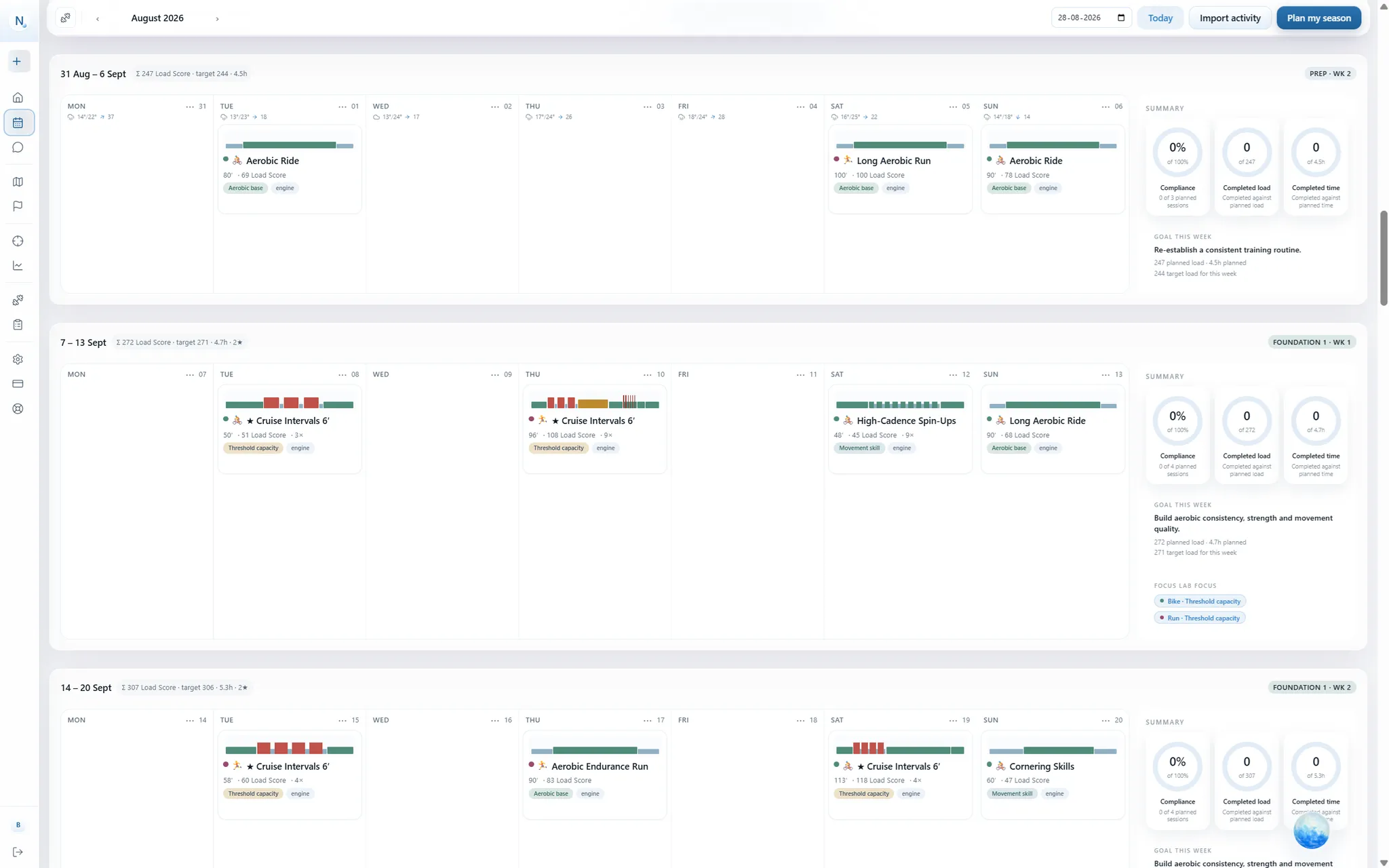
The recovery week is the last week of each Foundation or Event shaping subperiod. The cadence is not a universal law. Three loading weeks plus one recovery is the common shape, and older athletes or slower recoverers get two plus one instead, because the cadence is set by the athlete's recovery rate rather than by tradition. Some plans use uneven cycles where the loading runs differ in length.
What the recovery week protects is the adaptation, not your feelings. Training is the stimulus. The adaptation is paid out during the recovery that follows, and a plan that never stops asking never gets to collect. It also protects the next block's entry requirement. Arriving at an Event shaping subperiod already buried means those sessions get attempted rather than executed, which produces the load without the stimulus. A session can hit its load target and still fail the thing it was prescribed for.
The taper aims at a form band, not a countdown
The taper is not a fixed number of easy days. It is a solved trajectory.
Nymiva takes the race-day form band appropriate to the event and works out what weekly loads land you inside it, given the fitness and fatigue you actually arrive with and your own fatigue time constant rather than a textbook one. Two athletes with the same event and the same goal can get different taper weeks, because they enter the taper carrying different things.
That constant comes from your own data where the data supports fitting it, from your age band where it does not, and from the source default where neither applies. Which of the three was used stays visible. If the band cannot be reached inside the taper's own bounds, because you enter the run-in buried or because you are already fresher than the band, the plan carries the closest achievable point and says so rather than pretending.
Several events are one plan, not several plans stapled together
An athlete with four races in a season does not get four plans. The season holds one event portfolio, and each event carries a priority from A+ down to C plus a relationship to the others: goal race, tune-up, qualifier or training race.
The portfolio is what resolves the conflicts. Shared demands get trained once instead of twice. Where two events want incompatible preparation, the higher priority wins, and the compromise gets stated rather than absorbed silently. A B-race week is not a recovery week. It borrows the easy shape of one, but it is a mini taper with a race in it, so it holds fitness rather than taking the recovery week's discount. Recovery costs after a race are charged to the portfolio's budget, not to the individual event.
Lower priority races are allowed to be useful. A C event can serve as a rehearsal of fuelling and pacing, or as an assessment that replaces a planned test. It is not allowed to quietly cost you the A+ event. Building that portfolio yourself is covered in building your own season.
A plan made in January is a hypothesis
The season built for you today is a prediction about an athlete who does not exist yet. It assumes a rate of progress, a level of consistency, and a body that stays healthy for the next several months. Any of those can turn out wrong.
That is the honest reason a plan has to adapt. Missed sessions are forgiven and never redistributed, because stacking last week's work onto this week is how a small interruption becomes a large one. Progress that runs ahead of the forecast earns a re-solve, not a shrug. Low impact changes can apply themselves, medium impact changes need you to have opted in, and anything that changes the primary focus, rebuilds a block, changes an event's priority or handles a return from injury waits for your approval.
The plan is not a promise about June. It is the best current answer, kept current.