IRONMAN 70.3 · Weymouth · 12 Sept 2027
How to train for IRONMAN 70.3 Weymouth
Weymouth has the reputation of a first-timer's race, and the organiser's own page calls the course fast and flat. Half of that is right. The run is flat. The bike is a rolling loop through the Dorset countryside with 884 m of climbing in it, and the steepest kilometre and a half of the day comes at kilometre 61, two thirds of the way round.
So the race splits into two different problems. Ride a hilly course the way it asks to be ridden, and the flat seafront run takes care of itself. Ride it the way the word "flat" suggests, and the run is where you find out.
By Kian Briel, founder. Analysed by engine 1, updated
What is actually on the road
The organiser's own course files, drawn the way the Event Analyzer draws a member's race.
- Swim1.91 km2 m upCourse file
- Bike90.9 km884 m upCourse file
- Run21.2 km45 m upCourse file
The swim is one clockwise lap in an L shape off Weymouth's beach, the only sea swim in the series along the Jurassic Coast. The Weymouth area hosted the London 2012 Olympic and Paralympic sailing events. You swim straight out, turn right, hold that line for 750 meters, take two right hand turns back towards the swim exit and one final left to leave the water. From there it is a 300m run to transition along a road that is partially carpeted. The water was 17 C in 2025 and 17 C in 2024.
The bike is a single anti-clockwise loop of 90.9 km. It heads north through rolling countryside to King's Stag, then comes back to Weymouth through Godmanstone and Dorchester, and finishes at Lodmoor Country Park, where you rack the bike and find your RED bag.
The run is a 2.5 lap course. From transition it goes out to the Overcombe roundabout, turns back towards the town along the beachfront, and loops past the finish line into a two-way section on Custom House Quay. There is a U-turn under the Town Bridge, then the route returns towards Lodmoor via Alexandra Gardens and a short out and back. The whole thing climbs 45 m.
The profile tells the rest. The bike starts climbing inside the first 4 km, with 1.5 km at 4.9 percent out of town, and from there it never settles for long. There are short rises of roughly three and a half to five percent all the way to kilometre 60, the longest flat stretch is 10.9 km from kilometre 16, and 8.1 percent of the whole course by distance is climbing. Then comes kilometre 61: 1.5 km at 8.3 percent to the highest point of the ride, 6.1 percent of the bike leg on one climb. The last 27 km give most of that height back on the way to the sea, in descents of up to six percent, though not all at once. There is one more climb, 1.4 km at 4.6 percent, from kilometre 83.
Course shape by distance
- Flat 84%
- Climbing 8%
- Descending 8%
The longest stretches
- Bike, climbing1.49 km6% of the bike
- Run, flat7.65 km36% of the run
- Run, flat7.91 km37% of the run
Each row is one unbroken stretch of the course that keeps the same shape the whole way. The number is how much of that leg you spend inside it, and it comes out the same whether you are fast or slow.
What this course asks of each leg
Twelve training dimensions scored for each leg against its own course, the way the Event Analyzer scores a member's race.
Aerobic endurance and muscular endurance, as on any half-distance triathlon, scored 85 and 82 on the bike. The run reads 85 and 81. The swim reads 85 and 80. What sets Weymouth apart sits just below them. Threshold capacity and threshold durability both score 70 on the bike, and high-intensity capacity scores 58 there against 40 on the run and the swim. With the bike filling 53 percent of a Trained athlete's day, the seven largest demands on the whole course are bike demands.
Strength and force reads 49 on the bike, which is the climb at kilometre 61 and the ramp out of town. The rolling middle shows up differently. Rehearsed as a session, this bike is twelve surges of three quarters of a minute in Zone 5, each followed by five and a quarter minutes of easy riding. That is the pattern of the Dorset lanes: a short rise, a recovery, another rise, repeated until you stop counting.
The swim has its own number. Technical skill scores 76 in the water, against 37 on the bike. An L shaped lap in the sea with four turns rewards a swimmer who can sight and hold a line.
The bands put it in time. A Trained athlete swims 38:20, rides 3:13:25 at 182 W and runs 2:00:26, for 6:02:11. The Competitive band finishes in 5:15:16, riding 2:49:48 at 249 W from 4.15 W/kg at 75 kg, then running 1:42:19 off a threshold input of 4:20 /km threshold pace.
Heat is not the issue here. The high was 22 C in 2026, 18 C in 2025 and 15 C in 2024. The low in 2024 was 4 C, and the day starts in the sea.
- Aerobic endurance85
- Muscular endurance80
- Technical skill76
- Threshold capacity70
- Aerobic durability65
- Threshold durability65
- Fueling resilience55
- High-intensity capacity40
- Anaerobic capacity25
- Strength / force20
- Environmental resilience15
- Sprint power5
Nymiva reads what you can already show, from your own data
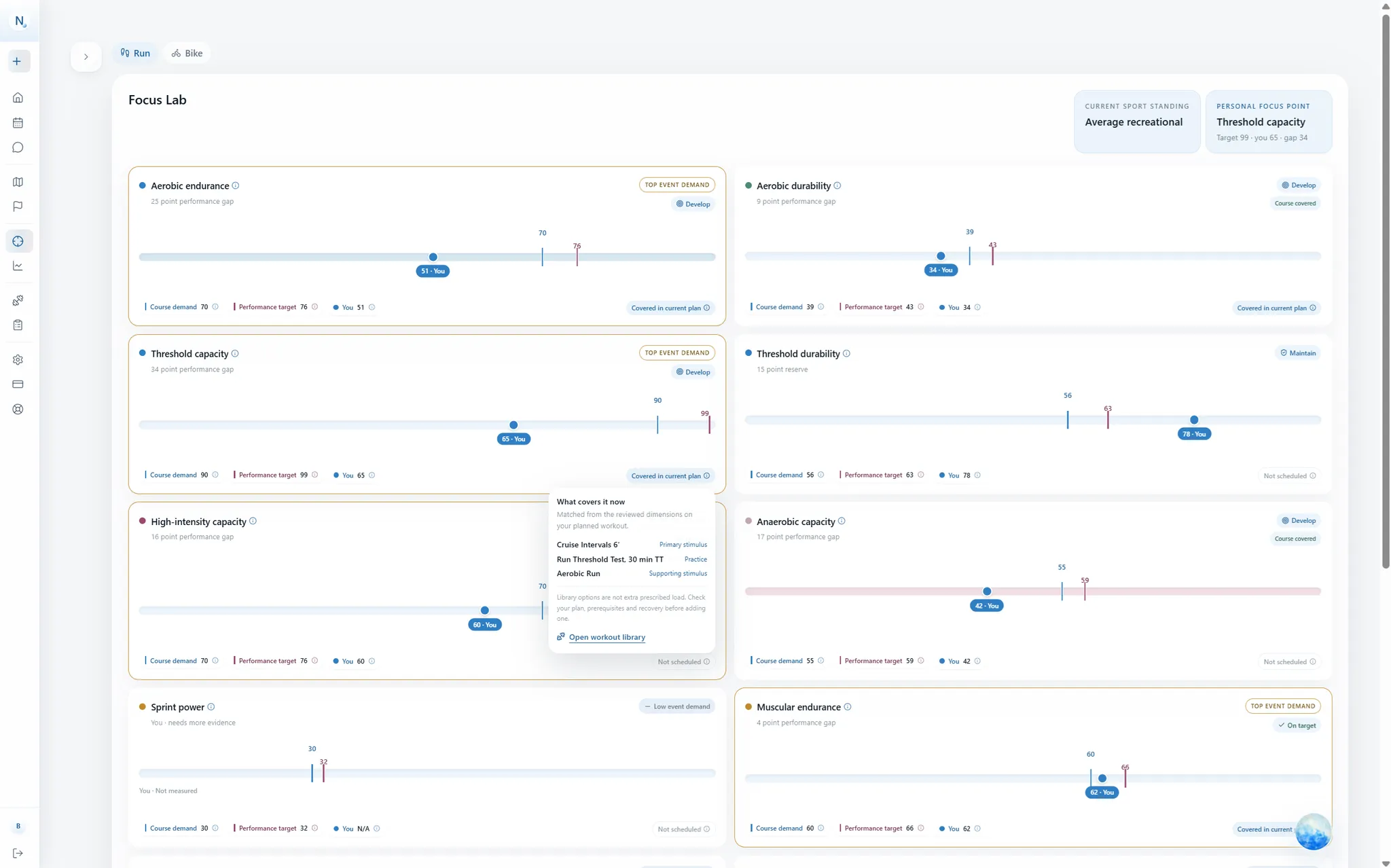
Connect your training history and the Focus Lab scores the same twelve dimensions this course demands against where you sit today. The gap between the two is what you train.
- MeasuredFrom your thresholds and testsThreshold power, threshold pace, critical swim speed and field tests you have done. The dimensions they can carry are scored directly.
- EstimatedFrom your training historyConnected activities are read for what they prove: long efforts, late-session fade, repeated hard work, fueling on long days. Each score says how it was read.
- ProxyFrom a stand-in, and named as oneWhere only an indirect signal exists, the score carries the proxy it came from and a lower confidence, never a number dressed as a measurement.
- UnmeasuredHonestly blankA dimension nothing in your data can answer stays unmeasured. It is never a zero, and the plan does not pretend to know it.
Every dimension ends in one word
- Develop the course asks more than you can show
- Maintain close enough to hold at the minimum dose
- Covered nothing to build here
- Unmeasured the course needs it, your data cannot say yet
Nymiva scores the same twelve dimensions for a course and for an athlete. The course scores come from the organiser's files. The athlete scores come from thresholds and connected training history, each labelled with its source and how much it can be trusted. Where Weymouth asks for more than the athlete can show, that dimension is a gap, and each gap is weighted by the share of the day it fills. On this course the bike carries more than half of that weight.
This page has no reader behind it, so its season starts from the plainest case: the gaps sit where the demands are largest. It runs 24 weeks in 5 developmental blocks and a two-week taper. Aerobic endurance leads the first block in all three sports. Threshold capacity then leads the bike and the swim while aerobic durability leads the run. In the third block the swim turns to technical skill, the bike to threshold durability and the run to threshold capacity. Muscular endurance leads the fourth, and aerobic endurance returns for the last block before the taper. A member's own season begins from their own numbers and will not match this one.
Train the bike to protect the run
Which demands matter most across the whole race. A leg's demand counts for as much of the day as that leg takes, so a score of 85 on the bike outweighs the same score on the swim.
- 01Aerobic enduranceBike leg, 53% of the day85 × 53%45
- 02Muscular enduranceBike leg, 53% of the day82 × 53%44
- 03Threshold capacityBike leg, 53% of the day70 × 53%37
The bike takes 53% of the Trained reference band’s day, so its demands carry the most race weight. What the bike leaves in the legs is what the run gets.
Which demand gets a block, and when
The engine freezes one lead focus per sport on every developmental block, holds the rest at maintenance, and verifies before it reprioritises.
An illustration, not your plan. This page has none of your data, so the season below is the engine’s answer to one stated assumption: that your gaps line up with what IRONMAN 70.3 Weymouth demands. Your own season is built from your history, your thresholds, the days you can train and the races you have entered, and it will differ from this in its priorities, its sessions and its load.
- 01Run muscular endurance, a practice block4 weeks
- 02Run aerobic endurance, a development block4 weeks
- 03Bike muscular endurance, a practice block4 weeks
- 04Bike aerobic endurance, a development block4 weeks
In the order the allocator places them, general first, most race-like last.
- Week 1PrepPrep
A lead-in week. It develops nothing by design.
- Weeks 2 to 5Foundation 1Closes with a recovery week
- PriorityBike aerobic endurance
- PriorityRun aerobic endurance
- PrioritySwim aerobic endurance
- SupportBike muscular endurance
- SupportRun muscular endurance
- SupportSwim muscular endurance
- SupportSwim technical skill
- SupportBike threshold capacity
- SupportBike threshold durability
- SupportRun threshold capacity
- SupportSwim threshold capacity
- SupportRun aerobic durability
- Weeks 6 to 9Foundation 2Closes with a recovery week
- PriorityBike threshold capacity
- PrioritySwim threshold capacity
- PriorityRun aerobic durability
- SupportBike aerobic endurance
- SupportRun aerobic endurance
- SupportSwim aerobic endurance
- SupportBike muscular endurance
- SupportRun muscular endurance
- SupportSwim muscular endurance
- SupportSwim technical skill
- SupportBike threshold durability
- SupportRun threshold capacity
- Weeks 10 to 13Foundation 3Closes with a recovery week
- PrioritySwim technical skill
- PriorityBike threshold durability
- PriorityRun threshold capacity
- SupportBike aerobic endurance
- SupportRun aerobic endurance
- SupportSwim aerobic endurance
- SupportBike muscular endurance
- SupportRun muscular endurance
- SupportSwim muscular endurance
- SupportBike threshold capacity
- SupportSwim threshold capacity
- SupportRun aerobic durability
- Weeks 14 to 17Event shaping 1Closes with a recovery week
- PriorityBike muscular endurance
- PriorityRun muscular endurance
- PrioritySwim muscular endurance
- SupportBike aerobic endurance
- SupportRun aerobic endurance
- SupportSwim aerobic endurance
- SupportSwim technical skill
- SupportBike threshold capacity
- SupportBike threshold durability
- SupportRun threshold capacity
- SupportSwim threshold capacity
- SupportRun aerobic durability
- Weeks 18 to 21Event shaping 2Closes with a recovery week
- PriorityBike aerobic endurance
- PriorityRun aerobic endurance
- PrioritySwim aerobic endurance
- SupportBike muscular endurance
- SupportRun muscular endurance
- SupportSwim muscular endurance
- SupportSwim technical skill
- SupportBike threshold capacity
- SupportBike threshold durability
- SupportRun threshold capacity
- SupportSwim threshold capacity
- SupportRun aerobic durability
- Weeks 22 to 23PeakPeak
The taper. Load comes down toward the race, content stays specific.
- Week 24RaceRace
Race week.
Held at maintenance between blocks
- Runmuscular endurance, aerobic endurance, aerobic durability, threshold capacity, threshold durability
- Bikemuscular endurance, aerobic endurance, aerobic durability, threshold capacity, threshold durability
- Swimaerobic endurance, aerobic durability, threshold capacity, threshold durability, muscular endurance, technical skill
Touches scheduled by each capability’s own decay, at a fraction of its development dose, so earlier work is still there on race day.
The sessions the blocks are built from
One entry per kind of work the block trains, at the intensity that work is meant to be done at. Where the same work runs at several lengths, the entry shows the span it grows across rather than one entry per length.
- Foundation 1 · Weeks 2 to 575 to 240 min
150 to 210 min at Zone 2
BikePower, Zone 2Trains aerobic capacity - Foundation 1 · Weeks 2 to 540 to 270 min
180 to 210 min at Zone 3, then 30 min at Zone 4
BikePower, Zone 3Trains aerobic capacity - Foundation 1 · Weeks 2 to 535 to 120 min
90 min at Zone 2
RunPace, Zone 2Trains aerobic capacity - Foundation 1 · Weeks 2 to 550 min
4 x 1.5 min at Zone 3, 6 min easy between
RunHeart rate, Zone 3Trains aerobic capacity - Foundation 1 · Weeks 2 to 545 to 51 min
4 x 8 min at Zone 2, 1 min easy between
SwimPace, Zone 2Trains aerobic capacity - Foundation 1 · Weeks 2 to 547 to 81 min
3 x 1000 m at Zone 3, 0.3 min easy between
SwimPace, Zone 3Trains aerobic capacity
12× rolling-course surges
0.8 min at Zone 5, then 0.8 min at Zone 5, then 0.8 min at Zone 5, then 0.8 min at Zone 5, then 0.8 min at Zone 5, then 0.8 min at Zone 5, then 0.8 min at Zone 5, then 0.8 min at Zone 5, then 0.8 min at Zone 5, then 0.8 min at Zone 5, then 0.8 min at Zone 5, then 0.8 min at Zone 5, 5.3 min easy between
Compiled by the deterministic course compiler from the organiser’s file: the course’s one repeatable requirement, rehearsed at a dose the progression allows.
- Bike
- 92 min
- Trains threshold durability
- Supports muscular endurance
- Supports high intensity capacity
24 weeks, laid out backwards from race day
The shortest runway Nymiva builds for this event type, with its blocks, recovery weeks, taper and race week in place.
- 1
- 2
- 3
- 4
- 5
- 6
- 7
- 8
- 9
- 10
- 11
- 12
- 13
- 14
- 15
- 16
- 17
- 18
- 19
- 20
- 21
- 22
- 23
- 24
- Prep
- Foundation
- Event shaping
- Peak
- Race
- Recovery week
Your own season carries these same phases on your own dates, with the load solved from your fitness and the days you can train, and it changes when your data does.
What each level does on the day
Reference finish times per peer band, the pacing plan the model holds each band to, and where the day is decided.
| Band | Swim | Bike | Run | Finish |
|---|---|---|---|---|
| Recreational2:11 /100m critical swim speed · 2.47 W/kg at 75 kg · 6:08 /km threshold pace | 0:45:14 | 3:34:46 | 2:24:50 | 6:54:50 |
| Trained1:51 /100m critical swim speed · 3.03 W/kg at 75 kg · 5:06 /km threshold pace | 0:38:20 | 3:13:25 | 2:00:26 | 6:02:11 |
| Competitive1:36 /100m critical swim speed · 4.15 W/kg at 75 kg · 4:20 /km threshold pace | 0:33:09 | 2:49:48 | 1:42:19 | 5:15:16 |
| Elite1:26 /100m critical swim speed · 5.27 W/kg at 75 kg · 3:50 /km threshold pace | 0:29:42 | 2:35:04 | 1:30:31 | 4:45:17 |
Pacing plan
- 0 km0.6%27.9 km/h7:39
- 3.56 km4.9%13.1 km/h6:41
- 5.02 km1.8%22.5 km/h0:44
- 5.29 km-6%58.1 km/h0:29
- 5.76 km0.1%30.3 km/h3:03
- 7.3 km4.2%14.6 km/h1:11
- 7.59 km-1%35.8 km/h3:16
- 9.54 km3.3%17.1 km/h0:32
66 more segments in the full plan.
- Run: reach 4:20 /km and this course gives back 46:55.
Where it is decided
At kilometre 61, and in the 27 km after it.
By then the rolling lanes have asked their question more than a dozen times. Every rise is short enough to surge, and a rider who has answered each one out of the saddle reaches the climb with the real work of the day still ahead. The climb is 1.5 km at 8.3 percent and it takes 6.1 percent of the bike leg. It is the one place on the course where a Trained athlete holding 182 W is honestly climbing, and the one place where going over that number costs the most.
Then the road turns back down towards the coast. The descents are fast and they are recovery, but only for a rider who arrives at the top with something left to recover. Arrive empty and the last climb from kilometre 83 is a second bill for the same mistake.
The run is where the verdict gets read out. The first 7.6 km are flat and hold 36 percent of the run leg. The next 7.9 km are flat and hold 37 percent more. A Trained athlete runs 2:00:26 from an input of 5:06 /km threshold pace, and on a course this even the pace either holds from the Overcombe roundabout to the finish or it does not.
Getting it wrong
The first mistake is believing the brochure. "Fast and flat" describes the run. Train only on flat roads for Weymouth and the rolling first 60 km of the bike becomes the hardest part of your season, met for the first time on race day.
The second is the ramp out of town. It arrives inside the first 4 km, straight out of transition, with the swim still in your legs. Riding it at the pace of the riders around you sets the tone for every rise that follows.
The third is the descent home. After the climb at kilometre 61 most of the road runs downhill, and riders spend it chasing speed rather than bringing their effort down. Then the rise from kilometre 83 takes whatever the chase left. The run starts at Lodmoor Country Park, and Custom House Quay is just as long on the last lap as on the first.
Conditions on the day
- 2026high 22 C, low 8 C
- 2025high 18 C, low 11 Cwater 17 C
- 2024high 15 C, low 4 Cwater 17 C
From the organiser’s own records. Not a forecast.
Every session is a claim, every block is a test
A plan is not a calendar. Each key session states what it trains and how that is checked, and each block ends with a public verdict before the next one is chosen.
What a block promises
Bike aerobic endurance moves from your baseline to a stated target by the end of Foundation 1
- The baseline is your measured score when the block starts. The target is the score the model predicts for it.
- Verified at the block’s recovery week, by a field test or a refresh of the supply read from your history.
- Confidence rises by agreement between independent signals, never by one metric crossing a line.
- A block that misses its target is a public miss. The next block is chosen from what was proven, not from what was planned.
- 01Stimulus achievedThe work landed in the zone the session named, for the dose it named.
- 02Partially achievedSome of the work landed. The session banks what it can prove.
- 03Not achievedThe load may have been there. The stimulus was not, so nothing is banked.
- 04Data insufficientNo usable stream. The session is neither credited nor blamed.
- Session verified
- Progression banked
- Block verified
- Priority reassessed
- Plan adapted
Your numbers, this course
Analyze IRONMAN 70.3 Weymouth against my fitness
The same simulation and the same Focus Lab read, on your thresholds instead of a band’s. Three numbers give a finish estimate and a partial read. A connected history gives the whole table.
The first 14 days are free.
- Trained band finish
- 6:02:11
- Of the day on the bike
- 53%
- Dimensions scored per leg
- 12
- Season runway shown
- 24 wk
Questions people ask
- Is the IRONMAN 70.3 Weymouth bike course hilly?
- It is rolling, not flat. The one-loop 90 km through the Dorset countryside climbs 884 m in total, and 8.1 percent of the whole course by distance is climbing. The steepest sustained climb is 1.5 km at 8.3 percent from kilometre 61, and it takes 6.1 percent of the bike leg.
- What water temperature should I expect off Weymouth's beach?
- The organiser logged 17 C in both 2025 and 2024, and has no reading for 2026. The swim is one clockwise lap in an L shape, with a 750 meters leg after the first right turn. The wetsuit decision is not on the organiser's course page, so check it in race week.
- Is the IRONMAN 70.3 Weymouth run flat?
- Yes. The 2.5 lap run along the beachfront climbs 45 m in total. Its two longest stretches are 7.6 km and 7.9 km of flat road, and together they make up nearly three quarters of the run leg.
- Where are the transitions?
- The swim exit is a 300m run from transition along a partially carpeted road. The bike returns to Lodmoor Country Park, where you rack, collect your RED bag and head out on the run.
Course data from the organiser’s published files, analysed 23 Sept 2026 by engine 1, demand model 4. Reference times are simulated for a peer band at a stated reference athlete and are not a prediction for anyone. Nothing on this page is medical advice.
IRONMAN® and IRONMAN 70.3® are registered trademarks of World Triathlon Corporation. Nymiva is an independent training platform and is not affiliated with, sponsored by or endorsed by World Triathlon Corporation. Course data is read from the organiser’s public course pages for the purpose of describing the event.