Guided triathlon plans built as one season
Swim, bike and run planned together rather than as three plans stapled at the edges. Shared aerobic work is reused, sport-specific work is protected.
A guided triathlon plan is one season that happens to contain three sports, not three sport plans running alongside each other. Swim, bike and run are planned against a single shared budget of time, load and recovery, because a single shared budget is what you actually have. Work that transfers between the sports gets reused, and work that does not transfer gets protected rather than quietly substituted.
Three sensible plans add up to one unsustainable week
Take a good swim plan, a good bike plan and a good run plan. Each one is defensible on its own terms. Each one also assumes it has first claim on your Tuesday, on your long weekend day, and on the recovery that follows.
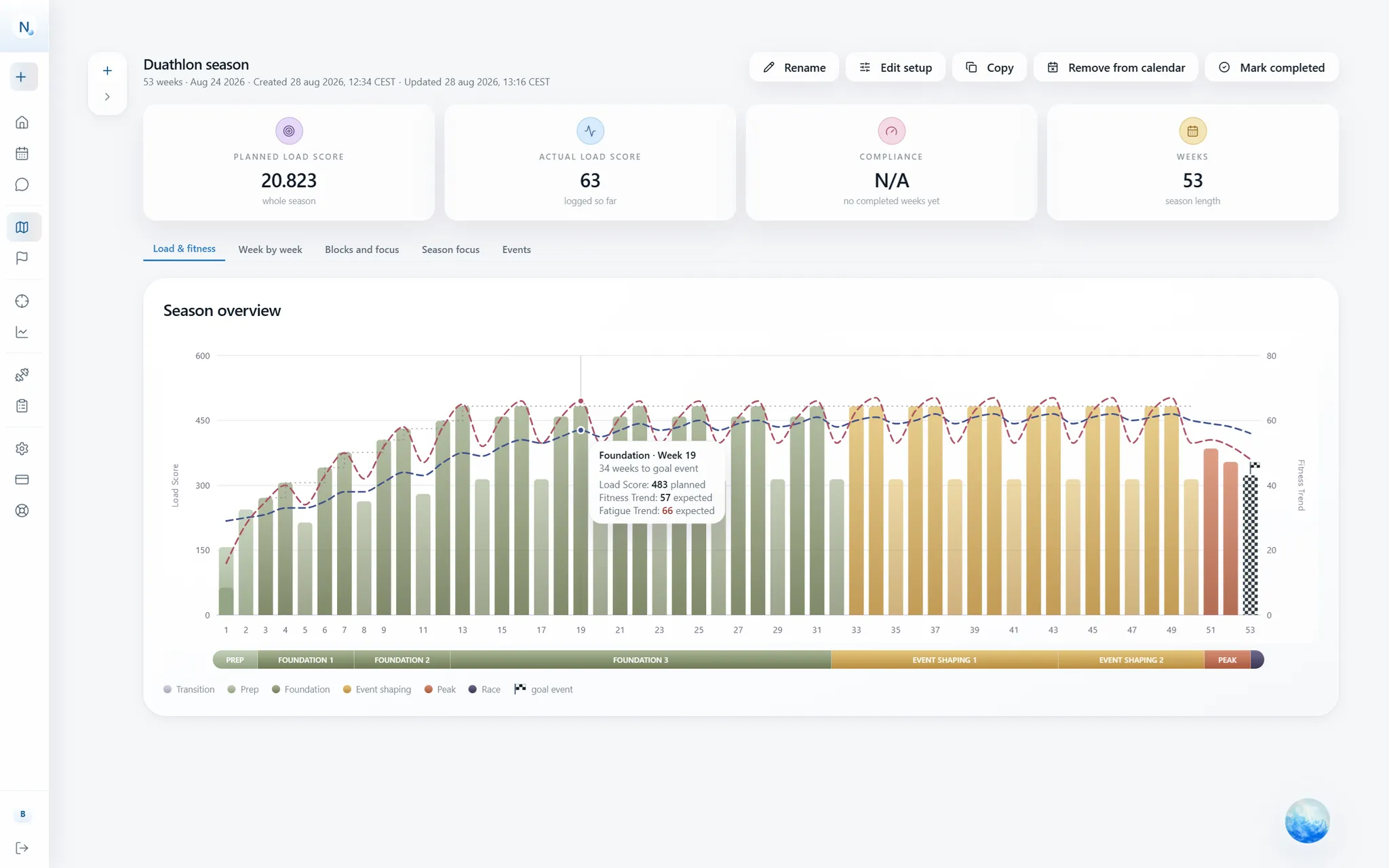
Stack them on one calendar and the arithmetic stops working. Three plans that each schedule two quality sessions a week have just given you six, spread across a body that can absorb rather fewer. Three plans that each protect a long session have booked three long days. None of them is wrong. Together they describe an athlete who does not exist.
The failure is rarely dramatic. It shows up as a swim session executed at the right load with none of the intended quality, because it followed a hard ride. It shows up as a run block that never progresses, because every run lands on legs that were already spent. The load looks correct on paper the whole time, which is exactly why the problem survives so long. A session can hit its load target and still fail the stimulus it was prescribed for.
You have one body, one recovery capacity and one calendar. So the three sports have to be planned against each other from the start, not optimised separately and reconciled afterwards.
A triathlon is a sequence of legs, not a fourth sport
Run, bike and swim are first-class sports in Nymiva, each with its own zone models, field tests, limiter taxonomy and workout ontology. Triathlon is not a fourth sport sitting beside them. It is an event made of ordered legs, swim then bike then run, and it is modelled leg by leg.
That distinction does real work. Each leg is analysed against the actual course you entered and scored across twelve demand dimensions, so the swim leg of a choppy sea start and the swim leg of a downstream river swim are different demands rather than the same word. The bike leg of a rolling course and the bike leg of a flat, exposed one ask for different abilities. The run leg is scored as the run leg of this event, arriving in the state this bike leg leaves you in.
Each leg's demands then meet your own history for that sport, which is where the gaps get named. The detail of how each sport is handled is covered separately in guided swim plans, guided bike plans and guided run plans. What follows is what changes when all three are in the same season.
Shared work is reused, sport-specific work is protected
Central aerobic fitness transfers between endurance sports. Changes in the heart, lungs and blood do not much care which endurance sport produced them, and the evidence for that is strong. Peripheral muscular fitness is the opposite. It is specific to the muscles doing the work, it does not cross over, and the evidence for that is also strong.
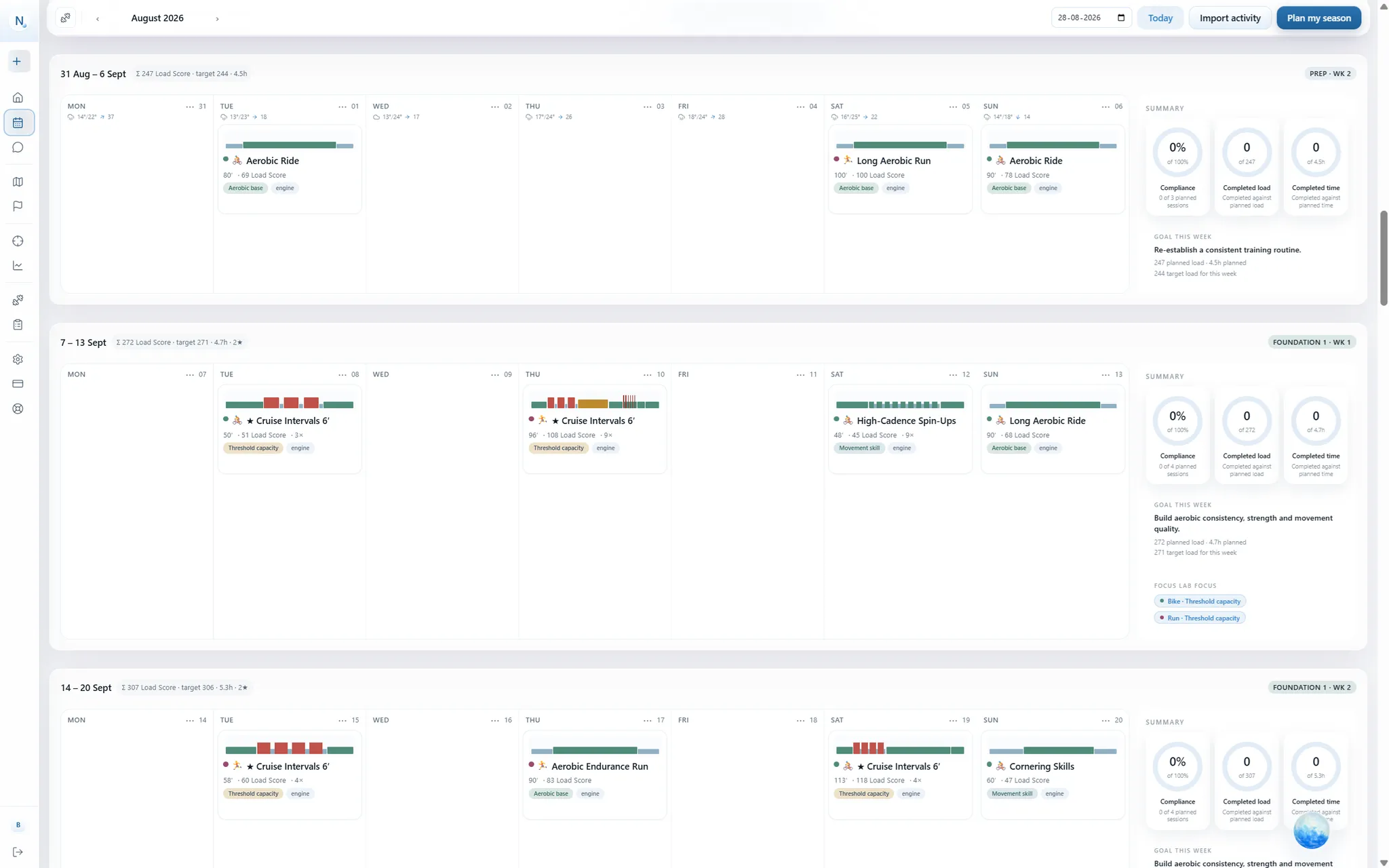
Those two facts set the whole shape of a triathlon season. Aerobic development that any of the three sports can deliver is trained once rather than three times, in whichever sport can carry it at the lowest cost. Cycling is often that sport, because it can carry substantial aerobic load without the impact that running carries.
The honest corollary is the part that gets skipped. Cycling sparing your legs does not mean cycling maintains your running. It does not maintain run-specific durability, and it does not maintain running economy, because those are peripheral and local. So run-specific work is protected in the plan as run-specific work. It is never replaced by an equivalent block of riding on the grounds that the aerobic accounting matches.
Transfer is carried as a direction and a confidence grade rather than as a decimal. There is no defensible coefficient in the literature that says one hour of riding is worth some precise fraction of an hour of running, so the model does not invent one. Rules are marked positive, conditional, interference or none, each with its confidence and its source. Conditional rules carry the condition that governs them, which is usually your ability level or training age.
The run off the bike is a demand in its own right
Running economy is measurably worse running off the bike than running fresh, and the size of that impairment is related to ability. It is largest in developing athletes and close to absent in elite triathletes. That is not a quirk of race day. It is a trainable gap, and it is why the run leg is modelled as the run off the bike rather than as a run.
Bricks exist to train that specific thing. An aerobic brick rides in a steady aerobic zone and then runs off it, and the work is settling the legs quickly and holding form when the gait is not yet yours. A race-pace brick is the sharpest version, locking race effort on the bike and then running off it at race effort, and it belongs late in the season when that specificity is what remains to be built. There is a hilly variant for courses that demand it, and a long aerobic version for long-course athletes whose gap is fatigue resistance rather than pace.
Bricks are not a way to fit two sessions into one slot. They carry a stated purpose, an approved dose range and a stop rule, like every other structure in the library, and they are prescribed when the run off the bike is the gap worth closing.
Transitions are trained, not hoped for
Transitions get real sessions with real structure. T1 practice runs three to five rounds of a race-pace swim set into the full routine of wetsuit, shoes and helmet, then five minutes of riding at race intensity. T2 practice runs short race-pace rides into the full changeover and then three to five minutes of running at the pace you intend to leave T2 holding.
The point is that efficiency and calm are the workout, not a side effect of it. Both sit in the Event shaping, Peak and Race phases, because rehearsing a routine you have not yet earned the fitness to execute teaches the wrong thing.
Interference is charged honestly
Hard sessions in different sports still compete for the same recovery. A hard swim and a hard run are different local stresses on the same nervous system, the same sleep and the same appetite for load, and treating them as independent is how a week that reads well produces an athlete who is flat by Thursday.
Fatigue across three sports is therefore not modelled as the naive sum of per-sport load. The central response is shared, which sets a lower bound on your systemic exposure. The peripheral response is independent, which sets an upper bound. No source gives a coefficient to locate the truth between those bounds, so exposure is carried as an interval rather than collapsed into a single confident number, and a week can come back as clearly within budget, clearly over, or genuinely indeterminate.
Hard-day spacing is enforced across sports, not per sport. Three quality sessions that each satisfy their own sport's spacing rule and happen to land on consecutive days will be refused and moved, because the constraint belongs to you and not to the discipline. Concurrent training may also interfere with cycling activation patterns specifically, though the studies are underpowered and that rule is carried at low confidence and labelled as such.
What all of this buys is a week you can actually complete. Prescribed load is not the objective. Completed load, executed as intended, in three sports at once, is a harder problem and the one worth solving.