Guided bike plans for road, gravel and climbs
Your power curve, your thresholds and the climb lengths on your actual course decide the work. How a guided cycling plan is built around the race you entered.
The course decides the work
A guided bike plan should start with the course, not the distance. A flat time trial, a gravel day made of repeated short punches, and a mountain event with twenty minute climbs are three different demands, and a plan that treats all three as "cycling" will train something well and the wrong thing. Nymiva reads the route you actually entered, keeps its climbs as durations rather than distances, and lays the season out backwards from what those durations will ask of your legs.
In brief
- A distance label is not a demand. Two 120 km rides can require close to opposite abilities.
- Climb lengths on your course become the interval durations that matter in the most specific part of your season.
- Your power curve, your thresholds from real efforts, and your fade late in long rides describe what you can currently hold. The gap between that and the course is what gets trained.
- Repeatability is its own question. Riding one strong twenty minute climb and riding four of them are different abilities.
- Everything works without a power meter. Diagnosis gets less precise, planning does not stop, and anything that genuinely needs power is shown as absent with a reason rather than faked.
Three rides that share a name
Consider three events on the same date, each of them "a bike race".
The flat time trial asks you to hold one position and one output for as long as the effort lasts, while your ability to sustain that output quietly decays. There are no recoveries built into the course. The abilities under load are threshold capacity and threshold durability, aerobic durability, and whatever the wind adds on the exposed sections.
The gravel day is a different animal. Output is spiky by nature, because surface, corners and short rises decide the pacing rather than your intentions. You spend the day making repeated efforts of thirty to ninety seconds and then trying to settle again, on a surface that costs you handling attention and makes fueling harder. That is high-intensity capacity, muscular endurance, technical skill and fueling resilience.
The mountain event asks for a handful of sustained climbs of fifteen to twenty five minutes, separated by descents you have to ride well, with the last climb arriving on tired legs. That is threshold capacity and strength and force, plus the fatigue resistance that decides whether the final climb resembles the first.
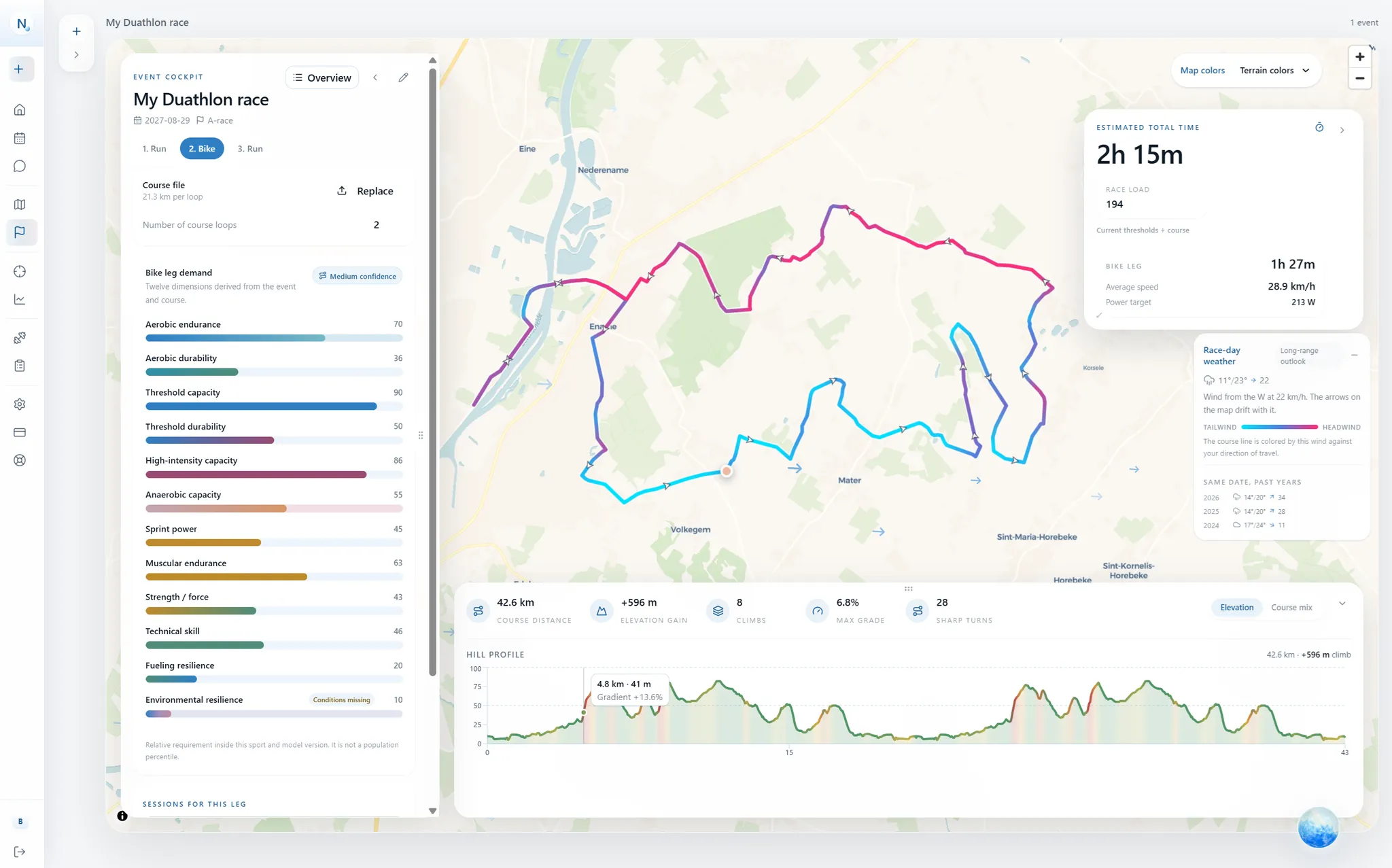
Nymiva scores each leg across twelve demand dimensions, and those three courses produce three visibly different fingerprints. How the route becomes that score, including gradient distribution, elevation per unit of distance, technicality and race-day wind drawn onto the course line, is covered in what the event analyzer reads from your course.
Climb lengths become interval durations
This is the part most plans skip. When a route is uploaded, it is walked as geometry and cut into ordered climbs, descents and flats, each carrying its own length, elevation change and average gradient. Climb length survives as a duration, because a four minute climb and a twenty minute climb sit in different physiological territory even when the total elevation gain matches.
That number is not decoration. Late in the season, when the work becomes event-specific, the sessions are shaped around the efforts your course actually contains. A course with four climbs of roughly twenty minutes eventually earns sustained efforts of that length, repeated, with the final one placed after enough accumulated work that it feels like the fourth. A course whose longest climb is four minutes earns something else entirely, because four minutes at a climbing effort is not a shortened twenty, it is a different energy system with a different progression.
The rest of the week does not disappear into that focus. The dominant gap sets a block's emphasis, not the content of every session. Aerobic development, recovery, technique and the maintenance of abilities you already have are protected, because a season that trains only the weakness arrives at the start line narrower than it left.
What your own riding already says
The demand side is the course. The supply side is you, measured from efforts you actually made.
The power curve is the honest description of what you can hold for any duration, built from your best output across every duration in your history rather than from a single test day. Beyond about an hour the curve is read as normalised power, because average power understates what a long variable ride demanded of you.
Thresholds are estimated from real efforts and updated as new evidence arrives, not typed in once during setup and left to drift for a season. When the evidence is thin or old, that is stated rather than hidden behind a confident number.
Repeatability is treated as a separate question from peak ability. A single strong effort tells you what you can produce fresh. Whether the fourth one resembles the first is what a mountain course actually asks.
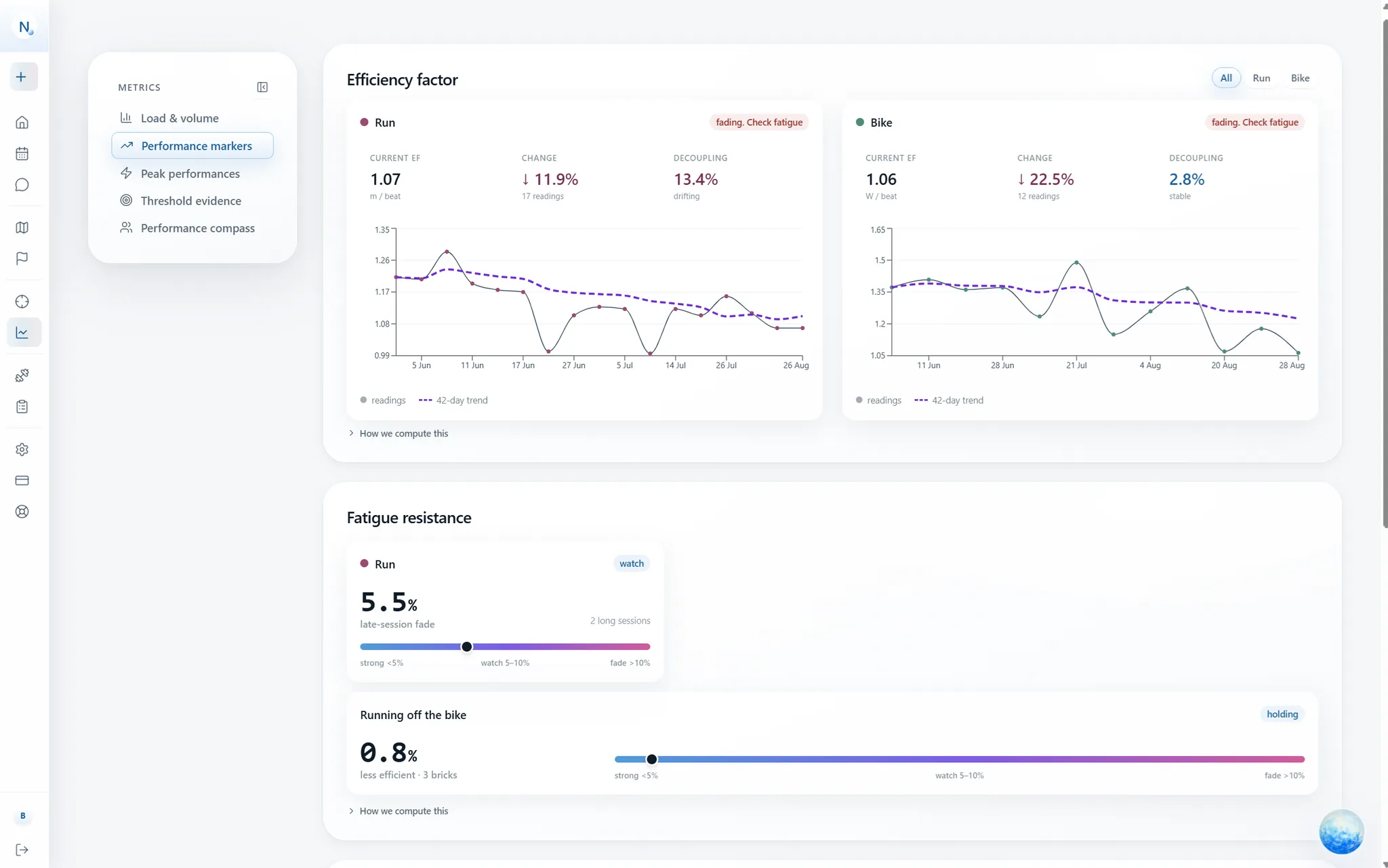
Durability is measured two ways. Efficiency across long steady rides is compared between the first quarter and the final quarter, and read against stated bands where a fade up to about five percent counts as durable and more than ten percent counts as aerobic stress. On the bike there is also a work-gated read, comparing your best five and twenty minute power when fresh against the same durations after roughly two thousand kilojoules of accumulated work. If neither side of that comparison exists in your history, the panel says so instead of inventing one.
Power meters are optional, and the plan says why
Everything works without one. The load model is metric-agnostic, so a plan is built, progressed and adapted whether your rides carry watts or not. What degrades is diagnosis, not planning, and the two are kept separate on purpose. Features that genuinely require power, such as the work-gated durability probe, appear as absent with a stated reason rather than approximated into something that looks like data.
Heart rate and perceived effort are first-class inputs, not consolation prizes. Perceived effort is captured twice for a session, once for how the early work felt and once after, because those two answers mean different things and blending them destroys both. The expected effort is never shown next to the input, since seeing the number you are supposed to report is the fastest way to stop reporting anything useful.
One property of heart rate matters more than any other when you read a hard week. Heart rate is suppressed under fatigue. The same wattage that sat at one number when you were fresh can sit several beats lower after a heavy block, which reads as improvement and is often the opposite. That is exactly why no single metric acts as a stoplight here. Verdicts are a synthesis of performance, load, subjective feedback and context, and athletes riding without power get wider safety margins on how fast load climbs, plus more weight on what they report.
The bike absorbs load that running cannot
Cycling is low impact, and that is a planning fact rather than a marketing line. The same aerobic stimulus can be carried on the bike at a tissue cost your legs would refuse from running, which is why a rider can hold volume through a block that would break a runner doing the equivalent.
Transfer is partial, though, and Nymiva models it that way. Riding supports aerobic development and can protect fitness through an injury interruption, but it does not maintain run-specific durability or economy, and pretending otherwise is how athletes arrive aerobically fine and structurally unprepared. For multi-sport athletes, where the bike is one leg among three and the run off the bike is its own demand, how a triathlon season is planned as one season covers the sharing and the protecting in detail.
When you disagree with the plan
The season Nymiva proposes is a starting position, not a verdict. Availability, the events you actually care about, and the abilities you want emphasised are yours to set, and building your own season walks through the controls. Small adjustments can apply on their own, medium ones need you to have opted in, and anything that changes the primary focus, rebuilds a block or restarts you after an interruption waits for your explicit approval.
What the plan owes you in return is verification. Completing a session is not the same as achieving the stimulus it was prescribed for, and a block that ends without a measurable answer about the ability it targeted is a block you cannot learn from. Riding the right intervals for the right course is the first half of the work. Knowing whether they landed is the other half.