Guided swim plans, where technique gates fitness
Swimming is the sport where a threshold number can mis-rank your limiter. How guided swim plans treat technique as a first-class constraint, not a footnote.
Water punishes drag more than it rewards power
A guided swim plan has to start from technique, because swimming is the one endurance sport where the fastest route to a better time is often not to push harder. Resistance in water rises steeply with speed, so the drag you have failed to remove costs you more than the power you have added. This is why an athlete can be genuinely fit, strong on the bike, durable on the run, and still swim slowly.
In brief
- A swim threshold pace is a joint product of fitness and technique. On its own it cannot tell you which of the two is holding you back.
- A technical limiter can gate a physiological one. Training harder at a broken stroke buys progressively less, so a technical finding is allowed to outrank a threshold-based diagnosis rather than be outvoted by it.
- Critical swim speed is the threshold anchor, measured from your own timed efforts rather than assumed, and it sets your swim pace zones.
- The stroke is trained in parts. Catch, pull and recovery have their own drills, their own dose and their own place in a week.
- Open water is a different demand from a pool. No walls, no black line, sighting, and conditions the pool never produces.
- The product cannot see your stroke. It reads pace, distance, stroke rate and stroke length, and how those hold under fatigue. It does not replace eyes on the deck.
Why a swim threshold number can rank the wrong thing
In running and cycling, a threshold pace or power is a fairly direct read of an engine. Mechanics differ between athletes, but the propulsive act is roughly the same shape for everyone, and someone with a bigger aerobic capacity is usually faster. Water does not work that way. Propulsion is a skill applied to a moving, yielding medium, and two athletes with the same aerobic capacity can finish a long way apart purely because one holds water and the other slips through it.
So a swim threshold pace is a compound measurement. It carries fitness and technique together and cannot decompose itself. An accumulated training load figure has the same weakness in a more obvious form, because it rewards time spent in the water rather than what the water gave back.
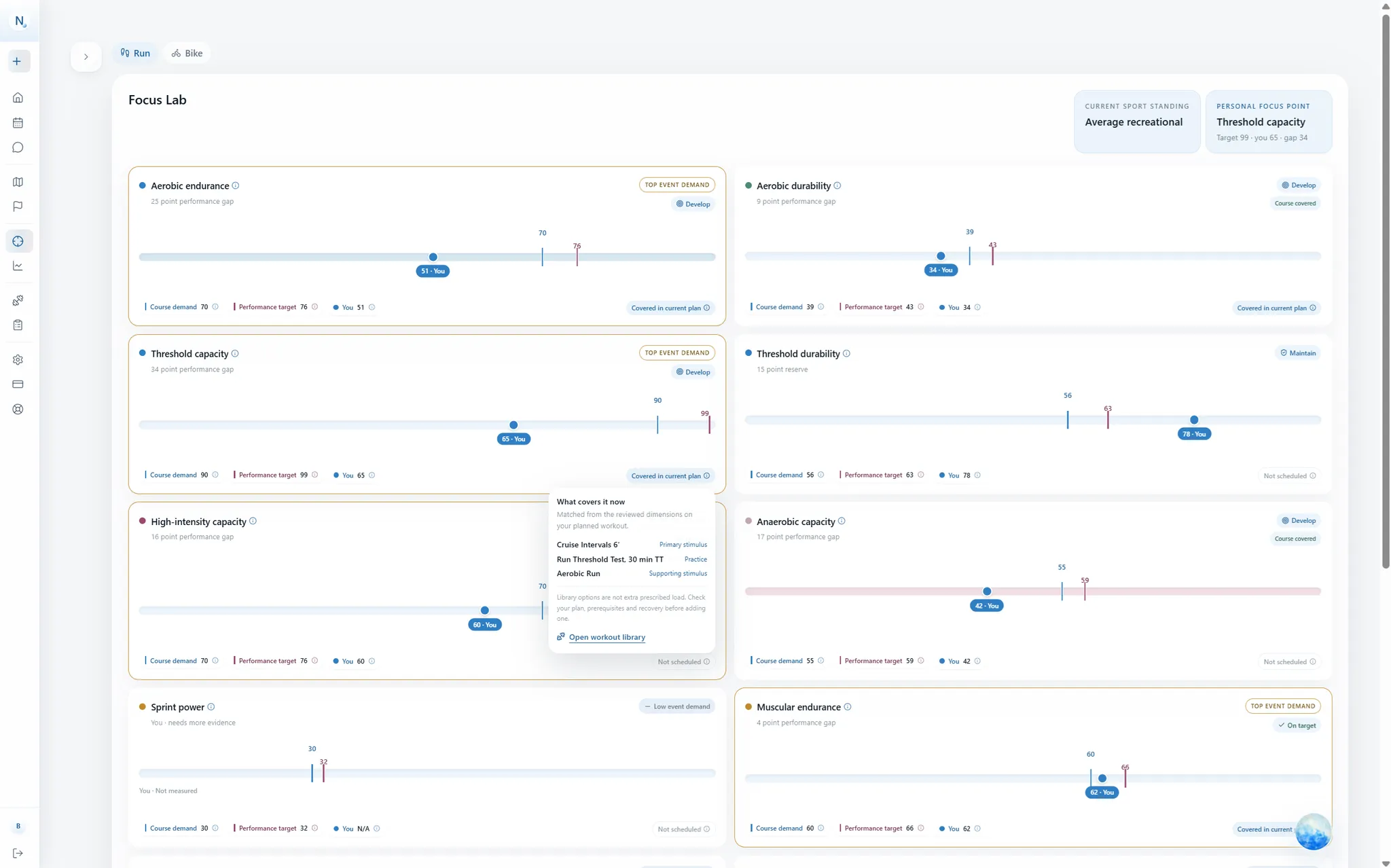
The practical consequence is a ranking error. Choose a limiter on the threshold number alone and the answer is almost always more threshold work performed with the same stroke, which spends a whole block confirming the problem instead of fixing it. In the Focus Lab, technical skill sits on the twelve-dimension list as a first-class limiter for that reason, and the swim technique finding is classified as technical rather than physiological so it can compete with a threshold gap directly.
A technical limiter gates a physiological one
When technique is the constraint, physiological work does not stop paying. It pays less, and the amount it pays keeps falling as the mismatch widens. A stroke that loses water at the front of the catch converts more of every extra watt into turbulence, so the return on a harder set gets smaller precisely as the set gets harder.
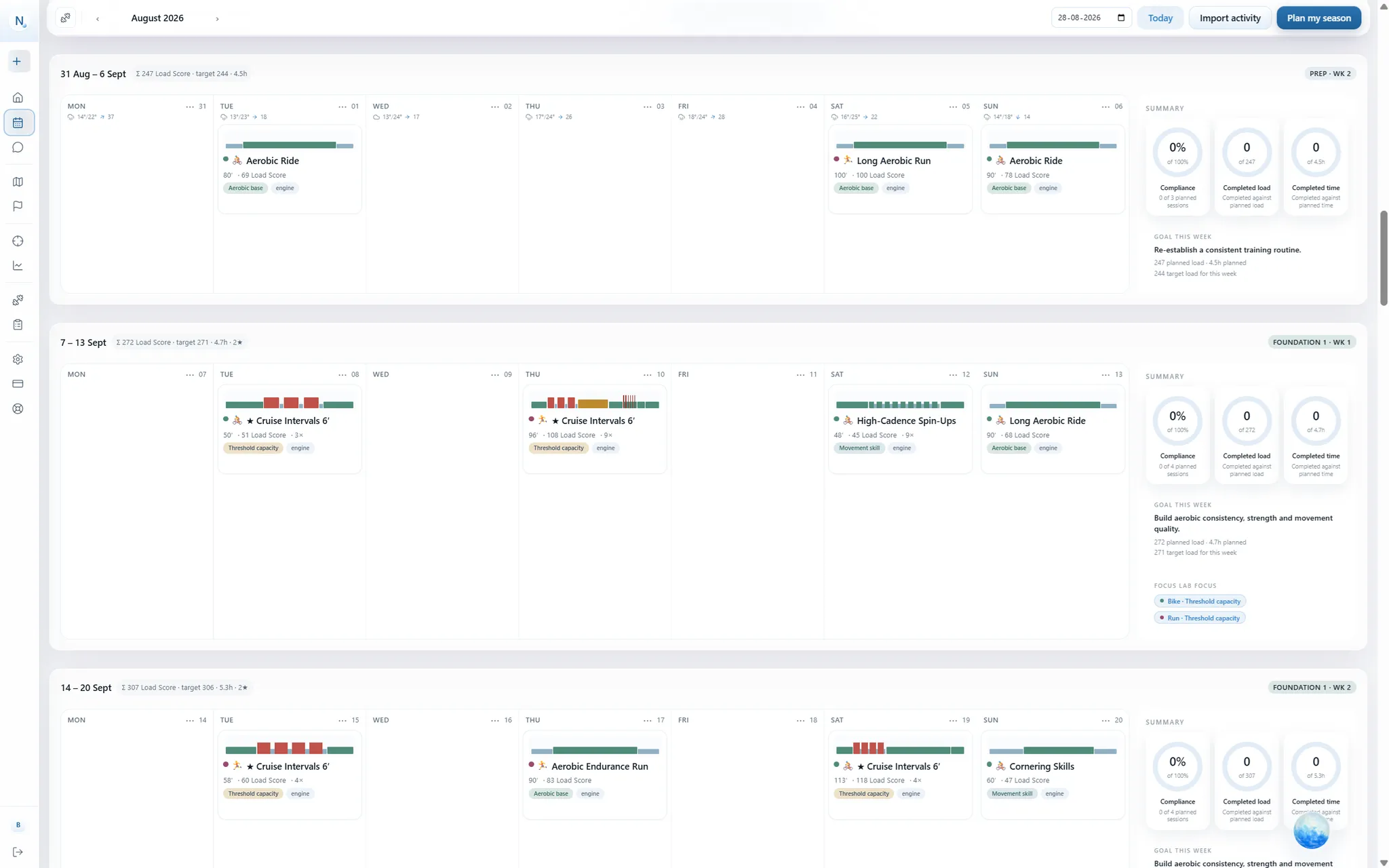
Planning has to reflect that ordering, and a technique-led block is not a soft week. Technical skill work runs mostly in Zones 1 and 2 so form stays clean, plus short fast repeats with full recovery. Limiter-first is never limiter-only, so a block emphasising technique still protects aerobic development, recovery and the abilities you already own.
One honesty note travels with these blocks. Technical skill has no established adaptation model of the kind threshold work has, so a block aimed at it predicts no gain in advance. It is run as deliberate practice and reports what actually happened instead of forecasting what should have.
Critical swim speed, measured rather than assumed
Critical swim speed is the swim threshold anchor, and it comes from your own efforts. The field test is a timed 400 metres and a timed 200 metres, both swum maximally and evenly, with critical swim speed calculated as the distance difference divided by the time difference. That one number sets your swim pace zones, which is what every subsequent set is prescribed against.
The threshold work built on it is a small, deliberate family rather than a catalogue. Broken repeats at critical swim speed accumulate more threshold time than a continuous swim could hold, for example four repeats of 200 metres on twenty seconds rest where a fading split ends the set. Each structure carries a stated purpose, an approved dose range and a stop rule, and your performance surface is where the threshold evidence behind the number is shown.
Two limits belong next to that. Critical swim speed moves when technique improves, so a jump in the number is ambiguous until you know which of the two changed. And the load method used for swimming is graded C in the evidence layer, because applying an intensity-squared stress calculation to swim speed preserves consistency with other sports but has not been validated for swimming specifically. Grade C means usable and uncertain, and the product says so rather than rounding it up.
The stroke trains in parts
Catch, pull and recovery are separately trainable, and the library treats them that way. Sculling held in the catch position trains feel for the water with no backward push at all. A drill mix rotates one-arm freestyle, catch-pause, fingertip drag and others, typically as 25 metres of drill into 25 metres of swimming. Paddle and pull work loads the propulsive phase specifically. Stroke-rate sets step turnover up on a tempo trainer while stroke count is held, which is the direct answer to overgliding.
That session exists because of one relationship: speed is stroke length multiplied by stroke rate. A low stroke count bought by gliding is false economy, so both factors are shown together rather than collapsed into one number. Stroke rate and distance per stroke are computed at ingest from device cadence and speed streams, and the recent trend is read as lengthening, shortening, stable, or not yet enough data to call. A shortening stroke when you are fresh sends you back to catch work rather than on to more tempo.
Open water is a different demand from a pool
An open-water swim asks for things a pool never tests. There are no walls, so there is no push-off and no micro-recovery every twenty-five metres, and pacing has to be genuinely continuous. There is no black line, so alignment is your job and sighting costs speed and rhythm every time you lift your head. Then there are the conditions: chop, wind, current, temperature, a wetsuit that changes your position and your shoulder cost, and other swimmers.
These are modelled as event demand rather than as a note on a workout, with environmental resilience scored as its own dimension and open-water races recognised as their own events. For a multi-leg race the swim is modelled as a leg with its own demand, which is also why wetsuit removal and the first transition get real rehearsal sessions rather than a reminder. That leg-by-leg treatment is covered in more depth in the post on guided triathlon plans.
The honest limit: it cannot see your stroke
No camera is watching you, and nothing here infers body position. What the product reads is pace, distance, stroke rate, distance per stroke, and how each holds as a session goes on. From that it can tell you your stroke is shortening under fatigue, that your threshold pace has stopped responding to threshold work, or that a required dimension has no evidence at all. Findings carry a confidence label, and unmeasured is shown as unmeasured rather than rounded down to a score.
What it cannot tell you is why. It cannot see that your elbow drops at the front of the catch, that you cross the centre line on entry, or that your head lifts before you breathe. Those need a coach on the deck, a filmed session from the side and below, or a squad that will tell you the truth. A plan can prioritise technique, prescribe the drills, protect the time and flag when the data points at technique as the constraint. Someone still has to watch you swim.