Guided run plans, from a flat 10k to an ultra
Age-graded pace ladders, downhill and eccentric durability, and the fatigue resistance the back half of a race asks for. How a guided run plan is built.
Guided means personalised, not downloaded
A guided run plan is not a template you pick off a shelf and start on Monday. It is built around your own training history and the specific race you entered, and it keeps changing as you train. A flat 10k and a mountain ultra do not get the same plan with the mileage turned up. They get different abilities trained, in a different order, because they are different events that happen to share a verb.
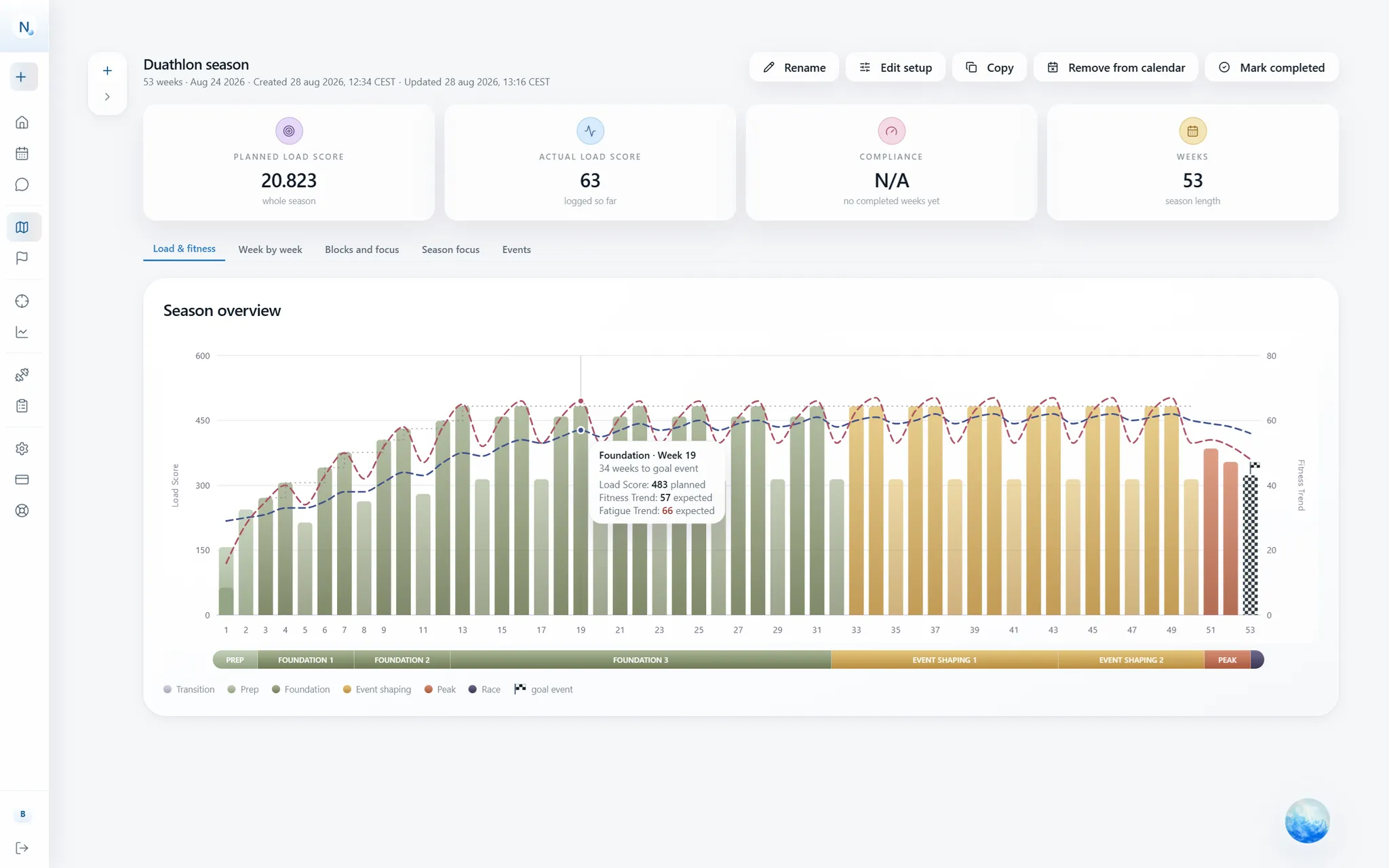
The chain is short enough to hold in your head. Your race becomes a set of measured demands. Your history becomes a measured supply. The gap between the two decides what a block emphasises, and every session you complete is checked against the thing it was prescribed to do.
In brief
- Guided means personalised to your history and your course, then adapted. Nothing here is a general plan handed to everybody.
- A course is scored across twelve demand dimensions, so two races at the same distance can ask for near-opposite abilities.
- Pace targets are age-graded against published road factors, so they mean something relative to you.
- Descent is measured separately from climb, because eccentric loading has its own cost and flat training does not rehearse it.
- Running is the impact discipline. Its weekly ramp is watched on its own and single-session length is ceilinged.
- The focus sets a block's emphasis. Easy aerobic running, recovery and technique stay protected inside it.
The distance is a label, the course is the specification
Upload the route and the course is read as geometry. The distance and altitude series is cut into ordered climbs, descents and flats, each carrying its own length, gradient and elevation change. Climb lengths are kept as durations, because a four-minute climb and a twenty-minute climb sit in different physiological territory. Elevation gain and loss are kept apart rather than summed, because going down costs something that going up does not.
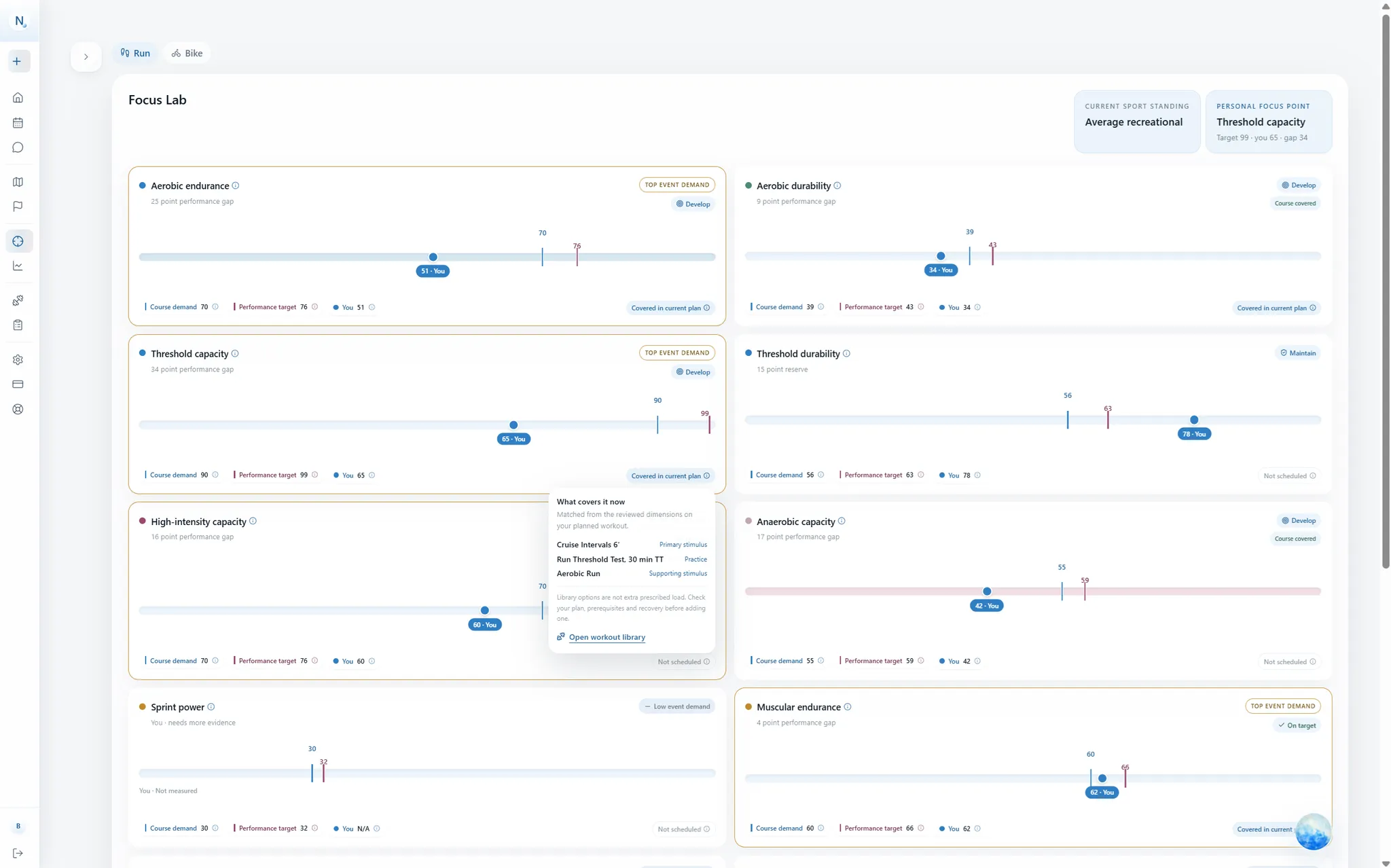
That resolves into one leg scored across twelve demand dimensions: aerobic endurance, aerobic durability, threshold capacity, threshold durability, high-intensity capacity, anaerobic capacity, sprint power, muscular endurance, strength and force, technical skill, fueling resilience and environmental resilience.
Run the two ends of the running spectrum through that and they barely overlap. A flat 10k is threshold capacity and high-intensity capacity, held at one output for a short window, with economy deciding what that output costs you and fueling barely registering. A mountain ultra is muscular endurance, strength and force, technical skill and fueling resilience, with the whole thing gated by whether your legs still work in the final quarter. Two 50 km trail races with identical total climbing can still differ, because elevation per unit of distance separates a rolling course from a mountain one.
This is also why a run inside a multi-sport event is never treated as "a run". A multi-leg event is modelled leg by leg, and the run off the bike carries its own demand, which is what guided triathlon plans are built around.
Age-graded pace, so the target means something
A pace target aimed at an abstract standard tells a 52-year-old very little. Run performances are graded first, using the World Masters Athletics 2015 single-age road factors for 5 km, published separately for men and women across ages 30 to 95. The factor converts a masters performance to its open-class equivalent, which puts every athlete on one honest scale before any ability band or ladder is applied.
Underneath that, the run model is built from your own bests using published equations rather than invented constants. A VO2-equivalent score comes from a best race effort via the Daniels and Gilbert equations. Critical speed and anaerobic distance capacity come from a linear distance-time fit across your two to twenty-five-minute bests, which approximates your measured threshold rather than a guessed one. The Riegel endurance exponent describes how fast your performance decays as distance grows, and a larger exponent is a durability deficit rather than a speed problem.
When the data cannot honestly support a model, it returns nothing instead of a number. Too few points, no spread in duration, or a non-physiological result all produce an absence, and the absence is shown as one.
Downhill, and the damage flat training never rehearses
Descending is the part of a hilly race that people arrive unprepared for, because it does not feel like training when it is going well. Eccentric loading, where the muscle lengthens under tension, is what shreds quadriceps in the second half of a mountain race, and no volume of flat running produces it. Total descent is therefore carried as its own figure in the demand model, and course technicality is estimated from gradient variability and turn density rather than assumed.
The same physiology runs the other way in session design. Short hill repeats are prescribed uphill precisely because the incline caps eccentric damage at a given intensity, which lets an anaerobic dose land without a week of soreness attached. Longer climb repeats at controlled effort build running-specific strength endurance, which is a different thing from short maximal force work and is scheduled as such.
The honest limit is that descent work is bounded by what a vetted or course-compiled structure can actually specify. Where your course contains a repeated, material motif, that motif can be compiled into a session and then dose-bounded by your history and phase. Where it does not, the plan says so rather than inventing one.
Fatigue resistance, not fresh-legs speed
Most races are lost in the back half, and the back half is a separate ability from the front. Aerobic decoupling measures it directly. Output per heartbeat is compared between the first and second half of a session, and a small drift signals durability that is genuinely holding. A rising drift at the same effort means aerobic economy is decaying under fatigue, which no fresh-legs interval will reveal.
The sessions that build it look like it. A long run finishing with a sustained block at goal-race effort is the canonical durability stimulus, because the same pace costs more late. A continuous run that steps up to threshold only in its final third asks you to hold quality once fatigue has already arrived. These are not long runs with a sprint bolted on. The point is the position of the effort inside the fatigue, not the effort itself.
Running is high impact, so the limits bind harder
Progression limits and recovery spacing matter more in running than in cycling for a mechanical reason. Every stride is a landing. Run is therefore treated as the impact discipline and its projected weekly rise in fitness is monitored on its own, against a conservative default cap that is never looser than your systemic one. When a week would breach it, the response is not to delete your session. Extra work is steered toward a non-impact sport, and the weekly load target stays binding.
Single-session length carries explicit ceilings too. For short-course events the continuous aerobic body of any one run is capped by demonstrated 5K ability, at ninety, seventy-five or sixty minutes depending on which band you sit in, with the most conservative ceiling applied when there is no 5K evidence at all. Ultra long runs progress in graduated percentage steps toward tier ceilings of roughly four, six and eight hours as the event distance grows. Where those ceilings mean a week cannot absorb its full load target, the shortfall is under-delivered honestly rather than concentrated into one heroic Sunday.
The focus sets the emphasis, never the whole block
The ability the Focus Lab names as your biggest event-relevant gap decides what a block emphasises. It does not become the content of every session in it. A muscular endurance block still protects easy aerobic running, still schedules recovery runs as recovery rather than as slow training, and still keeps technique work in the week, because economy is trained by hill sprints, strides and short pickups inside otherwise easy runs, not by a dedicated ability slot.
Abilities that are already on target are held at a maintenance dose rather than dropped, and the plan says which ones it is deliberately letting decay. Where you cannot yet execute the real work of a dimension, the answer is the smallest real dose of the real thing, climbed as fast as the guardrails allow. Months of an easier zone credited as the harder one is not a plan, it is a delay.
None of this is fixed in place. Low-impact adjustments can apply themselves, changing the primary focus or rebuilding a block always comes to you for approval, and anything that looks like pain, illness or injury is escalated rather than diagnosed. If you would rather move the blocks yourself, building the season by hand keeps every one of these checks running underneath you.