IRONMAN 70.3 · Vilamoura · 3 Apr 2027
How to train for IRONMAN 70.3 Vilamoura-Algarve
Nobody has raced this one yet. The first edition is in April 2027, and what people know about it comes from the organiser's page: a season opener on the Algarve coast, a swim beside a marina, a run it calls fast and flat. From that, most entrants picture a beach race in spring sun. Half of the picture is right. The run is flat. The ride is not.
The course file for the 90 km loop carries 1038 m of climbing, spread over seventy kilometres of countryside rather than piled into one mountain. A Trained athlete spends 54 percent of a 6:09:39 day on that bike. How they ride fifteen climbs decides how they run the coast.
By Kian Briel, founder. Analysed by engine 1, updated
What is actually on the road
The organiser's own course files, drawn the way the Event Analyzer draws a member's race.
- Swim1.9 km0 m upCourse file
- Bike90 km1,038 m upCourse file
- Run21.2 km in 2 laps32 m upCourse file
You start from Vilamoura Marina Beach for one loop of 1.9 km in ocean water, sheltered by the pier of the Vilamoura Marina. The organiser gives the April water as between 16 and 18 degrees Celsius. Transition sits in a big parking lot near the swim exit. The organiser warns it is a long one, and you can only mount at its exit, where the carpet ends.
The bike is a single loop into the Algarve and back. Its first 9.6 km are flat. Then the profile starts to saw: fifteen climbs, nineteen descents, and no flat stretch longer than 4.7 km until the last 9.7 km, which fall gently back to transition. The high point comes at kilometre 57, 274 m above where you started. The steepest sustained climb is 1.4 km at 7.7 percent from kilometre 30.6. The sharpest descent is 433 m at 9.5 percent after kilometre 62.
The run covers the coastline of Vilamoura and Quarteira in 2 laps, with two turnaround points. The file measures 21.2 km with 32 m of climbing, and it reads as one flat segment from the first step to the finish.
Look at where the bike's time goes. The engine cuts the leg into seventy-three segments, and the largest of them, the flat opening, holds 9.8 percent of it. The steepest climb holds 5 percent. No single stretch of road owns this ride.
Course shape by distance
- Flat 75%
- Climbing 12%
- Descending 13%
The longest stretches
- Bike, flat9.55 km10% of the bike
- Bike, climbing1.37 km5% of the bike
- Run, flat21.2 km100% of the run
Each row is one unbroken stretch of the course that keeps the same shape the whole way. The number is how much of that leg you spend inside it, and it comes out the same whether you are fast or slow.
What this course asks of each leg
Twelve training dimensions scored for each leg against its own course, the way the Event Analyzer scores a member's race.
On every leg the two leaders are aerobic endurance and muscular endurance. On the bike they score 85 and 83, and because the bike is more than half the day, the seven biggest demands on the whole course are bike demands. That much is true of any half-distance triathlon. Vilamoura shows itself further down the bike's list.
High-intensity capacity reads 58 there, against 40 on the run and the swim. Strength and force reads 50. Technical skill reads 46. All three trace back to one feature of the profile: a climb of a few minutes, a descent of a minute or two, then another climb, repeated from kilometre 10 to kilometre 80. It is a leg built from short questions.
Put the reference bands beside it. A Trained athlete swims 38:14, rides 3:21:23 at 182 W and runs 2:00:02, a day of 6:09:39. The Competitive band rides 2:50:57 from 4.15 W/kg at 75 kg and runs 1:41:59, for 5:16:00. That band is not a better climber. It holds a higher steady number on every kind of road, the climbs included, and still has a run left afterwards.
Heat is not the issue on this coast. The organiser's historical weather shows highs of 23 C, 18 C and 18 C across three years, with lows of 12 C to 14 C, and environmental resilience scores 10 on every leg. The water, at 16 to 18 degrees, is the cold part of the day.
- Aerobic endurance85
- Muscular endurance80
- Threshold capacity70
- Technical skill66
- Aerobic durability65
- Threshold durability65
- Fueling resilience55
- High-intensity capacity40
- Anaerobic capacity25
- Strength / force20
- Environmental resilience10
- Sprint power5
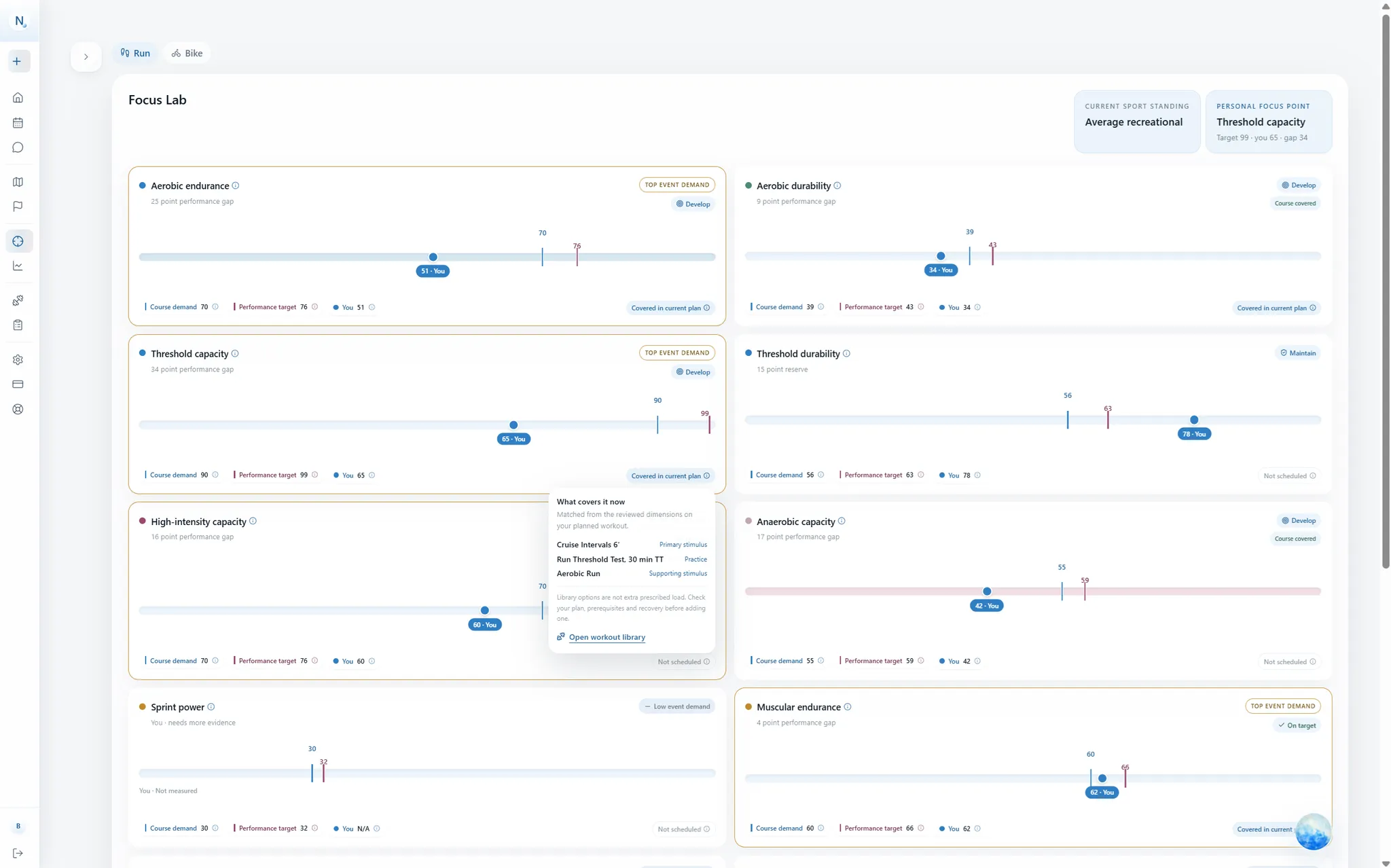
Nymiva reads what you can already show, from your own data
Connect your training history and the Focus Lab scores the same twelve dimensions this course demands against where you sit today. The gap between the two is what you train.
- MeasuredFrom your thresholds and testsThreshold power, threshold pace, critical swim speed and field tests you have done. The dimensions they can carry are scored directly.
- EstimatedFrom your training historyConnected activities are read for what they prove: long efforts, late-session fade, repeated hard work, fueling on long days. Each score says how it was read.
- ProxyFrom a stand-in, and named as oneWhere only an indirect signal exists, the score carries the proxy it came from and a lower confidence, never a number dressed as a measurement.
- UnmeasuredHonestly blankA dimension nothing in your data can answer stays unmeasured. It is never a zero, and the plan does not pretend to know it.
Every dimension ends in one word
- Develop the course asks more than you can show
- Maintain close enough to hold at the minimum dose
- Covered nothing to build here
- Unmeasured the course needs it, your data cannot say yet
Nymiva reads twelve dimensions from both directions. The course side comes from the organiser's files. The athlete side comes from thresholds and connected training history, and every score carries a note on its source and how far to trust it. Only where the course asks for more than the athlete shows is there a gap, and each gap is weighted by how much of the day it fills. With the bike above half of a Trained day and the swim near a tenth, two gaps of equal size on those legs are not worth the same.
There is no reader behind this page, so the season below cannot see anyone's gaps. It takes the plainest assumption, that they fall where the course asks most, and spreads 24 weeks over 5 developmental blocks and a two-week taper. Aerobic endurance opens in all three sports. The second block gives the bike to threshold durability, the run to aerobic durability and the swim to technical skill. Threshold capacity takes the third, muscular endurance the fourth, and aerobic endurance leads again before the taper. For a race on the third of April, that runway starts in autumn and runs through the winter. A member's own season is built from their numbers, and it will not look like this one.
Train the bike to protect the run
Which demands matter most across the whole race. A leg's demand counts for as much of the day as that leg takes, so a score of 85 on the bike outweighs the same score on the swim.
- 01Aerobic enduranceBike leg, 54% of the day85 × 54%46
- 02Muscular enduranceBike leg, 54% of the day83 × 54%45
- 03Threshold capacityBike leg, 54% of the day70 × 54%38
The bike takes 54% of the Trained reference band’s day, so its demands carry the most race weight. What the bike leaves in the legs is what the run gets.
Which demand gets a block, and when
The engine freezes one lead focus per sport on every developmental block, holds the rest at maintenance, and verifies before it reprioritises.
An illustration, not your plan. This page has none of your data, so the season below is the engine’s answer to one stated assumption: that your gaps line up with what IRONMAN 70.3 Vilamoura-Algarve demands. Your own season is built from your history, your thresholds, the days you can train and the races you have entered, and it will differ from this in its priorities, its sessions and its load.
- 01Run muscular endurance, a practice block4 weeks
- 02Run aerobic endurance, a development block4 weeks
- 03Bike muscular endurance, a practice block4 weeks
- 04Bike aerobic endurance, a development block4 weeks
In the order the allocator places them, general first, most race-like last.
- Week 1PrepPrep
A lead-in week. It develops nothing by design.
- Weeks 2 to 5Foundation 1Closes with a recovery week
- PriorityBike aerobic endurance
- PriorityRun aerobic endurance
- PrioritySwim aerobic endurance
- SupportBike muscular endurance
- SupportRun muscular endurance
- SupportSwim muscular endurance
- SupportBike threshold capacity
- SupportBike threshold durability
- SupportRun threshold capacity
- SupportSwim threshold capacity
- SupportRun aerobic durability
- SupportSwim technical skill
- Weeks 6 to 9Foundation 2Closes with a recovery week
- PriorityBike threshold durability
- PriorityRun aerobic durability
- PrioritySwim technical skill
- SupportBike aerobic endurance
- SupportRun aerobic endurance
- SupportSwim aerobic endurance
- SupportBike muscular endurance
- SupportRun muscular endurance
- SupportSwim muscular endurance
- SupportBike threshold capacity
- SupportRun threshold capacity
- SupportSwim threshold capacity
- Weeks 10 to 13Foundation 3Closes with a recovery week
- PriorityBike threshold capacity
- PriorityRun threshold capacity
- PrioritySwim threshold capacity
- SupportBike aerobic endurance
- SupportRun aerobic endurance
- SupportSwim aerobic endurance
- SupportBike muscular endurance
- SupportRun muscular endurance
- SupportSwim muscular endurance
- SupportBike threshold durability
- SupportRun aerobic durability
- SupportSwim technical skill
- Weeks 14 to 17Event shaping 1Closes with a recovery week
- PriorityBike muscular endurance
- PriorityRun muscular endurance
- PrioritySwim muscular endurance
- SupportBike aerobic endurance
- SupportRun aerobic endurance
- SupportSwim aerobic endurance
- SupportBike threshold capacity
- SupportBike threshold durability
- SupportRun threshold capacity
- SupportSwim threshold capacity
- SupportRun aerobic durability
- SupportSwim technical skill
- Weeks 18 to 21Event shaping 2Closes with a recovery week
- PriorityBike aerobic endurance
- PriorityRun aerobic endurance
- PrioritySwim aerobic endurance
- SupportBike muscular endurance
- SupportRun muscular endurance
- SupportSwim muscular endurance
- SupportBike threshold capacity
- SupportBike threshold durability
- SupportRun threshold capacity
- SupportSwim threshold capacity
- SupportRun aerobic durability
- SupportSwim technical skill
- Weeks 22 to 23PeakPeak
The taper. Load comes down toward the race, content stays specific.
- Week 24RaceRace
Race week.
Held at maintenance between blocks
- Runmuscular endurance, aerobic endurance, aerobic durability, threshold capacity, threshold durability
- Bikemuscular endurance, aerobic endurance, aerobic durability, threshold capacity, threshold durability
- Swimaerobic endurance, aerobic durability, threshold capacity, threshold durability, muscular endurance, technical skill
Touches scheduled by each capability’s own decay, at a fraction of its development dose, so earlier work is still there on race day.
The sessions the blocks are built from
One entry per kind of work the block trains, at the intensity that work is meant to be done at. Where the same work runs at several lengths, the entry shows the span it grows across rather than one entry per length.
- Foundation 1 · Weeks 2 to 575 to 240 min
150 to 210 min at Zone 2
BikePower, Zone 2Trains aerobic capacity - Foundation 1 · Weeks 2 to 540 to 270 min
180 to 210 min at Zone 3, then 30 min at Zone 4
BikePower, Zone 3Trains aerobic capacity - Foundation 1 · Weeks 2 to 535 to 120 min
90 min at Zone 2
RunPace, Zone 2Trains aerobic capacity - Foundation 1 · Weeks 2 to 550 min
4 x 1.5 min at Zone 3, 6 min easy between
RunHeart rate, Zone 3Trains aerobic capacity - Foundation 1 · Weeks 2 to 545 to 51 min
4 x 8 min at Zone 2, 1 min easy between
SwimPace, Zone 2Trains aerobic capacity - Foundation 1 · Weeks 2 to 547 to 81 min
3 x 1000 m at Zone 3, 0.3 min easy between
SwimPace, Zone 3Trains aerobic capacity
12× rolling-course surges
2.3 min at Zone 5, then 2.3 min at Zone 5, then 2.3 min at Zone 5, then 2.3 min at Zone 5, then 2.3 min at Zone 5, then 2.3 min at Zone 5, then 2.3 min at Zone 5, then 2.3 min at Zone 5, then 2.3 min at Zone 5, then 2.3 min at Zone 5, then 2.3 min at Zone 5, then 2.3 min at Zone 5, 5.3 min easy between
Compiled by the deterministic course compiler from the organiser’s file: the course’s one repeatable requirement, rehearsed at a dose the progression allows.
- Bike
- 110 min
- Trains threshold durability
- Supports muscular endurance
- Supports high intensity capacity
24 weeks, laid out backwards from race day
The shortest runway Nymiva builds for this event type, with its blocks, recovery weeks, taper and race week in place.
- 1
- 2
- 3
- 4
- 5
- 6
- 7
- 8
- 9
- 10
- 11
- 12
- 13
- 14
- 15
- 16
- 17
- 18
- 19
- 20
- 21
- 22
- 23
- 24
- Prep
- Foundation
- Event shaping
- Peak
- Race
- Recovery week
Your own season carries these same phases on your own dates, with the load solved from your fitness and the days you can train, and it changes when your data does.
What each level does on the day
Reference finish times per peer band, the pacing plan the model holds each band to, and where the day is decided.
| Band | Swim | Bike | Run | Finish |
|---|---|---|---|---|
| Recreational2:11 /100m critical swim speed · 2.47 W/kg at 75 kg · 6:08 /km threshold pace | 0:45:07 | 3:45:53 | 2:24:21 | 7:05:21 |
| Trained1:51 /100m critical swim speed · 3.03 W/kg at 75 kg · 5:06 /km threshold pace | 0:38:14 | 3:21:23 | 2:00:02 | 6:09:39 |
| Competitive1:36 /100m critical swim speed · 4.15 W/kg at 75 kg · 4:20 /km threshold pace | 0:33:04 | 2:50:57 | 1:41:59 | 5:16:00 |
| Elite1:26 /100m critical swim speed · 5.27 W/kg at 75 kg · 3:50 /km threshold pace | 0:29:37 | 2:36:08 | 1:30:13 | 4:45:58 |
Pacing plan
- 0 km0.5%28.4 km/h20:12
- 9.55 km4%15.1 km/h2:00
- 10.1 km1.6%23.3 km/h6:06
- 12.4 km6%11.2 km/h6:25
- 13.6 km-0.7%34.3 km/h0:48
- 14.1 km-4.7%52.9 km/h0:38
- 14.6 km-1.1%36.3 km/h2:21
- 16.1 km-3.3%46.7 km/h1:22
65 more segments in the full plan.
- Run: reach 4:20 /km and this course gives back 53:39.
Where it is decided
Not on any one climb. Across seventy kilometres of the bike, all of them together.
Everyone will talk about the 7.7 percent ramp at kilometre 30.6 afterwards. It is 5 percent of the leg. The other fourteen climbs hold the rest of the uphill, and between them the road drops fast enough to hand back whatever the last one cost. Ask the engine to turn this file into a session and it returns twelve hard efforts of two and a quarter minutes in Zone 5, each followed by more than five minutes of easy spinning. That is the leg in miniature. Twelve times, the road offers a reason to go harder.
The right reply is dull. A Trained rider holds 182 W on the flat opening, and the same 182 W on each climb. Past the high point at kilometre 57 the work is not over: the 9.5 percent descent, then three more climbs of 5 percent or steeper before kilometre 77. Then the last 9.7 km fall gently to transition. They are the easiest kilometres of the day, and they send you onto the run feeling fresher than you are.
The run then settles the account. Two laps, 2:00:02 for a Trained athlete from an input of 5:06 /km threshold pace, the same two turnarounds twice. A rider who answered every climb with a surge finds the second lap long. One who held the number finds it is where the passing happens.
Getting it wrong
Training for the steep one. The 7.7 percent climb is what people will warn you about, so riders spend the winter on long steep hills. Strength and force scores 50 here, well behind aerobic endurance at 85. The course wants fifteen moderate climbs ridden the same way, not one ridden heroically.
Giving time away downhill. Nineteen descents, the sharpest at 9.5 percent, one of them nearly 2 km at 6.4 percent. A rider who brakes through every one spends the next climb chasing the wheel they lost, which is a surge by another name.
Believing the run's promise too early. The organiser calls it fast, flat and made for personal bests, and it is flat. But a best set off 1038 m of climbing is not the best a flat bike would allow. Start the first lap at the pace the bike has left you, not the one the coastline suggests.
Conditions on the day
- 2026high 23 C, low 14 C
- 2025high 18 C, low 12 C
- 2024high 18 C, low 14 C
From the organiser’s own records. Not a forecast.
Every session is a claim, every block is a test
A plan is not a calendar. Each key session states what it trains and how that is checked, and each block ends with a public verdict before the next one is chosen.
What a block promises
Bike aerobic endurance moves from your baseline to a stated target by the end of Foundation 1
- The baseline is your measured score when the block starts. The target is the score the model predicts for it.
- Verified at the block’s recovery week, by a field test or a refresh of the supply read from your history.
- Confidence rises by agreement between independent signals, never by one metric crossing a line.
- A block that misses its target is a public miss. The next block is chosen from what was proven, not from what was planned.
- 01Stimulus achievedThe work landed in the zone the session named, for the dose it named.
- 02Partially achievedSome of the work landed. The session banks what it can prove.
- 03Not achievedThe load may have been there. The stimulus was not, so nothing is banked.
- 04Data insufficientNo usable stream. The session is neither credited nor blamed.
- Session verified
- Progression banked
- Block verified
- Priority reassessed
- Plan adapted
Your numbers, this course
Analyze IRONMAN 70.3 Vilamoura-Algarve against my fitness
The same simulation and the same Focus Lab read, on your thresholds instead of a band’s. Three numbers give a finish estimate and a partial read. A connected history gives the whole table.
The first 14 days are free.
- Trained band finish
- 6:09:39
- Of the day on the bike
- 54%
- Dimensions scored per leg
- 12
- Season runway shown
- 24 wk
Questions people ask
- How hilly is the IRONMAN 70.3 Vilamoura-Algarve bike course?
- The organiser lists the bike as hilly, and its course file measures 1038 m of climbing on one 90 km loop. The first 9.6 km are flat. After that come fifteen climbs, a high point 274 m above the start at kilometre 57, and a steepest sustained climb of 1.4 km at 7.7 percent.
- How cold is the water for the swim at Vilamoura Marina Beach?
- The organiser puts the water between 16 and 18 degrees Celsius in April. The swim is one loop in the ocean, sheltered by the pier of the Vilamoura Marina. The wetsuit rule is not on the organiser's course page, so check it in race week.
- Is the IRONMAN 70.3 Vilamoura-Algarve run course flat?
- Yes. It is two laps along the coastline of Vilamoura and Quarteira with two turnaround points, and the course file measures 32 m of climbing over 21.2 km. The engine reads it as one flat segment from start to finish.
- When is the race, and how long is the season on this page?
- The first edition is on 3 April 2027. The illustrative season runs 24 weeks, with five developmental blocks and a two-week taper, which puts most of the preparation in the winter.
Course data from the organiser’s published files, analysed 24 Sept 2026 by engine 1, demand model 4. Reference times are simulated for a peer band at a stated reference athlete and are not a prediction for anyone. Nothing on this page is medical advice.
IRONMAN® and IRONMAN 70.3® are registered trademarks, and 5150 is a trademark, of World Triathlon Corporation. Nymiva is an independent training platform and is not affiliated with, sponsored by or endorsed by World Triathlon Corporation. Course data is read from the organiser’s public course pages for the purpose of describing the event.