

Expected race times
The bike is about half of every level’s day
- Recreational
- Trained
- Competitive
- Elite
A Trained athlete finishes in about six hours
For a typical athlete at each level, not a prediction for you.
| Level | Swim | Bike | Run | Finish |
|---|---|---|---|---|
| Recreational | 0 h 45 | 3 h 19 | 2 h 25 | 6 h 40 |
| Trained | 0 h 38 | 3 h 03 | 2 h 01 | 5 h 52 |
| Competitive | 0 h 33 | 2 h 42 | 1 h 43 | 5 h 07 |
| Elite | 0 h 30 | 2 h 28 | 1 h 31 | 4 h 38 |
Half the gap between the Recreational and Trained levels opens on the run.
A Recreational athlete is out for about six hours and forty minutes, and an Elite athlete a little over four and a half. The organiser's finish limit is eight and a half hours, so even the Recreational level gets home with close to two hours to spare.
Power and pace
Held steady from start to finish, for a 75 kg rider
| Level | Bike power | Run pace |
|---|---|---|
| Recreational | 148 watts | 6:49 min per km |
| Trained | 182 watts | 5:40 min per km |
| Competitive | 249 watts | 4:49 min per km |
| Elite | 316 watts | 4:16 min per km |
Around 180 watts carries a Trained rider round this loop, and around 150 a Recreational rider. That number has to hold on the climb away from the coast, where the road rises for about six kilometres and it's easy to push too hard.
On the run, a Trained athlete holds about five forty per kilometre and a Recreational athlete just under seven, on legs that have just come down from Kashubia.
The course
The bike is rolling and the run is hilly
Each box is 400 metres high.
- Swimopen water
- Bikerolling
- Runhilly4 laps
You swim a single lap in the Gulf of Gdańsk, from a rolling start on the City Beach to the end of the South Pier.
The bike is one loop inland. You leave the city through Koleczkowo, ride on past Kielno and Szemud, turn back near Nowy Dwór Wejherowski and come home over the first stretch in reverse. The road climbs off the coast between about kilometre ten and sixteen, rolls across high ground for most of the ride, then drops back to the sea for the last part into town.
The run is four laps of about five kilometres. Each lap goes along Świętojańska Street, turns down Piłsudskiego Avenue towards the sea and ends on the Seaside Boulevard. Every lap climbs away from the water and comes back down, which is what makes the run hilly.
What the course asks for
On this course the run asks the most of your legs. You need legs that hold a steady effort for a long time, and the laps test that harder than the bike does. Under it sits the aerobic endurance to keep going for close to six hours. Late in the run you also have to hold a strong effort when you're already tired, every time a lap turns uphill.
Where it is decided
Not on the steepest climb. That's about 200 metres at 7.4 percent near kilometre thirteen, and it takes less than one percent of your bike time.
The time goes on the run. Two flat stretches, one around the end of the first lap and one in the third, each hold about an eighth of your run time. If your legs still hold pace there, that's where you gain time.
Getting it wrong
The first mistake is believing the word flat and riding the opening kilometres through town like a time trial. The climb to Kashubia comes straight after, and you start it already in the red.
The second is treating the drop back to the coast as a rest and reaching the run without the fuel you've practised taking on the bike.
Then there's the first lap. The crowd on the Seaside Boulevard pulls you along, and you pay for it on the climbs of laps three and four.
Weather and water
Race day has been mild and wet in some years, windy in some years
Air and water from the organiser, wind and rain from a weather archive.
| Year | Air °C | Water °C | Wind | Rain |
|---|---|---|---|---|
| 2026 | No record | No record | Light wind | Some rain |
| 2024 | 13 to 23 | 18 | Light wind | Some rain |
| 2023 | 10 to 16 | 18 | Windy | Wet |
In 2023 the sea was too rough to swim, and race day brought more than ten millimetres of rain and gusts above fifty kilometres an hour, according to the weather archive. In 2024 and 2026 there was some rain and lighter wind. Pack for rain. Age groupers start swimming after ten in the morning, so your run falls in the early afternoon.
Under the 2026 athlete guide, wetsuits are allowed up to and including 24.5 degrees and compulsory below 16. At the water temperatures the organiser has recorded here, you can wear one.
Past editions
- 2023A leg was shortenedSource for 2023
- 2025CancelledSource for 2025
Back in 2015 Gdynia hosted the first half-distance race of the Polish series, and in 2021 the first full-distance race in the country.
In 2023 rough sea cancelled the swim, and the day began on the bike. For 2025 the organiser gave the date to a new race in Kraków, and Gdynia had none. The race came back on 19 July 2026 as part of the city's centenary. The organiser hasn't published a 2027 date yet.
Leave 2023 out when you compare times, because nobody swam.
How to train for it
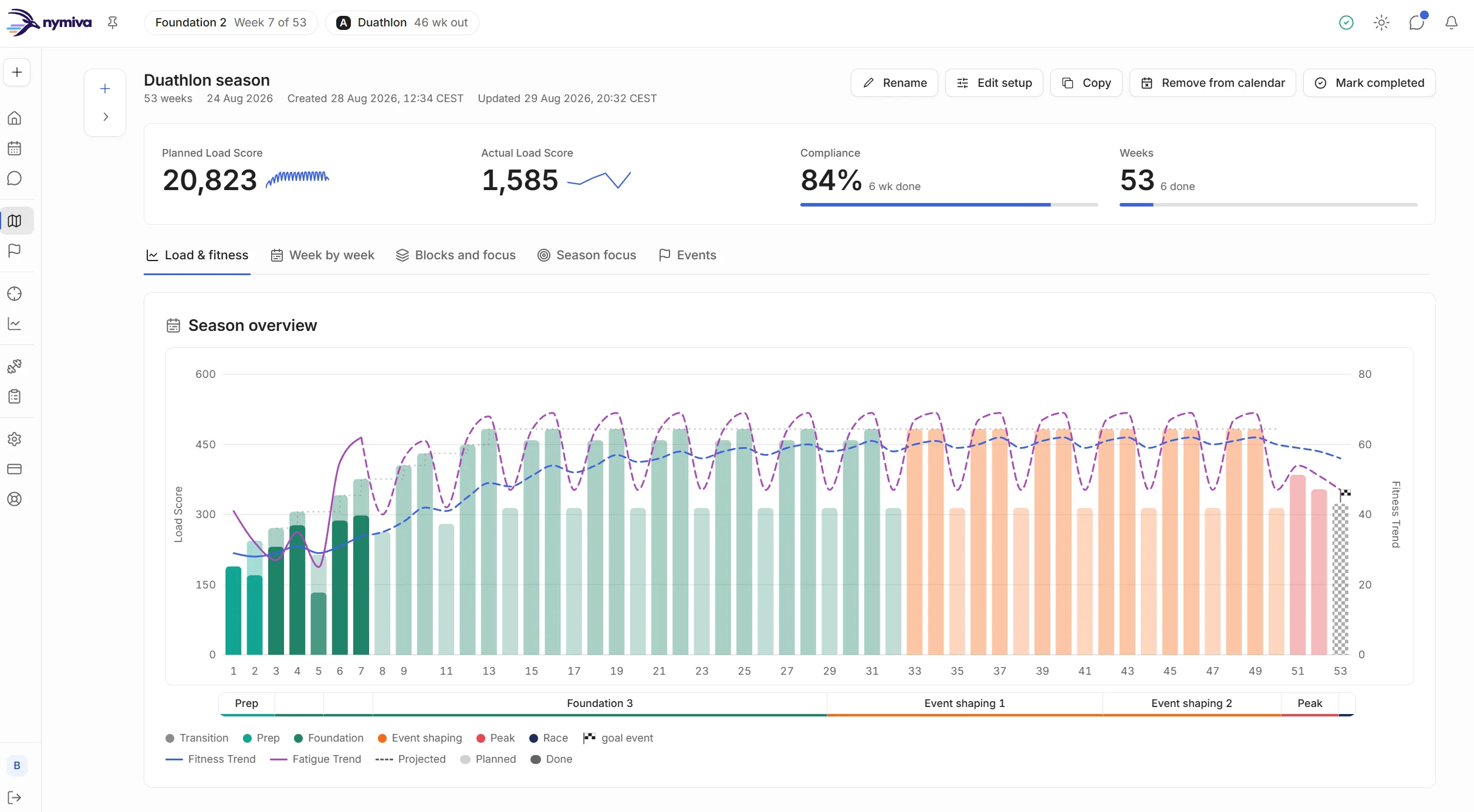
The season is 24 weeks long
Every fourth week is lighter, so your body can absorb the work.
- Week 1
Set the routine. A few easy swims, rides and runs to set up your training week.
- Weeks 2 to 5
Aerobic endurance. Mostly long easy sessions, so your body learns to keep going for hours. One short, controlled harder session on the bike and one on the run each week.
- Weeks 6 to 9
Aerobic endurance. The easy hours stay, and steady, comfortably hard efforts start, mostly on the bike.
- Weeks 10 to 13
Muscular endurance. The long run grows from one hour to an hour and a half, and the bike gets sessions at or near race pace, so your legs hold the pace for longer.
- Weeks 14 to 17
Threshold capacity. Raise the hardest effort you can hold for about an hour.
- Weeks 18 to 21
Threshold durability. Race rehearsal. Long runs of an hour and a half or more, long rides, and a ride at race pace every two weeks, so a strong effort holds when you are tired.
- Weeks 22 to 23
Taper. Training comes down step by step. Short race-pace pieces and a bike-to-run session keep you sharp, so you arrive fresh.
- Week 24
Race week. Short easy sessions with a few touches of race pace, then race day.
This is the season Nymiva lays out before it knows anything about you, and it's the shortest one it builds for a half distance.
Gdynia's bike climbs early and its run climbs on every lap. Put a climb into the first half hour of your long rides and then settle into a steady effort, and take some long runs over short, repeated hills.
Why a personal plan
Nothing on this page knows how you swim in open water or how much time your week has.
Nymiva begins with your own training history. It works out what Gdynia asks for that you can't show yet and trains that first. Each session is checked against what it was meant to train, and your plan changes only when you change it or approve a change. You don't need a power meter for it.
If the plan you have is working, keep it. If you'd rather have a season built from your own numbers for this race, that's the job Nymiva does.
Questions people ask
In Nymiva's simulation of this course a Trained athlete finishes in 5:51:50 and a Recreational athlete in 6:39:56. Those are times for a typical athlete at each level, not a prediction for you.
The organiser recorded 18 C water in 2023 and in 2024. The 2026 athlete guide allows wetsuits up to and including 24.5 C and makes them compulsory below 16 C.
No. It is one loop of 88.1 km from Gdynia into Kashubia with 682 m of climbing. The steepest stretch is about 200 metres at 7.4 percent, near kilometre 13.
The shortest season Nymiva builds for a half distance is 24 weeks. A more ambitious goal makes it longer, never shorter.