Guided duathlon plans, and the second run
Run, bike, run, with the run off the bike treated as its own demand. How multi-leg events are modelled leg by leg so the second run is trained, not hoped for.
The second run is the race
A duathlon is decided on the second run, and the second run is the one leg you cannot rehearse by training the sport it belongs to. Run, bike, run means the closing run happens on legs that have already raced a run and then a bike. So Nymiva models a multi-leg event leg by leg, and the run off the bike carries its own demands, its own sessions and its own place in the season rather than borrowing them from your open running.
In brief
- Duathlon is not a sport in the model. It is an ordered set of legs, each scored on its own terms.
- The closing run is a separate demand from the opening run. It happens on pre-fatigued legs, so it is trained in that state.
- The first run is a pacing problem before it is a fitness problem. Run at open-run pace, it spends what the two legs after it need.
- Transitions are trained inside real sessions instead of being left to race morning.
- Two sports, one body. Hard-day spacing and ramp limits are checked across the week, not once per sport.
- Duathlon has a thinner research base than triathlon or road running. The rules covering it carry lower evidence grades, and the product says so.
A run plan plus a bike plan prepares you for a race that does not exist
The tempting way to train for run, bike, run is to build a good run block, build a good bike block, and let race day assemble them. It produces an athlete who runs well fresh and rides well fresh. A duathlon asks for neither.
Look at what the race does to you. The opening run arrives at the bike with your legs already loaded. The bike is then ridden on a system that did not start from rest, loading the same muscles again in a different pattern for longer. The closing run is the only leg performed on legs that have already done everything else in the race. Three legs, and exactly one of them resembles a session you would have done fresh.
This is where the transfer question gets sharp. Central aerobic fitness, the heart, lungs and blood side, moves freely between endurance sports, and the evidence for that is strong. Peripheral fitness in the working muscle does not. It is sport-specific and has to be trained in that sport, a finding graded with high confidence in Nymiva's cross-sport transfer matrix. Cycling therefore builds much of what your closing run needs and almost none of what your closing run's legs need.
Modelling the event leg by leg
Duathlon and triathlon are not entries in Nymiva's sport registry. Run, bike and swim are, each with its own zone models, field tests, limiter taxonomy and workout ontology. A multi-leg event is a composition of ordered legs on top of those, which is the structural reason each leg can be scored separately.

Upload the course and the event analyzer reads each leg as geometry. Gradient distribution, climb lengths kept as durations rather than distances, elevation per unit of distance, surface, and course technicality. A 40 km bike leg with four four-minute climbs and a flat exposed 40 km produce different demand profiles, and each leg resolves into a score across twelve demand dimensions.
Sequence then does its own work. A leg that arrives third weighs differently from one that opens the day, and stacking disciplines raises threshold durability and fueling resilience above what the same distances ask for standing alone. Your two run legs are not flattened into "15 km of running with a bike in the middle".
The run off the bike gets its own sessions
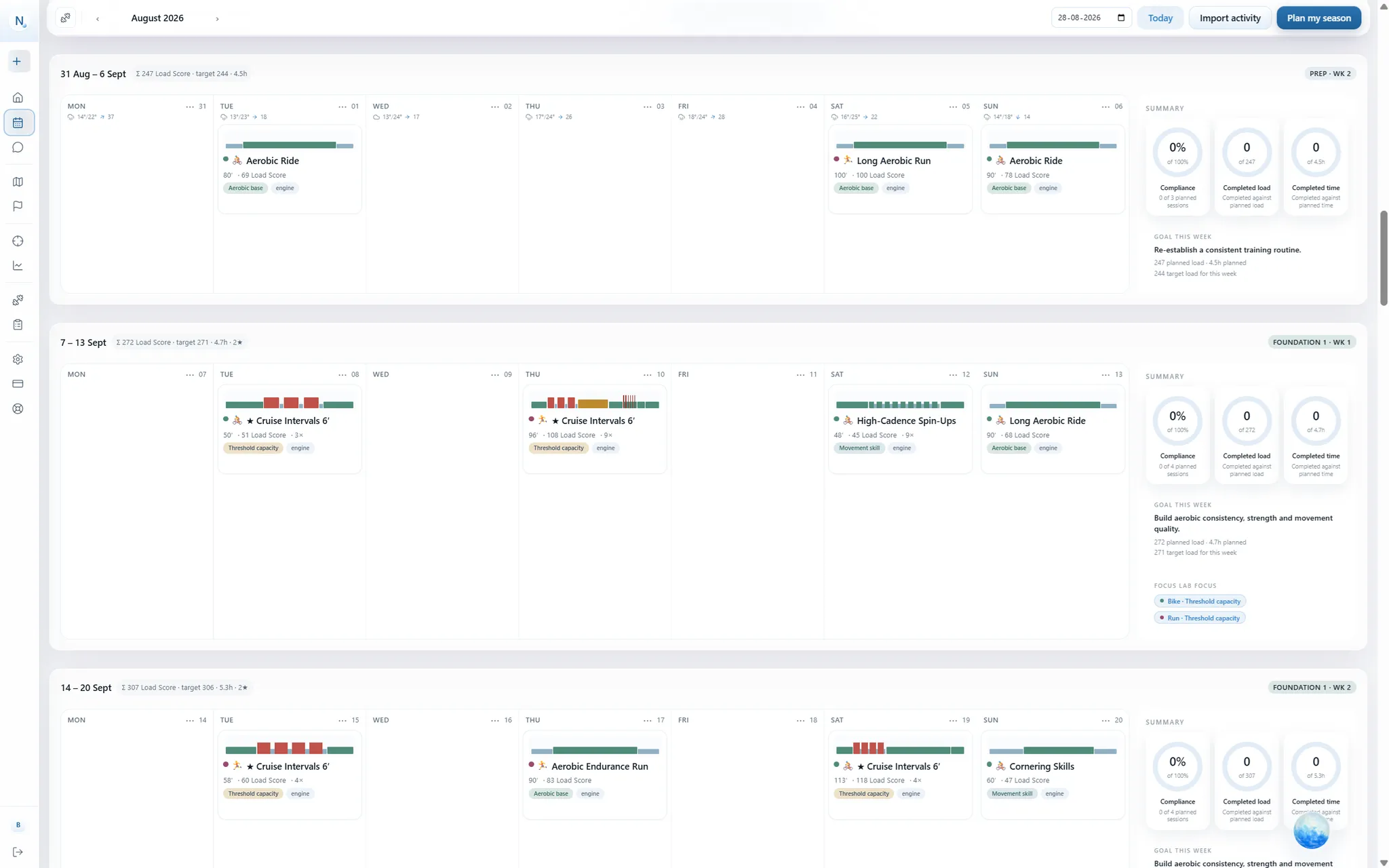
Once the closing run is a named demand, a plan has to train it rather than hope for it. The workout library holds bike-to-run structures as first-class templates. A step in one of them is labelled T2 transition, sitting between the ride and the run off the bike, because the session reproduces the sequence and not merely the total work.
The doses are not arbitrary. Race-rehearsal bricks are sized by race tier, so the bike effort and the bricked run scale to the event you entered, and templates carry race categories that stop a short-course structure being selected during long-course preparation. One library structure is explicitly duathlon-shaped, alternating short hard trainer rides with two to four minute run intervals in repeated rounds, training the leg-change itself rather than one crossing of it.
These sit where the season semantics put them. Phase names are load and focus budgets, not zone caps, and the most event-specific work belongs to late Event shaping. Course-shaped and race-pace structures arrive when they will still be in your legs on race day. A brick also passes an integrity check, so a session counts as one because its structure is one, not because a bike and a run share a day.
Pacing the first run
The opening run is where a duathlon is most often thrown away, and the mechanism is plain. Held at your open-run pace, it is a hard effort taken on credit from two legs you have not ridden or run yet. You arrive in transition faster and leave the bike worse, and the closing run collects the bill.
Treat that as a limiter in its own right. Pacing control and effort regulation are a real limiter class, not a temperament, and they respond to training like any other capability. A first run trained as a controlled effort at a target derived from the whole event is a different session from a 5 km time trial, and it should be prescribed as one. To be clear about the standing of that argument, it is mechanism and coaching practice rather than a measured finding, and it is graded accordingly.
Transitions are a trainable skill
Transitions are technical skill under fatigue, and the model treats technical skill as one of the twelve demand dimensions rather than as race-day admin. That matters more than the seconds suggest, because the leg change happens twice and the second one arrives when you are least able to think.
The useful part is that transitions need no separate training slot. They are rehearsed inside sessions you are already doing, which is what the transition step in the brick templates is for. Practising the change while genuinely fatigued is the version that transfers.
Two sports, one body, one recovery capacity
Duathlon has the same shared-budget problem as triathlon, in a smaller shape. One cardiovascular system, one set of legs, one recovery capacity. A plan that treats run and bike as independent columns will quietly prescribe two sports' worth of hard days.
So the guardrails are cross-sport. Hard-day spacing is checked across the whole week rather than once per sport. Load ramps are checked per discipline, because peripheral load really is sport-specific, while combined systemic exposure is carried as a range rather than a single number, since the literature gives no defensible coefficient for adding two sports' stress together. When the data for that check is missing, the validator abstains and says so instead of passing. The longer version of this argument, with the third sport in it, is in guided triathlon plans, and the run-specific machinery it draws on is in guided run plans.
What the evidence will and will not carry
Duathlon is a smaller field than triathlon or road running, with the published literature to match. More of the guidance here rests on transferable physiology and coaching practice than on duathlon-specific studies, and pretending otherwise would be the quickest way to lose your trust.
The product grades rather than smooths. Every coaching rule carries an evidence grade and stated applicability limits, and the lower grades stay visible instead of being rounded up. There is a concrete example in the race simulator. Its target race intensities for a bike leg inside a swim-bike-run event use published values, because the source table publishes them. For duathlon it falls back to a labelled product heuristic, for the stated reason that the source publishes no recommendation for that format. That is the pattern throughout. Where the evidence is good the plan says so, where it is thin the plan says that too, and the second run gets trained either way.