Duathlon training plan, from 12 weeks
From 12 weeks. Run, bike, run, with the run off the bike treated as its own demand so the leg that decides the race is trained rather than hoped for.
By Arne, founder. Updated
Floors, not fixed lengths. These are the minimums for finishing the event. A more ambitious goal raises them, and a season can run up to 52 weeks.
What the weeks look like
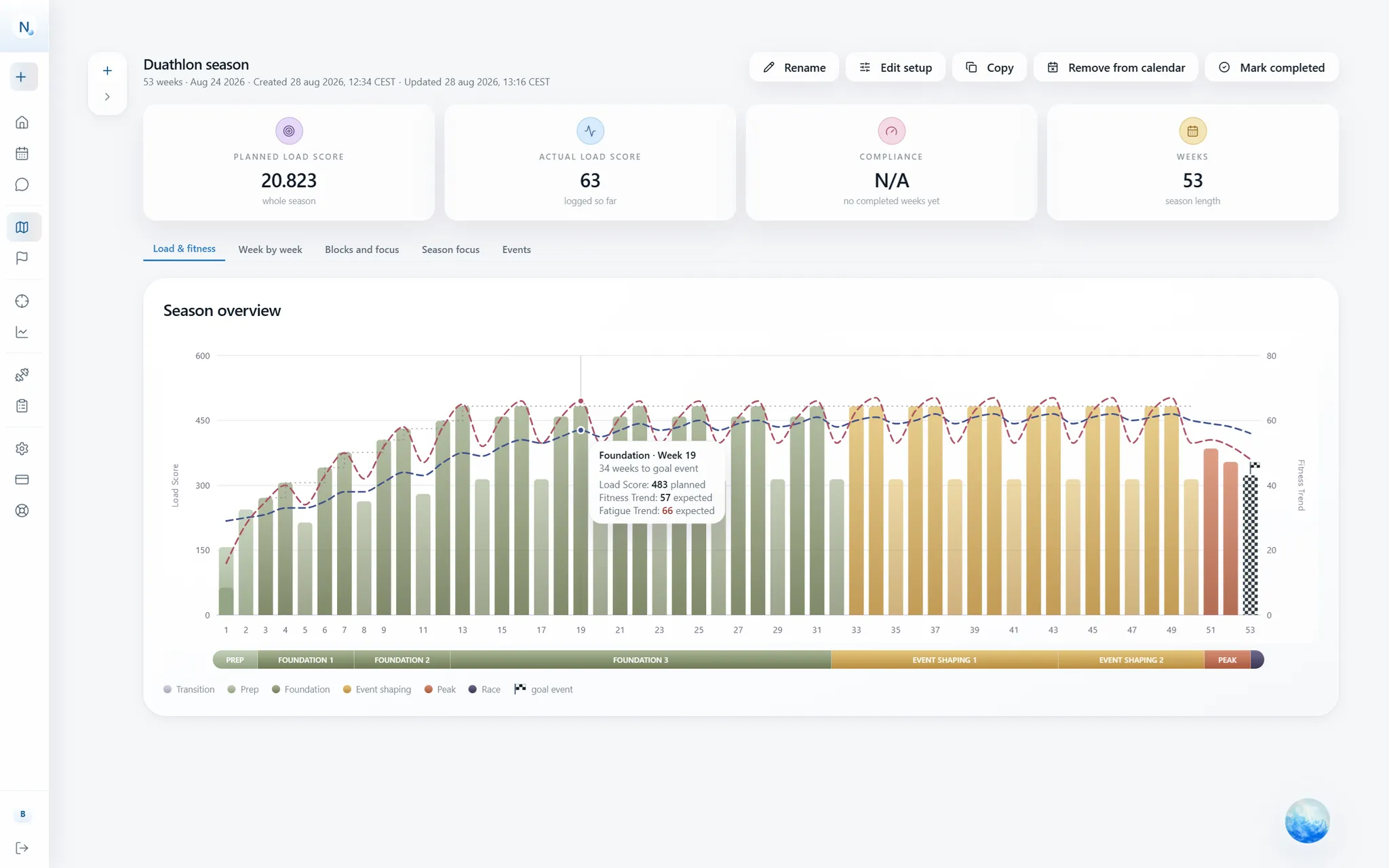
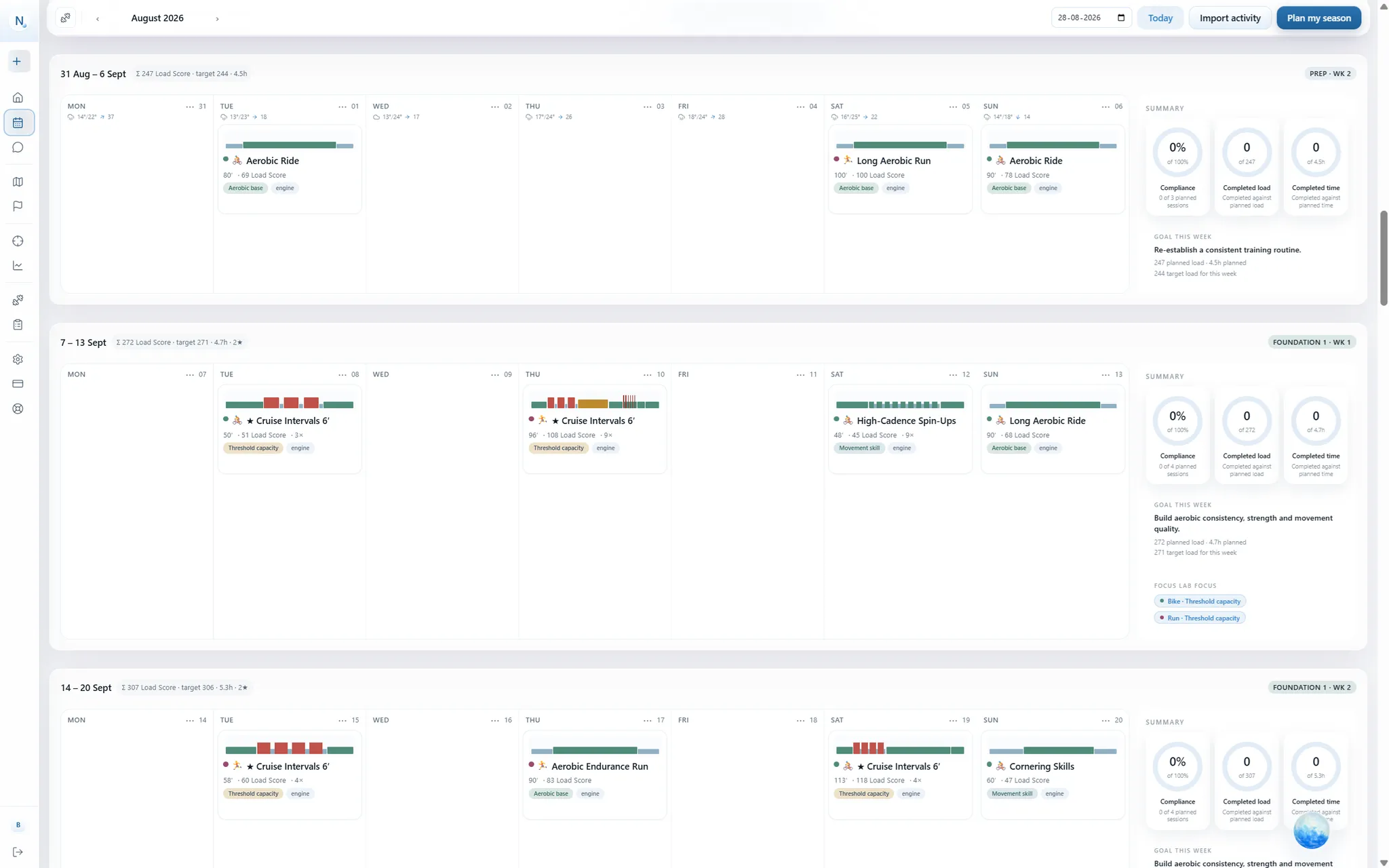
Three weeks from the 12 week duathlon plan for a typical athlete with a finishing goal. Your own plan is built from your history, your course and the days you can train, so the sessions, the hours and the split will differ.
Week 1 of 12Foundation
3 h 35 total| Day | Session | Trains | Time | Effort |
|---|---|---|---|---|
| Tue | Easy run | Aerobic endurance | 40 min | Easy |
| Wed | Aerobic ride | Aerobic endurance | 1 h | Easy |
| Fri | Run with 6 x 1 minute at 10K effort | Running economy | 45 min | Easy, short lifts |
| Sun | Endurance ride, then 10 minutes easy run straight off the bike | Aerobic endurance, run off the bike | 1 h 10 | Easy |
Week 7 of 12Event shaping
4 h 30 total| Day | Session | Trains | Time | Effort |
|---|---|---|---|---|
| Tue | Run 4 x 4 minutes at threshold, 2 minutes easy between | Threshold | 50 min | Threshold |
| Wed | Easy ride | Aerobic endurance | 55 min | Easy |
| Fri | Ride 3 x 8 minutes at threshold | Threshold | 1 h 05 | Threshold |
| Sun | Brick: ride with the final 15 minutes at race effort, then 20 minutes run off the bike at race effort | Run off the bike | 1 h 40 | Race effort late |
Week 11 of 12Peak
4 h 55 total| Day | Session | Trains | Time | Effort |
|---|---|---|---|---|
| Tue | Run 5 x 3 minutes at 10K effort, 2 minutes easy between | High-intensity capacity | 50 min | Hard |
| Wed | Easy ride | Aerobic endurance | 1 h | Easy |
| Fri | Ride 2 x 12 minutes at threshold | Threshold | 1 h 05 | Threshold |
| Sun | Race rehearsal: 15 minutes run at race effort, ride, then 20 minutes run off the bike, transitions timed | Run off the bike, transitions | 2 h | Race effort |
What a duathlon actually asks of you
The second run decides the race, and it is the only leg you cannot rehearse fresh. Run, bike, run means the closing run starts on legs that have already raced a run and then ridden a bike. Two good separate blocks, one for running and one for riding, produce an athlete who runs well from rest and rides well from rest. The day asks for neither. So the closing run is modelled as its own demand rather than as more running, and it gets sessions that reproduce the state it happens in.
The opening run is where most duathlons are thrown away. Run it at the pace you would run that distance alone and you have taken an expensive effort on credit from two legs you have not started. You reach the first transition ahead of yourself and you leave the second one worse. Pacing control is trained here as an ability, not treated as temperament, and the opening run is prescribed as a controlled effort against the whole event.
The change from bike to run is a demand in its own right. It is technical skill performed while tired, and it happens twice. It needs no separate slot in your week, because it is rehearsed inside sessions you already have, which is the only version that transfers.
Two sports share one recovery budget. One cardiovascular system, one set of legs, one capacity to absorb work. A plan with a run column beside a bike column will quietly prescribe two sports' worth of hard days, so hard-day spacing and load ramps are checked across the whole week rather than once per sport. The reasoning behind all of this is in guided duathlon plans.
Why the plan you downloaded does not fit
A fixed plan cannot know your run threshold or your bike threshold, so every intensity in it is a guess presented as a prescription. It cannot know whether your bike leg is flat and exposed or a set of honest climbs, which changes what your legs bring to the second transition. It cannot know which sport you came from, and almost every duathlete came from one. That is the largest single fact about how your plan should be weighted. It cannot know that Tuesday evening is the only weekday you own, and it cannot change when something in your build goes wrong.
How your plan is built
Your training history goes in, the course you entered goes in, and the days you can genuinely train go in. Your history becomes the supply, the event becomes the demand, and Focus Lab names the gap that matters most for this race. The season is then laid out backwards from race day through Prep, Foundation, Event shaping and Peak, which is what other plans call base and build. Phases are budgets rather than zone caps. They govern how much load a week needs and which abilities it develops, and the most event-specific work, including race-pace running off the bike, sits closest to the race. How the planning engine works covers the mechanism.
The minimum plan length shown above is evidence grade D, established coaching practice rather than a finding from a trial. Duathlon also has a thinner research base than triathlon or road running, so more of the guidance rests on transferable physiology and coaching practice than on studies of this format. Every coaching rule carries an evidence grade and stated applicability limits, and the lower grades stay visible.
What changes when your goal changes
The wizard asks what outcome you want, not only which race. There are five levels, from finishing to excellent, and the plan's minimums scale with your answer. Chasing an excellent result rather than a finish means roughly twice the weekly training time, two more sessions in the week, and a longer minimum build. Same race, same athlete, genuinely different plan. The weekly hours shown above are finisher floors and they are destinations rather than week one. A season can run up to a year.
What a week actually looks like
Expect one clearly hard run session, one hard bike session, and at least one session that crosses from the bike to the run inside the same workout. That crossing session is not a bonus. It trains the leg the race is decided on, and it grows more event-specific as the season moves toward race day. Easy days have to be genuinely easy for the hard ones to land. Every session states what it is for and where you should stop.
When life interferes
Missed sessions are forgiven and never stacked onto the following week, because catch-up training is how a small interruption becomes an injury. Illness suspends the plan and rebuilds toward the level you had actually reached, not the level the original plan wanted, and any revision of your goal comes to you for approval. Small adjustments can apply themselves. Changing your primary focus or rebuilding a block always asks first. Anything that looks like pain, illness or injury is escalated to you rather than diagnosed, because this is training guidance and not medical care.
Questions people ask
I am a runner. Do I just add some cycling?
Riding is not a supplement to your running here. It is the longest leg of the race, and it decides what your legs have left for the finish. A strong runner usually finds the gap sits in bike durability, and the block is weighted accordingly rather than protecting the sport you already like.
I am a cyclist. Is the running the whole problem?
Usually the running off the bike is, rather than running in general. Cycling carries real aerobic load without the impact, but it does not build the muscular durability the closing run needs. Run-specific work stays run-specific and is never substituted with an equivalent block of riding.
How does this compare with a short triathlon build?
The swim is the obvious difference, but the deeper one is that a duathlon puts running at both ends of the day, loading the same tissue twice around a long ride. The sprint triathlon plan shows how the week reshapes when a swim leads instead.